








Operating temperature: a complete guide
Operating Temperature: Why It's a Key Parameter
In the landscape of modern architectural lighting, LED strips have gained a position of absolute centrality: they are used to illuminate museum shelving, theater handrails, office suspended ceilings, design residential kitchens, and luxury hotel corridors. Their versatility, energy efficiency, and extraordinary ability to integrate into building elements make them virtually irreplaceable for those designing spaces with deep attention to light quality. Yet, there is a technical parameter that many designers and installers tend to read hastily or even ignore: operating temperature. An error that, in the medium-to-long term, translates into unexpected maintenance costs, unsatisfactory colorimetric performance, and, in the most serious cases, installations that need to be completely redone.
Operating temperature is not an accessory number printed on the packaging to comply with a regulatory obligation. It is the result of a complex thermal chain that starts from the LED chip, passes through the PCB (Printed Circuit Board), reaches the aluminum profile or mounting surface, and finally dissipates into the surrounding environment. Each link in this chain contributes to the final result: if even one of them is poorly sized or improperly installed, the entire installation operates outside the declared operating temperature range, with effects ranging from reduced luminous efficiency to accelerated degradation, up to premature failure.
This article stems from the awareness that designing with LED strips also means designing with the heat they produce. This is not academic thermodynamics: it is about concretely understanding that a 14.4 W/m strip installed in a plasterboard channel without an aluminum profile operates at radically different temperatures compared to the same strip housed in an anodized profile with diffuser, and that this difference translates directly into more or fewer years of useful life. The numbers, as we will see, are unequivocal.
What Is Operating Temperature? Definitions, Standards, and Standard Ranges
Operating temperature, in English Operating Temperature or Working Temperature, is the range of ambient temperatures within which an electronic device is designed to function under normal conditions, guaranteeing declared performance and adequate service life.
For LED strips, this parameter is directly linked to IEC technical specifications and European standards EN 55015 and EN 61547, which regulate electromagnetic compatibility, as well as to guidelines from the Alliance for Solid-State Illumination Systems and Technologies (ASSIST) for the quality and durability of solid-state lighting systems.
Standard Notation: How to Read the Data on the Technical Sheet
In the vast majority of professional LED strip technical datasheets, operating temperature is expressed with a notation such as:
Ta: -10°C ~ +45°C or Operating Temperature: -10°C to +45°C
where Ta indicates the ambient temperature (Ambient Temperature) at the point near the strip during operation.
This range should not be confused with other thermal parameters that frequently appear in professional datasheets:
| Abbreviation | Full Name | Description | Typical Value for Standard Strips |
|---|---|---|---|
| Ta | Ambient temperature | Air temperature surrounding the strip during operation | -10°C / +45°C |
| Tc | Case / board temperature | Temperature measured on the PCB at a reference point | max +60°C (typical) |
| Tj | Junction temperature | Temperature at the p-n junction of the LED chip: the most critical data | max 105°C–125°C |
| Ts | Storage temperature | Temperature during storage (without power) | -20°C / +60°C |
| Rth j-b | Thermal resistance junction-board | Resistance to heat flow from junction to PCB | Depends on specific chip |
Understanding the difference between these parameters is the first step in designing a thermally correct installation. Many selection errors occur because operating temperature (Ta) is confused with maximum junction temperature (Tj): these are two distinct quantities, linked by a chain of thermal resistances, but not interchangeable.
Why Is the -10°C / +45°C Range So Widespread?
The range -10°C / +45°C is not accidental: it is the result of years of standardization in the LED industry and responds to two converging needs. On one hand, it guarantees that strips can operate in typical indoor environments even during the coldest winter months (for example, in an unheated warehouse or technical room); on the other, it sets an upper limit that excludes applications in particularly hot environments — such as engine compartments, industrial kitchens, or outdoor environments in hot climates — without an adequate thermal management system.
It is important to emphasize that +45°C is the air temperature in the immediate vicinity of the strip, not the temperature of the strip itself. In practice, during Mediterranean summer months, in an unventilated compartment, this temperature can be easily reached or exceeded, making proper design of aluminum profiles and environmental ventilation an essential technical requirement, not an optional recommendation.
Reference Standards: IEC, EN, and International Standards
The operating temperature specification in LED strips is regulated or influenced by several international standards that every professional in the sector should know:
| Standard | Organization | Relevance for Operating Temperature |
|---|---|---|
| IEC 62031 | IEC | LED modules for general lighting: safety requirements, includes thermal specifications |
| IEC 62384 | IEC | DC or AC power supplies for LED modules: operating temperature range |
| EN 60598-1 | CENELEC | Luminaires: general requirements including temperature limits |
| LM-80 | IES | Method for measuring luminous flux maintenance of LED modules at different temperatures |
| TM-21 | IES | Long-term useful life projection of LED modules as a function of temperature |
| ASSIST — Recommend. Vol. 1 Is. 2 | ALLIANCE | Guidelines for SSL source quality: includes operational thermal recommendations |
The Thermal Physics of LED Strips: From Chip to PCB to Environment
To truly understand LED operating temperature and its practical implications, it is essential to understand how heat is generated, transferred, and dissipated in an LED strip. Contrary to common belief, an LED strip is not "cold": it is simply more efficient than a traditional source, but it still generates heat, in quantities proportional to the absorbed power and inversely proportional to its luminous efficiency.
Where Heat Originates in an LED Strip
Heat in an LED strip has a single primary origin: the p-n junction of the semiconductor chip. In an ideal LED chip, all electrical energy would convert into photons (light), without any thermal loss. In reality, even the best commercial LED chips convert only 30–50% of absorbed electrical energy into light: the remaining 50–70% inevitably transforms into heat, which must be removed from the junction to prevent overheating.
This is why a 14.4 W/m LED strip dissipates approximately 8–10 W/m as heat: a figure that must guide every design choice regarding the thermal management system, starting with profile selection.
The Thermal Chain: From Junction to Environment
The path of heat from the chip junction to the environment can be schematized as a series of cascading thermal resistances:
| Node | Denomination | Thermal Resistance (Rth) | Design Influence |
|---|---|---|---|
| Junction → Package | Rth j-p | Depends on chip (0.5–5 K/W) | Fixed by chip manufacturer: not modifiable |
| Package → PCB | Rth p-b | 0.1–1 K/W | Influenced by quality of thermal paste or substrate |
| PCB → Interface | Rth b-s | 0.05–0.5 K/W | Depends on double-sided adhesive and mounting flatness |
| Interface → Profile | Rth s-hs | 0.01–0.3 K/W | Critical: varies enormously between profile and direct mounting |
| Profile → Air | Rth hs-a | 0.1–2 K/W | Depends on profile geometry, finish, and ventilation |
The resulting junction temperature (Tj) is the sum of all these thermal resistances multiplied by the dissipated power, added to the ambient temperature:
Tj = Ta + Q × (Rth j-p + Rth p-b + Rth b-s + Rth s-hs + Rth hs-a)
where Q is the power dissipated as heat [W/LED or W/m] and Ta is the ambient temperature.
It follows that reducing Rth s-hs and Rth hs-a, i.e., choosing an aluminum profile with good conductivity and optimized geometry, is the most effective lever available to the designer to keep Tj within safe limits even when Ta approaches the upper limit of the operating temperature.
Thermal Conductivity of Materials: Aluminum vs. Plasterboard vs. Wood
The choice of mounting surface, which in many architectural projects is determined by aesthetic reasons before technical ones, has a dramatic impact on the actual operating temperature of the strip under real conditions. The thermal conductivity data of materials most commonly used in construction are eloquent:
| Material | Thermal Conductivity λ [W/m·K] | Effectiveness as Heat Sink | Notes for Installation |
|---|---|---|---|
| Aluminum 6063 (extruded profiles) | 200–210 | Excellent | Reference standard for professional LED profiles |
| Aluminum 1050 | 220–230 | Excellent | Used in high-dissipation applications |
| Copper | 380–400 | Excellent but expensive | Rare in consumer/pro standard LED applications |
| Stainless Steel | 14–16 | Poor | To be avoided as primary dissipation surface |
| Plasterboard | 0.2–0.4 | Almost none | Risk of overheating without profile: strip outside operating temperature |
| Solid Wood | 0.1–0.3 | Almost none | Risk of fire and strip degradation without adequate profile |
| Resin/PVC | 0.1–0.2 | None | Incompatible with high-power strips without profile |
The comparison is merciless: an aluminum profile conducts heat 500–2000 times better than plasterboard. Translated into practice: a 14.4 W/m strip recessed into a plasterboard opening without a profile, in a 28°C environment, can reach a PCB temperature of over 75°C, well beyond specification values, while the same strip in a properly sized aluminum profile keeps the PCB at 48–52°C, comfortably within the nominal operating temperature.
What Temperature Does an LED Strip Reach? Measurements, Scenarios, and Variables
One of the most frequent questions among lighting professionals is what temperature an LED strip actually reaches during normal use. The answer, as often happens in engineering, is it depends on many variables. But with the right theoretical foundations and some reference data, it is possible to make reasonable predictions and design accordingly.
PCB Temperature as a Function of Power: Experimental Data
Thermographic measurements conducted on LED strips of various power levels, under different mounting conditions, return a picture consistent with theoretical predictions. The following values refer to measurements under standard conditions (Ta = 25°C, power supply at steady state, strip operating for 60 minutes to reach thermal stability):
| Strip Power [W/m] | On double-sided tape on plasterboard | In aluminum profile without diffuser | In aluminum profile with diffuser |
|---|---|---|---|
| 4.8 W/m | 38–42°C | 30–34°C | 32–36°C |
| 9.6 W/m | 52–60°C | 38–44°C | 40–47°C |
| 14.4 W/m | 68–80°C | 48–56°C | 52–60°C |
| 20.0 W/m | 85–100°C ⚠ | 58–68°C | 62–72°C |
| 24.0 W/m | >105°C 🚫 | 68–80°C | 72–85°C |
⚠ = attention zone; 🚫 = danger zone — the strip operates beyond specification limits.
The data confirm a fundamental principle: low-power LED strips (4.8 W/m) have ample thermal margins even without a profile, while high-power strips (14.4 W/m and above) require an adequate aluminum profile to remain within the declared operating temperature.
The "Ambient Temperature" Factor: How Seasons Modify the Equation
The previous table assumes an ambient temperature of 25°C. But in real installations, ambient temperature can vary significantly: an uninsulated attic in the Mediterranean summer can reach 40–45°C, a technical room with active servers can exceed 35°C, an unheated room in winter can drop to -5°C. Each additional degree of ambient temperature translates into one additional degree of temperature on the PCB and junction, linearly scaling the thermal chain.
| Ambient Temperature (Ta) | Estimated PCB Tc | Margin Relative to Specification Limit | Evaluation |
|---|---|---|---|
| 0°C (winter) | 28–34°C | Wide | ✓ Optimal |
| 20°C (spring/autumn) | 44–52°C | Sufficient | ✓ Correct |
| 30°C (indoor summer) | 54–62°C | Reduced | ⚠ Attention |
| 38°C (summer peak / technical rooms) | 62–70°C | Minimal | ⚠ Verify profile |
| 45°C (operating limit) | 70–80°C | None/negative | 🚫 Out of specification |
The Role of Duty Cycle: Always-On vs. Dimmed Strips
An often overlooked aspect is that operating temperature also varies as a function of the operating duty cycle. A strip dimmed to 50% generates approximately 50% of the heat compared to full power, significantly lowering the operating temperature. This has important practical implications:
- in potentially hot environments, dimming can be a thermal management strategy as well as an aesthetic one;
- in cold environments, the strip can operate at full power without thermal risks even with smaller profiles;
- DALI or PWM control systems not only allow light modulation: they actively contribute to maintaining LED operating temperature within nominal limits.
Maximum Temperature: Technical Meaning and Consequences of Exceeding It
In technical terminology, the maximum temperature of an LED strip can refer to two distinct quantities, and confusing them is one of the most common errors made during selection. It is necessary to clarify with rigor, because properly designing an LED lighting installation means knowing how to distinguish these values and knowing where to find them.
Maximum Ambient Temperature (Ta max) vs. Maximum Junction Temperature (Tj max)
Ta max is the maximum ambient temperature indicated in the operating temperature specification: for standard Ledpoint strips, it is +45°C. This is the quantity that the designer must compare with the actual environmental conditions of the installation. If the installation environment reaches or exceeds this temperature, the strip operates outside the guaranteed range, with consequences for performance and durability.
Tj max is the maximum absolute temperature that the p-n junction of the LED chip can withstand without permanent damage: typically 105°C–125°C for professional-grade LED chips, 85°C for some consumer series. Exceeding Tj max even for a few minutes can cause irreversible damage: degradation of the encapsulation material (the so-called yellowing of the encapsulant), permanent reduction of luminous flux, variation of color temperature, and, in extreme cases, chip detachment from the substrate.
How Quickly Does an LED Strip Degrade When Exceeding Maximum Temperature?
The relationship between temperature and degradation in solid-state sources is well documented in technical literature and LM-80 and TM-21 reports. The Arrhenius model, applied to LED components, indicates that:
Every 10°C increase in junction temperature above the nominal value approximately halves the useful life of the LED strip.
This principle, known as the "10°C Rule" (or Arrhenius Rule of Ten), implies that a strip designed for 50,000 hours at Tj = 80°C might have a useful life of only 25,000 hours if the actual Tj is 90°C, and just 12,500 hours at 100°C.
| Operating Tj [°C] | Estimated L70 Useful Life [hours] | Change Relative to Nominal | Condition |
|---|---|---|---|
| 60°C | >100,000 | +100% | ✓ Excellent |
| 70°C (nominal) | 70,000 | Reference | ✓ Nominal |
| 80°C | ~50,000 | -29% | ⚠ Acceptable |
| 90°C | ~35,000 | -50% | ⚠ Critical |
| 100°C | ~17,500 | -75% | 🚫 Out of specification |
| >105°C (Tj max) | Unpredictable | — | 🚫 Permanent damage likely |
Color Shift: The Visible Thermal Indicator
One of the most visible effects often not immediately attributable to excessive temperature is the so-called color shift: the variation of the color temperature emitted by the strip relative to the nominal value. An LED chip designed to emit at 4000K (neutral white) can shift toward 3700–3800K (warmer) or toward 4200–4400K (cooler) depending on the type of phosphor coating and junction temperature.
In high-end installations (museums, art galleries, fashion showrooms) thermal color shift is unacceptable: not only because it compromises the color rendering (CRI) of illuminated works or products, but because it creates visual discontinuities between sections of the same installation that are at different temperatures (for example, the central part of a channel being warmer than the ends). Maintaining strips within the nominal operating temperature is the only way to guarantee chromatic stability over time.
What Maximum Temperature Means: An Operational Summary
For an architect or technician who must make practical decisions on-site, the maximum temperature of an LED strip translates into three concrete operational guidelines:
- never install LED strips in environments whose temperature may exceed Ta max (+45°C) without providing an adequate thermal management system, i.e., in the vast majority of cases, a properly sized aluminum profile;
- do not overload power supply circuits: every watt above the nominal sizing translates into additional heat at the junction;
- always verify the datasheet of the specific strip, because even at the same nominal power, strips of different quality can have different Tj max values: a datum that makes the difference between an installation that lasts 10 years and one that requires maintenance after 3.
Installation Environment Temperature: Requirements, Calculations, and Critical Scenarios
The question of what temperature there should be in an environment where LED strips are installed is not simple to answer: it actually conceals a design complexity that should not be underestimated. The short answer is: the temperature of the environment where LED strips are installed must not exceed Ta max (+45°C) and must not drop below Ta min (-10°C). But the operationally useful answer requires considering specific scenarios, preliminary calculations, and differentiated technical measures.
Typical Environments and Their Thermal Ranges: A Practical Mapping
| Type of Environment | Typical Ta Range [°C] | Compatible with Ta -10°C/+45°C | Required Measures |
|---|---|---|---|
| Offices and Executive Spaces | 18–26°C | ✓ Yes | None, standard |
| Residential Homes | 16–28°C | ✓ Yes | None, standard |
| Museums and Art Galleries | 18–22°C (climate control) | ✓ Yes | Profile required for chromatic stability |
| Retail Stores and Shops | 18–26°C | ✓ Yes | Profile recommended for strips >9.6 W/m |
| Technical Rooms / Server Rooms | 20–35°C | ⚠ With caution | Profile mandatory; verify ventilation |
| Attics / Lofts in Summer | 35–55°C | 🚫 Partially no | Strip with profile + mandatory ventilation |
| Industrial Kitchens | 30–45°C | ⚠ At the limit | Robust profile + IP65 strip + thermal verification |
| Covered Outdoor Environments (Canopy) | -5°C / +45°C (seasonal) | ⚠ At the limit in summer | IP65/IP67 strip + waterproof profile |
| Cold Storage Rooms | -25°C / +5°C | 🚫 Ta min exceeded | Strip with extended range (-40°C/+50°C) |
How to Calculate the Actual Temperature Around the Strip
In installations in suspended ceilings, channels, or closed architectural cavities, the air temperature in the immediate vicinity of the strip can be significantly higher than the temperature of the occupied environment, due to heat accumulation in poorly ventilated spaces. This phenomenon of thermal stratification is one of the main causes of installations operating outside the operating temperature even in air-conditioned environments.
A preliminary estimate of the temperature increase in the cavity relative to the environment can be made with the following empirical approximation (valid for closed cavities with low ventilation):
ΔT (cavity) ≈ 0.8 × P_strip [W/m] × L_cavity [m] / A_section [cm²]
where P_strip is the strip power in W/m, L_cavity is the length of the section without openings in m, and A_section is the free cross-sectional area of the cavity in cm². In very small cavities with high-power strips, this delta can easily exceed 10–15°C relative to the ambient temperature.
Ventilation and Passive vs. Active Thermal Management
In quality architectural lighting projects, thermal management of LED strip operating temperature may require both passive and active interventions:
- passive management: aluminum profiles with optimized geometry, diffusers that do not overly hinder convective heat exchange, ventilation openings in channels, selection of LED strips with power appropriate to the environment. This is the preferred solution for the vast majority of installations, due to its simplicity, reliability, and absence of maintenance;
- active management: in installations with very high power in hot environments, it is possible to provide small in-line fans in channels, or localized conditioning systems. This solution is rare in civil installations but may be necessary in museum environments with high-intensity lighting or in outdoor installations in tropical climates.
What Is a Temperature Range? From Datasheet to Installation Practice
The concept of temperature range, or thermal range, is a foundational element of the specification of every electronic component, and LED strips are no exception. Understanding its precise technical meaning is essential for those designing long-term lighting installations, where performance guarantee is measured not in months but in years or decades.
Technical Definition of Temperature Range
A temperature range is a segment of the thermal axis delimited by two extreme values, the minimum and the maximum, within which a device is designed to operate while respecting declared specifications. For a standard Ledpoint LED strip with specification Ta: -10°C ~ +45°C, this means:
- above the upper limit (+45°C): performance is not guaranteed, degradation accelerates, useful life is reduced non-linearly, and the manufacturer's warranty is void;
- below the lower limit (-10°C): the PCB can become brittle, polymeric materials lose flexibility, electrical contacts can suffer microfractures from thermal stress, and adhesive viscosity changes compromising adhesion to the surface;
- within the range: the strip functions as intended, guaranteeing the luminous flux, color temperature, and useful life declared in the datasheet.
High Temperature: What It Means Technically
In the technical language of LED lighting engineering, the term "high temperature" referring to LED strips can have different meanings depending on context:
| Context | What "High Temperature" Means | Practical Threshold |
|---|---|---|
| Ambient Temperature (Ta) | Hot environment approaching or exceeding Ta max | Ta > 35°C |
| PCB Temperature (Tc) | Board exceeding safety value | Tc > 60°C |
| Junction Temperature (Tj) | Chip at or beyond absolute maximum | Tj > 85–100°C |
| Color Temperature (CCT) | High color temperature (cool light) | CCT > 5000K (different concept!) |
It is important not to confuse operating temperature, which concerns the thermal physics of the device, with color temperature, which is a measure of the spectral quality of emitted light. An LED strip with high color temperature (6500K, very cool light) is not necessarily a strip that operates at high thermal temperature, and vice versa. These are completely distinct concepts, but both important for the designer.
Thermal Range and On/Off Cycles
An often overlooked aspect of the temperature range is its impact on thermal cycling during on/off operation. Every time a strip turns on, the temperature rises rapidly from the ambient value to the steady-state temperature; every turn-off returns it to ambient temperature. These thermal cycles generate mechanical stress on SMD solder joints, cable connections, and the interface between chip and substrate.
Professional-grade LED strips are designed to withstand tens of thousands of these cycles without degradation. But installations subject to extreme thermal cycles (for example, strips turned on in summer in hot environments and turned off in winter at temperatures close to -10°C) will need to be evaluated with greater attention in terms of profile and connector selection.
Where Do I Find the Operating Temperature? Technical Sheets, Labels, and Certifications
One of the most frequent practical questions from those approaching professional LED strip selection is where to concretely find the operating temperature. The answer is less obvious than it seems: the specification can be hidden in different points of the product documentation flow, and knowing how to find it is a skill that distinguishes the professional from the inexperienced installer.
The Technical Datasheet: The Primary Source
The technical datasheet, or technical sheet, is the main document where the manufacturer declares all product specifications, including operating temperature. In professional datasheets, this information is typically found in the Technical Parameters section, and is expressed with one of the notations already seen:
Operating temperature (Ta) or operating temperature: -10°C to +45°C
Storage temperature (Ts): -20°C to +60°C
Max junction temperature (Tj max): 105°C
In more detailed datasheets you will also find de-rating curves: graphs showing how the allowable current decreases as ambient temperature increases, to keep Tj below the maximum value.
The Package Label and CE Marking
For LED strips destined for the European market, the CE mark certifies conformity to applicable Directives, primarily the Low Voltage Directive (LVD) and the RoHS Directive, and implies that the manufacturer has verified the operating temperature specifications in a defined regulatory context. The CE mark does not directly certify operating temperature, but guarantees that the product has been designed and tested according to recognized standards.
On package labels, the operating temperature sometimes appears in condensed format, sometimes alongside the storage temperature.
Operating Temperature in Additional Certifications
For installations in regulated contexts, work environments subject to ATEX regulations, naval installations, medical environments, certification of operating temperature must be documented with greater precision. In these contexts, it is necessary to request from the supplier:
- the LM-80 report: flux maintenance tests at different temperatures (55°C, 85°C, optionally 105°C), conducted for at least 6,000 hours by accredited laboratories;
- the TM-21 extrapolation: useful life projection calculated from LM-80 data, with explicit indication of test temperature;
- UL certifications (for North American markets) or ENEC (for European markets), which include specific thermal verifications.
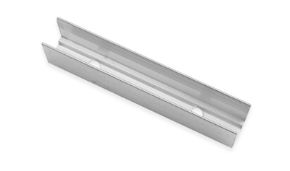
The Fundamental Role of Aluminum Profiles in Managing Operating Temperature
If there is a single technical element that more than any other determines whether an LED strip will operate within or outside its declared operating temperature, that element is the aluminum profile. It is not an aesthetic accessory. It is not an optional extra for high-end installations. It is, in the vast majority of installations with medium and high-power strips, an essential technical component for proper thermal management of the system.
The Aluminum Profile as a Heat Sink: Operating Principles
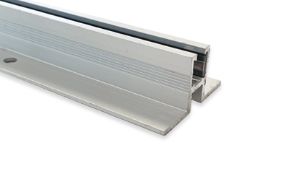
An aluminum profile for LED strips functions as a passive heat sink. Its function is to transfer heat from the strip PCB to the ambient air, exploiting the thermal conductivity of aluminum (approximately 200 W/m·K) and the surface exposed to air for natural convection. The larger the external surface area of the profile, the greater its dissipation capacity; the higher the convection coefficient (which increases with environmental ventilation), the greater the heat removed per unit of time.
In practice, a good aluminum profile can lower the operating temperature of the PCB by 15–30°C compared to mounting on a surface without a profile. This thermal margin translates directly into additional years of useful life and stability of photometric performance over time.
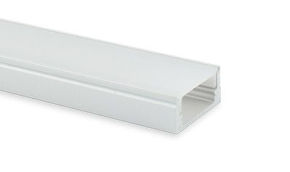
Profile Types and Their Impact on Operating Temperature
The available range of profiles includes different types, each with specific thermal characteristics:
| Type | Description | Dissipation Effectiveness | Typical Application | Compatibility with High-Power Strips |
|---|---|---|---|---|
| Surface-Mounted (Non-Recessed) | Mounted visibly on flat surfaces, maximum air exposure | High | Shelving, handrails, furnishings | ✓ Excellent |
| Recessed (In Wall/Ceiling) | Recessed into structure, dissipation toward structure + air | Medium-High | Suspended ceilings, raised floors | ✓ Good with ventilation |
| Angular | Positioned in 90° or 45° corners, compact geometry | Medium | Kitchens, wardrobes, architectural corners | ⚠ Verify with strips >14.4 W/m |
| Suspended (Pendant) | Hung from ceiling, maximum convection on all sides | Very High | Linear lighting in open spaces | ✓ Excellent |
| For Plasterboard | Integrated into plasterboard edge, partly visible, partly hidden | Medium | Coves, luminous frames | ⚠ Only with strips ≤9.6 W/m |
| Walkable | Resistant to foot traffic, dissipation toward floor | Medium | Floors, steps, sidewalks | ⚠ Verify with manufacturer |
| Waterproof (IP65/IP68) | Sealed for humid environments, dissipation reduced by sealant | Medium-Low | Bathroom environments, pools, outdoor | ⚠ Only specific IP strips |
| For Mirror | Specific profile for mirror backlighting | Medium | Bathrooms, changing rooms, fitting rooms | ✓ With strips ≤9.6 W/m |
The Diffuser: Thermal Impact and Aesthetic-Technical Compromise
Aluminum profiles can be supplied with or without a diffuser. The diffuser, generally made of polycarbonate or PMMA, has a dual function: to homogenize light by eliminating the dotted effect of individual LEDs, and to protect the strip from dust and impacts. From a thermal point of view, however, the diffuser creates a layer of trapped air that reduces natural convection, slightly increasing the PCB temperature compared to the same profile without a diffuser.
On average, the presence of an opaque diffuser increases PCB temperature by 3–7°C compared to an open profile, while a transparent or satin diffuser has a lesser impact (1–4°C). In installations with high-power strips in already hot environments, this increase can make the difference between an installation within or outside the operating temperature.
Anodizing: Effect on Thermal Dissipation
Aluminum profiles for LED strips are available in three main surface finishes: anodized silver (natural), anodized black, and white painted. From a thermal dissipation point of view, the finish affects surface emissivity:
- black anodized aluminum: emissivity ~0.8–0.9 — best for radiative thermal dissipation;
- silver anodized aluminum: emissivity ~0.05–0.15 — worse for radiation but identical for convection;
- white painted: emissivity ~0.85–0.95 — excellent for radiation.
In practice, for the vast majority of installations the difference in thermal dissipation between finishes is on the order of 2–5°C: negligible in most cases, but to be considered in installations at the limit of operating temperature.
How to Choose the Right Profile Based on Operating Temperature
The choice of the correct profile to keep the strip within its operating temperature depends on three fundamental variables: strip power (W/m), expected ambient temperature at the installation point, and type of installation (open, closed, in cavity). A practical sizing rule, valid as a first approximation, is the one we report below.
Choose a profile whose thermal resistance to air (Rth hs-a) satisfies the condition:
Rth hs-a ≤ (Tc max − Ta max) / Q_dissipated [W/m]
Example: 14.4 W/m strip with Q_dissipated = 9 W/m, Tc max = 60°C, Ta max = 35°C:
Rth hs-a ≤ (60 − 35) / 9 = 2.78 K·m/W
A profile with section ≥8×17 mm satisfies this requirement in most natural convection installations.
High-Power LED Strips and Operating Temperature: The Rules Change
High-power LED strips, generally those with linear power greater than 14.4 W/m, represent a category of their own in the landscape of thermal management. With these strips, operating temperature is not simply a parameter to verify: it is the dominant design constraint that determines every choice, from profile to power supply, from run length to installation environment.
Why High-Power Strips Are Thermally Critical
A 24 W/m strip dissipates as heat approximately 16–17 W/m. In a 3-meter run, this is 48–51 W of heat to remove per linear meter of profile. For comparison, a 50W halogen bulb generates approximately the same heat at a single point: distributing this thermal power over 3 meters is more manageable, but still requires a seriously sized dissipation system.
Without an adequate profile, a 24 W/m strip installed in summer in an unconditioned room can reach PCB temperatures of over 100°C: well beyond the declared maximum temperature, with consequent guaranteed premature failure.
High-Power Strips and Run Length Reduction
An often underutilized strategy for managing the operating temperature of high-power strips is reducing the length of continuous runs. Dividing a long run into shorter segments, with small spaces or intermediate connectors, allows better thermal dissipation between segments, avoiding heat accumulation in the central sections of channels. This technique is particularly effective in linear suspended ceiling installations where ventilation is limited.
The Power Supply as an Additional Heat Source
In high-power installations, the power supply also contributes to the overall thermal balance. A 150–200W power supply installed in a closed plasterboard cavity generates 10–15W of additional heat (corresponding to its conversion losses, typically 85–90% efficiency). Installing the power supply inside the cavity housing the LED strips can increase the ambient temperature in the cavity by 3–8°C, further reducing the available thermal margin. The correct solution is to install the power supply in a separate ventilated compartment, or in an accessible area for heat dissipation.
COB LED Strips and Operating Temperature: Specificities and Precautions
COB (Chip-on-Board) LED strips represent one of the most significant innovations in the LED strip landscape in recent years. COB technology positions LED chips directly on the PCB without intermediate packaging, creating an extraordinarily homogeneous light distribution free of the dotted effect typical of traditional SMD strips. This architecture, however, has specific implications for operating temperature that every professional must know.
Why COB Strips Require Even More Careful Thermal Management
In COB strips, the chip density per unit length is typically much higher than in SMD strips: we are talking about 384–720 chips/m compared to 60–240 chips/m in standard SMD strips. This greater density entails a higher heat flux per unit area of PCB, and a specific thermal resistance (Rth per chip) that must be compensated by a more aggressive dissipation system.
In practice: a 10 W/m COB strip may require a larger profile than an SMD strip of the same power, because the heat distribution on the PCB is more uniform but more intense per unit surface area.
These strips maintain the same operating temperature specification as standard SMD strips: -10°C / +45°C. This datum, however, must be read with even greater attention, since the thermal margin is consumed more rapidly in COB strips in case of inadequate dissipation.
The recommendation for COB strips is therefore to always use generously sectioned aluminum profiles, preferably with an opaque diffuser (which for COBs is not necessary to eliminate the dotted effect, already absent by nature, but can be useful for mechanical protection) and to carefully verify the PCB temperature in the first hours of operation with a thermal camera or thermocouple.
Professional Scenarios: Museums, Cultural Spaces, Retail, and Interior Architecture
LED operating temperature manifests differently in different application contexts. Analyzing some specific professional scenarios allows translating technical principles into concrete design decisions, offering architects and installation technicians an immediate reference for the most common cases.
Museums and Art Galleries: When Temperature Is Doubly Critical
In museum spaces, managing the operating temperature of LED strips is a topic of absolute priority for two distinct but closely interconnected reasons. The first is the same that applies to every professional installation: keeping strips within the nominal thermal range to guarantee their durability and performance stability. The second is specific to the museum context: the heat radiated by LED strips must not alter the conservation conditions of displayed works of art.
Modern museums maintain exhibition rooms at controlled temperatures (typically 18–22°C, with relative humidity at 45–55%), which creates environmental conditions favorable to thermal management of strips. However, installations at the head of display cases, in closed niches, or inside exhibition elements can create warmer micro-environments, where the temperature can rise by 5–10°C relative to the main environment.
In these contexts, the choice of Ledpoint products is guided by precise criteria:
- strips with verified operating temperature specification (-10°C/+45°C) and LM-80 documentation;
- recessed or angular aluminum profiles, installed with mounting clips that guarantee thermal contact with the profile;
- opaque or satin diffusers to eliminate the risk of glare on works;
- DALI dimming systems for duty cycle management and operating temperature control.
Retail Spaces and Shops: High Power, High Retention
In commercial spaces, aesthetic pressure on lighting choices is maximum: light must enhance products, create atmosphere, guide customer flow. This often translates into the use of high-power LED strips (14.4–20 W/m) to achieve high luminous intensities. The theme of LED strip operating temperature becomes critical especially in summer installations in stores with insufficient air conditioning, or in storefront installations exposed to solar irradiation.
A documented real case: a store illuminates its shelves with 14.4 W/m strips mounted with simple double-sided tape on laminate shelving. In full summer, with the storefront facing south and air conditioning struggling to maintain 26°C in the shelving area, the temperature in the immediate vicinity of the strips can reach 38–42°C. Without a profile, the strip operates at over 80°C on the PCB: out of specification. With a 30×15 mm section angular aluminum profile, the same strip operates at 52–58°C: within operating temperature, with a sufficient safety margin.
High-End Residential Architecture: Durability as an Aesthetic Value
In high-level residences, where LED strips are integrated into fixed architectural elements, stucco frames, coves, lacquered suspended ceilings, custom kitchens, operating temperature becomes a theme of durability and aesthetic coherence over time. An installation that degrades prematurely in a luxury apartment not only has an economic maintenance cost, but entails invasive interventions in finished environments where every operation is complex and expensive.
In these contexts, the correct philosophy is to design with the worst case: size the thermal system for the most unfavorable foreseeable conditions (summer, maximum power, environment at the limit of operating temperature), and not for average conditions. A conservative approach that, in the long term, is always the most economical.
Market Data, Statistics, and Surveys on Thermal Management in LED Installations
The scale of the thermal management problem in LED installations is not anecdotal: it is documented by market surveys, industry studies, and technical reports that converge on an unequivocal datum. Inadequate thermal management is the primary cause of premature failure in LED installations, exceeding in frequency even component quality problems and electrical design issues.
Industry Numbers: Premature Failures and Thermal Management
| Cause of Failure | Estimated Incidence | Correlation with Operating Temperature |
|---|---|---|
| Inadequate Thermal Management | 45–55% | Direct — primary cause |
| Power Supply / Driver Problems | 20–25% | Indirect — heat also degrades driver capacitors |
| LED Component Quality | 12–18% | Indirect — lower quality chips have lower Tj max |
| Installation Errors (connections, voltage) | 8–12% | Partial — overvoltage increases generated heat |
| Mechanical Vibrations | 2–5% | None |
| Other | 3–8% | Variable |
The figure of 45–55% of premature failures attributable to inadequate thermal management is confirmed by studies from the U.S. Department of Energy (DOE) Solid-State Lighting Program and the Lighting Research Center (LRC) at Rensselaer Polytechnic Institute. In Europe, sector surveys conducted by lighting installer associations in Germany, France, and Italy show similar percentages, with higher peaks in residential installations where the level of technical competence is on average lower.
The European Market for Aluminum LED Profiles: Growth and Awareness
| Year | EU Market Value [M€] | Annual Growth Rate | Main Driver |
|---|---|---|---|
| 2021 | ~380 | — | Post-COVID renovation boom |
| 2022 | ~430 | +13.2% | Growth of residential and retail LED lighting |
| 2023 | ~490 | +14.0% | Adoption of ED 2009/125/CE regulation, Ecodesign |
| 2024 | ~560 | +14.3% | Growth of COB and high-power strips; thermal awareness |
| 2025 (estimate) | ~640 | +14.3% | Public building retrofit; BAR-E-02 regulation and similar |
The steady growth of the European aluminum profile market, at a rate exceeding 14% annually, reflects a growing awareness of their technical importance and not just aesthetic. Aluminum profiles are becoming standard components in professional LED installations, no longer optional. And the main reason is precisely the need to keep strips within their nominal operating temperature.
Economic Savings: Correct Thermal Management vs. Frequent Maintenance
The cost of maintaining an LED installation operating outside its operating temperature is significantly higher than the additional cost of an adequate aluminum profile. A cost-benefit analysis on a 50-meter linear installation with 14.4 W/m strips returns the following indicative figures:
| Cost Item | With Adequate Profile | Without Profile (Double-Sided Tape on Plasterboard) |
|---|---|---|
| Profile Cost (50 m) | ~€400–600 | €0 |
| Estimated Strip Useful Life | 50,000–70,000 h | 15,000–25,000 h |
| Years Before Replacement (8h/day) | 17–24 years | 5–9 years |
| Strip Replacement Cost + Labor (50 m) | 1 intervention in 20 years ≈ €800 | 2–3 interventions in 20 years ≈ €2,400 |
| Total 20-Year Cost (profiles + maintenance) | ~€1,200–1,400 | ~€2,400–3,000 |
The calculation is clear: investing in adequate aluminum profiles is economical even from a purely financial point of view, before even considering lighting quality and chromatic stability over time.
Technical Deep Dive: Operating Temperature in Professional LED Installations
Why the -10°C/+45°C Specification Is More Important Than Most Installers Think
In professional LED lighting installations, the operating temperature specification is one of the most technically significant parameters listed in any LED strip datasheet, yet it remains one of the most frequently overlooked by lighting designers, architects, and electrical installers. The notation Ta: -10°C to +45°C defines the boundary conditions within which the strip performs as specified: maintaining nominal luminous flux, declared color temperature, expected service life, and compliance with applicable safety standards.
Operating outside this range, particularly beyond the upper limit, does not simply void the warranty. It accelerates degradation of every component in the thermal chain: the LED chip encapsulant yellows more rapidly, phosphor conversion efficiency decreases, junction temperature exceeds maximum Tj, and solder joints undergo stress cycles that ultimately lead to electrical failure. In high-end architectural applications, these effects become visible long before electrical failure occurs: chromatic drift, lumen depreciation, and visual incoherence along a luminaire are all symptoms of a strip operating above its declared operating temperature.
The Thermal Chain: From Junction to Environment
Understanding operating temperature requires understanding the thermal chain that connects the LED junction to the surrounding air. Heat generated at the semiconductor p-n junction must travel through a series of interfaces, each with its own thermal resistance, before it can be dissipated into the surrounding environment. The total temperature difference between junction and environment is simply the product of total thermal resistance and dissipated power:
ΔT_total = Q_dissipated × ΣRth = Tj − Ta
Where Q_dissipated is the generated heat (approximately 60–70% of input electrical power), and ΣRth is the sum of all thermal resistances from junction to environment. The aluminum profile is the most impactful element in ΣRth that the designer can control.
Aluminum Profiles: Engineering the Thermal Path
Aluminum profiles, the extruded channels that house LED strips in most professional installations, serve a dual function that is simultaneously structural and thermal. From a structural standpoint, they protect the strip from mechanical damage and provide clean aesthetic integration into the architectural surface. From a thermal standpoint, they function as passive heat sinks, transferring heat from the strip PCB substrate to the surrounding air via conduction through the aluminum body and convection from exposed surfaces.
The thermal performance of an aluminum profile depends on several parameters: its cross-sectional area (larger profiles dissipate more heat), surface finish (black anodized surfaces have higher emissivity for radiative heat transfer), presence or absence of a diffuser (which reduces convective airflow and adds 3–7°C to PCB temperature), and installation orientation (vertical installations with open ends benefit from chimney-effect natural convection).
The Ledpoint aluminum profile range covers every main installation scenario with geometrically optimized profiles for surface mounting, recessed installation, angular applications, suspended linear fixtures, and waterproof environments. Each profile is designed to keep the LED strip within its declared operating temperature range across its entire nominal power range.
High-CRI and Operating Temperature: A Critical Intersection
High-CRI LED strips (CRI ≥ 90, CRI ≥ 95, and CRI ≥ 97 variants) are particularly sensitive to operating temperature for a fundamental photophysical reason: their phosphor formulation, responsible for the broad spectral emission that produces high color rendering, is more temperature-sensitive than the phosphor blends used in standard-CRI strips. At elevated junction temperatures, phosphor conversion efficiency decreases disproportionately in the red spectral region, causing a measurable shift in the emitted spectrum and a perceptible variation in color rendering quality.
This interaction between operating temperature and color rendering quality is particularly relevant in museum lighting, where LED strips with CRI ≥ 95 are regularly specified to accurately render artworks, artifacts, and textiles. In these contexts, keeping the strip within its declared operating temperature is not just a matter of longevity, it is a fundamental requirement for photometric accuracy and conservation integrity.
The COB Strip Advantage and Its Thermal Implications
Chip-on-Board (COB) LED strips eliminate the discrete point-source appearance of conventional SMD strips by mounting hundreds of chips directly on the PCB substrate without intermediate packaging. The result is a continuous, homogeneous light line that is architecturally superior to any alternative. However, the thermal implications of COB technology require careful consideration.
In a COB strip, thermal energy per unit length is concentrated in a smaller package volume compared to an equivalent-power SMD strip. The junction-board thermal resistance (Rth j-b) is effectively the sum of contributions from hundreds of individual bare chip junctions, and while each chip contributes a small thermal load, their proximity means the PCB substrate heats more uniformly, and more rapidly, than SMD configurations. This makes the aluminum profile even more critical for COB strips than for their SMD counterparts at the same nominal power. The operating temperature specification remains -10°C/+45°C, but the margin for error in thermal management is reduced.
Checklist for Operating Temperature Compliance
For architects and lighting engineers specifying LED strip systems for professional installations, the following checklist provides a structured framework for operating temperature compliance:
| # | Verification Item | How to Verify | Consequence of Non-Compliance |
|---|---|---|---|
| 1 | Confirm Ta max in the installation environment | On-site measurement in worst season; HVAC data | Strip operates outside declared operating temperature |
| 2 | Verify strip operating temperature specification from datasheet | Product datasheet; Ledpoint product page | Risk of premature failure; warranty void |
| 3 | Calculate thermal load per meter (W/m) | Strip power × (1 − luminous efficiency) | Undersized thermal management |
| 4 | Select aluminum profile with adequate section | Compare Rth hs-a with thermal budget | Strip overheats; premature degradation |
| 5 | Verify installation cavity ventilation | Cavity calculation; avoid sealed enclosures | Trapped heat exceeds operating temperature limit |
| 6 | Specify driver/PSU location outside cavity | Project layout; specify separate ventilated enclosure | Additional heat source pushes cavity beyond Ta max |
| 7 | Confirm LM-80 report availability for long-term projects | Request from supplier; verify test temperature matches Ta | Unreliable lumen depreciation projections |
| 8 | Plan for seasonal thermal extremes | Consider summer peak temperatures; winter minimum | Specification valid only for average conditions |
LED Neon Flex Systems and Operating Temperature: Specific Considerations
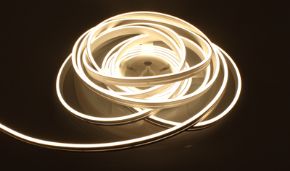
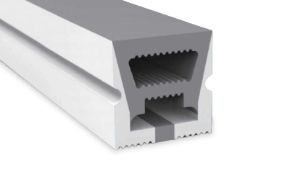
LED Neon Flex systems, flexible LED tubes that emulate the visual effect of traditional neon tubing, present a specific challenge for operating temperature. Unlike conventional LED strips mounted in open aluminum profiles, Neon Flex systems encapsulate the LED strip inside a silicone or PVC extrusion that, while providing IP68 protection and the characteristic neon aesthetic, also acts as a thermal insulator rather than a conductor.
The operating temperature specification of Neon Flex systems accounts for this additional thermal resistance in the design: the strip inside the extrusion is typically rated for lower power per meter than an equivalent open strip, precisely to ensure that even with the insulating effect of the encapsulant, the LED chips remain within their thermal specification.
Never attempt to increase the input power to a Neon Flex system beyond its nominal value: the temperature inside the silicone sheath can rise dramatically, pushing the strip well beyond its operating temperature without any visible external sign until failure occurs.
Guide to Selecting the Strip + Profile System Based on Operating Temperature
After having explored in depth all the theoretical and technical aspects of LED strip operating temperature, it is time to translate this knowledge into a practical and systematic selection process. This guide is designed for architects and installation technicians who must make concrete design choices, with real products and within defined timeframes.
Step 1 — Analysis of the Installation Environment
The first step is thermal characterization of the environment. The variables to determine are:
- maximum expected temperature during the year at the installation point (not in the general environment, but at the specific point where the strip will be): measure or estimate in summer during the hottest hours;
- minimum expected temperature: relevant especially for installations in unheated or outdoor environments;
- type of cavity or support: open, closed, with ventilation, in plasterboard, in plaster, in wood;
- presence of other heat sources nearby: power supplies, other fixtures, direct solar irradiation.
Step 2 — Definition of Photometric Requirements
Once the thermal context is defined, luminous requirements are defined:
- required illuminance (lux) on the work plane or illuminated surface;
- desired color temperature (CCT): warm white, neutral, cool, tunable white;
- required color rendering index (CRI/Ra): ≥80 for general use, ≥90 for retail and museums, ≥95 for high-precision applications;
- linear power necessary to achieve the required illuminance, taking into account the type of profile and diffuser.
Step 3 — Selection of Compatible LED Strip
With photometric and thermal requirements defined, LED strip selection must verify:
- the operating temperature specification (-10°C/+45°C for standard use) is compatible with the environment identified in Step 1;
- the linear power of the strip is that necessary for the photometric requirements;
- the supply voltage (12V or 24V) is suitable for the planned run lengths without excessive voltage drop.
| Ambient Ta max | Strip Power | Recommended Mounting Type | Minimum Recommended Profile |
|---|---|---|---|
| ≤25°C | ≤4.8 W/m | Double-sided tape on surface (with verification) | Optional |
| ≤25°C | 4.8–14.4 W/m | Aluminum profile | Section ≥10×8 mm |
| ≤30°C | ≤9.6 W/m | Aluminum profile | Section ≥10×8 mm |
| ≤30°C | 9.6–14.4 W/m | Aluminum profile | Section ≥17×8 mm |
| ≤35°C | ≤9.6 W/m | Aluminum profile + cavity verification | Section ≥17×8 mm |
| ≤35°C | 9.6–20 W/m | Large-section aluminum profile | Section ≥30×15 mm |
| ≤40°C | ≤9.6 W/m | Aluminum profile + ventilation | Section ≥30×15 mm |
| ≤40°C | >9.6 W/m | Large-section profile + active ventilation | Section ≥50×25 mm |
| >40°C | Any | Custom design; technical consultation | To be evaluated case by case |
Step 4 — Post-Installation Verification with Thermal Measurements
In medium and high-power professional installations, verification of actual operating temperature after installation is a good practice that should become an integral part of the process. Available tools are:
- IR thermal camera: allows a complete view of thermal distribution across the entire installation quickly and non-invasively. This is the preferred tool for site verifications;
- contact thermocouple: precise point measurement of PCB temperature at a specific point;
- temperature datalogger: continuous temperature recording over time, useful for verifying thermal peaks under worst-case conditions (summer, maximum power, midday hours).
Verification should be performed after at least 60 minutes of full-power operation, the time necessary for the system to reach thermal stability, and under the most unfavorable foreseeable environmental conditions.
Operational Checklist for Architects and Installation Technicians
A quick operational summary to take to the site and integrate into the specification and verification process for professional LED installations. This checklist integrates all the concepts about LED operating temperature covered in the previous paragraphs into an immediately usable tool.
| # | Action | When | ✓/✗ |
|---|---|---|---|
| 1 | Measure or estimate Ta max at the installation point (summer, worst conditions) | Design | |
| 2 | Verify that Ta max is below the strip operating limit (+45°C) | Product Selection | |
| 3 | Read the complete datasheet of the selected strip: Ta, Tc, Tj, Ts | Product Selection | |
| 4 | Calculate dissipated heat per meter (W/m × 0.65 for standard strips) | Design | |
| 5 | Select the aluminum profile with section adequate to power and Ta | Product Selection | |
| 6 | Verify presence of ventilation in the installation cavity | Design | |
| 7 | Install the power supply outside the cavity housing the strips or in a ventilated compartment | Installation | |
| 8 | Use mounting clips to ensure PCB-profile thermal contact | Installation | |
| 9 | Do not shorten the double-sided tape or use alternative tapes: they reduce thermal contact | Installation | |
| 10 | Verify actual temperature with thermal camera after 60 min at full power | Commissioning | |
| 11 | Document measured thermal values in the plant commissioning report | Commissioning | |
| 12 | Plan periodic thermal inspections (every 2–3 years) for critical installations | Maintenance |
Frequently Asked Questions About LED Strip Operating Temperature
The following questions collect the most frequent queries from architects, installation technicians, installers, and lighting designers about the operating temperature of LED strips. Each answer is formulated to be technically accurate and immediately applicable in professional practice.
What is the operating temperature of an LED strip?Operating temperature (Operating Temperature or Working Temperature) is the range of ambient temperatures within which an LED strip is designed to function while guaranteeing the performance declared by the manufacturer: luminous flux, color temperature, CRI, and service life. For standard strips available on ledpoint.it, this range is typically -10°C / +45°C. Operating outside this range not only voids the manufacturer's warranty, but accelerates component degradation in a non-linear and often irreversible manner. Operating temperature refers to the air temperature in the immediate vicinity of the strip during operation — not the temperature of the strip itself (which is always higher), nor the general room temperature. |
What temperature does an LED strip reach during operation?The temperature of an LED strip during operation depends on strip power, mounting type, and ambient temperature. In general:
With an adequate aluminum profile, Ledpoint strips maintain safe operating temperatures even in environments at 30–35°C. |
What is the maximum temperature that an LED strip must not exceed?There are two limits not to exceed, and they are distinct:
In installation practice, the most operational constraint is Ta max = +45°C, which must be respected through proper selection of aluminum profile and verification of site environmental conditions. |
What temperature should there be in the environment where LED strips are installed?The installation environment must have a temperature between -10°C and +45°C in the immediate vicinity of the strip to guarantee compliance with the standard operating temperature. However, it should be kept in mind that:
|
Where do I find the operating temperature specification of an LED strip?The operating temperature of an LED strip can be found in multiple places:
If the datum is not clearly indicated in one of these sources, it is a sign of poor product quality or documentation: it is preferable to choose suppliers that openly declare all technical parameters, as Ledpoint does on every product sheet. |
Do aluminum profiles really lower the operating temperature?Yes, and significantly. Thermographic measurements show that an adequately sectioned aluminum profile can lower the PCB temperature by 15–30°C compared to the same mounting without a profile (direct double-sided tape on plasterboard or wood). This thermal margin is crucial for:
|
What happens if the maximum temperature of the LED strip is exceeded?Exceeding the maximum temperature (Ta max = +45°C) has cascading effects on the entire strip:
|
Do COB LED strips have the same operating temperature specifications as SMD strips?The declared operating temperature range is generally the same (-10°C / +45°C), but COB strips are more sensitive to thermal management due to the higher chip density per unit length. This means that:
|
What is the difference between operating temperature and storage temperature?These are two distinct parameters that should not be confused:
A strip can be stored at -15°C in a warehouse (within storage temperature) but cannot operate at that temperature (below operating temperature). Similarly, a strip can be temporarily exposed to +55°C in a box during shipping (within storage temperature) but must not operate at that temperature. |
Is it possible to install standard LED strips in environments with temperature below -10°C?No, it is not advisable for standard LED strips with operating temperature specification -10°C / +45°C. Temperatures below -10°C can cause:
For applications in very cold environments (cold storage rooms, outdoor environments in northern climates), it is necessary to select specific LED strips with extended operating temperature range, for example -25°C / +50°C or -40°C / +60°C. Contact the Ledpoint technical team for specific consultation. |
Neon Flex systems represent one of the fastest-growing product categories in the professional architectural lighting market. Their ability to imitate the aesthetic of traditional neon, with homogeneous, continuous, soft light, combined with the versatility of LED technology (low power, long life, unlimited color palette) makes them a solution of choice for impactful installations in commercial spaces, hospitality, and public architecture. However, their construction structure imposes specific considerations on operating temperature that differ markedly from those of standard LED strips. A neon flex system is fundamentally an LED strip enclosed within a flexible silicone or PVC extrusion. This outer shell, which gives the system its characteristic shape and its IP protection rating (typically IP65 or IP67), has a significant and non-negligible thermal impact: silicone and PVC have very low thermal conductivities (respectively 0.2–0.5 W/m·K for silicone and 0.1–0.2 W/m·K for PVC), and thus act as thermal insulators rather than conductors. This means that heat generated by the LED strip inside the neon flex struggles to dissipate outward, accumulating inside the enclosure and increasing the internal system temperature. In a neon flex with a 12 W/m strip, the internal temperature can be 8–15°C higher than the external temperature of the enclosure under steady-state operating conditions. Professional neon flex manufacturers compensate for this effect by reducing the chip density and power of the internal strip, so as to guarantee that the declared operating temperature is respected even taking into account the thermal insulation of the encapsulant. Neon flex systems are available in a range that includes first and second generation, with high-flexibility silicone versions and more economical PVC versions. The operating temperature specifications vary slightly between models: In outdoor installations in hot climates, or in indoor environments with elevated temperatures, Neon Flex systems require specific precautions for maintaining operating temperature: Beyond LED strips in reels and neon flex systems, the Ledpoint catalog includes two product categories that merit specific treatment from the point of view of operating temperature: LED bars and backlighting systems. Both categories present construction characteristics that specifically influence thermal management and compliance with the declared operating temperature range. LED bars are rigid linear aluminum light sources with internal LED strip already integrated, represent a particularly interesting case from a thermal point of view. Unlike LED strips in reels that are installed in profiles chosen by the designer, LED bars already have the dissipation profile integrated into the product body. This means that thermal management has already been designed by the manufacturer, significantly simplifying the installer's choices. The aluminum body of the LED bar acts as a heat sink for the internal strip: its geometry is optimized to keep the internal PCB within the declared operating temperature, under nominal operating conditions. However, the same considerations about the installation environment apply to LED bars: an installation in a closed cavity, without ventilation, can cause the LED bar to reach temperatures above the declared limits, especially in high-power versions. LED backlighting systems (used to illuminate opal polycarbonate panels, backlit signs, advertising lightboxes, and architectural panels) present a specific thermal case that requires particular attention. In these systems, the LED strip is installed inside a closed cavity (the lightbox), at a variable distance from the illuminated surface. Ventilation inside the box is often reduced or absent, and heat generated by the strip tends to accumulate. The critical variables for thermal management of a backlighting system are several, let's see them in the following table. In any discussion about the operating temperature of LED installations, it would be incomplete not to dedicate a specific analysis to power supplies (or LED drivers). These components are an integral part of every LED lighting system, and their operating temperature is as critical as that of the strips if not more so, considering that a power supply failure takes the entire installation offline, not just a section of the strip. Professional LED power supplies typically have a wider operating temperature specification than strips: many mid-range models declare a range -20°C / +50°C or even -25°C / +70°C for industrial-grade models. However, this specification must be read with attention: it often refers to the operating temperature without power reduction (de-rating). Above a certain temperature (typically 40–50°C), many power supplies automatically reduce the delivered power to protect their internal components, particularly electrolytic capacitors, which are the most heat-sensitive components in a switching power supply. Electrolytic capacitors in LED switching power supplies have a declared useful life at a specific temperature (typically +85°C or +105°C for professional models). Even for capacitors, the Arrhenius rule applies: every 10°C increase in operating temperature approximately halves the useful life of the capacitor. Since capacitors are often the component with the shortest useful life in a switching power supply, their longevity directly determines that of the entire power supply. The practical implication is that installing a power supply in a closed, hot cavity is not just a problem of LED strip operating temperature: it is also a problem of power supply useful life. A power supply in a technical compartment at 45°C, at the limit of strip operating temperature, can have a useful life of its capacitors reduced to 25–30% compared to the same power supply in a 25°C environment. The good practice rules for positioning power supplies in LED installations, in relation to the operating temperature of the overall system, are: Waterproof LED strips (categorized according to the IP (Ingress Protection) system with ratings IP65, IP67, or IP68) present construction characteristics that specifically influence their actual operating temperature. Understanding these specificities is essential for anyone designing installations in humid, wet, or outdoor environments. IP protection systems add layers of protective material on the LED strip that, inevitably, reduce the system's ability to dissipate heat to the environment. The relationship between IP protection level and impact on thermal dissipation can be schematized as follows: The most critical datum emerges for IP68 strips: the full silicone sheath or epoxy resin encapsulation adds a thermal delta of 12–20°C compared to the same strip in IP20 version. In practice, an IP68 14.4 W/m strip that in IP20 version would operate at 55°C on the PCB, in IP68 version can operate at 67–75°C under the same environmental conditions. This datum must be considered when comparing the operating temperature specification with real conditions. LED strips with IP65 or IP67 rating are frequently used in bathrooms, kitchens, SPA environments, and covered outdoor areas. For these applications, Ledpoint offers specific waterproof aluminum profiles, with perimeter gaskets and sealed diffusers. These profiles guarantee protection from humidity while maintaining adequate thermal dissipation. It is important to note that combining an IP67/IP68 strip with a waterproof profile creates an overlap of insulating layers that can further reduce thermal dissipation. In these cases, it is preferable to use IP44 or IP65 strips (light coating) in the waterproof profile, letting the profile — and not the strip — guarantee protection from humidity. Intelligent LED lighting control systems (from simple PWM dimmers to DALI 2 protocols, passing through DMX systems and KNX controls) are not just tools for aesthetic light management. From the operating temperature perspective, dimming systems are active thermal management tools: by reducing the power delivered to strips, they proportionally reduce generated heat, lowering operating temperature and extending useful life. PWM (Pulse Width Modulation) dimming, the most widespread technique for reducing brightness level in LED strips, acts by modulating the duration of current pulses over time, without modifying current amplitude. From a thermal point of view, this means that during "off" intervals the strip partially cools, reducing the average temperature over time. In practice, the thermal reduction obtained with PWM dimming is proportional to the duty cycle: With a strip dimmed to 70% (duty cycle = 0.7), the average dissipated power is 70% of that at full power, and the average PCB temperature is approximately (0.7 × (Tc_max − Ta)) + Ta. At 25°C ambient temperature, a strip that at full power reaches 55°C on the PCB, dimmed to 70% reaches approximately 45°C. Dimming to 50% therefore brings operating temperature to approximately 40°C, a very comfortable value for chip useful life. DALI (Digital Addressable Lighting Interface) and DMX (Digital Multiplex) protocols allow individual control of each lighting zone, with programming of customized intensity profiles as a function of time, space occupancy, and environmental conditions. In contexts where operating temperature is a critical variable, such as museums with high-intensity lighting in summer, or technical rooms with variable temperatures, these systems allow automatically programming power reduction during critical moments, keeping the installation within nominal operating temperature without manual intervention. In more advanced installations, it is possible to integrate temperature sensors at critical points of the system (aluminum profiles, suspended ceiling cavities, near power supplies) connected to controllers capable of automatically reducing strip power when temperature exceeds predefined thresholds. This solution, still niche in the professional market but rapidly growing, represents the future of intelligent thermal management in high-quality LED installations. The principle is simple: if a sensor detects that the temperature in the compartment exceeds 38°C, the controller automatically lowers strip power to 70%, reducing generated heat and keeping the system within operating temperature. As soon as the temperature drops below the safety threshold, the strips return to full power. In this way, operating temperature becomes an actively controlled parameter and not just a passive limit to respect during the design phase. RGB, RGBW (RGB + white), and RGBCCT (RGB + Correlated Color Temperature) colored light LED strips present specificities in operating temperature management related to their multichip construction structure. Understanding these specificities is important for those designing dynamic lighting installations in architectural or entertainment contexts. In an RGB LED strip, each luminous point contains three side-by-side LED chips: one red, one green, one blue. When the strip is used at full intensity on all three channels (saturated white light, the most thermally stressful case), the total power generated by each LED point is the sum of the three chips. This makes RGB strips thermically more demanding than monochrome strips of the same nominal power per channel, because thermal power is concentrated in a more restricted space. An interesting aspect, and often surprising to non-experts, is that the operating temperature of an RGB strip varies depending on the color produced. Red, green, and blue LED chips have different conversion efficiencies. In practice, an RGB strip emitting intense blue light (only blue channel active at full power) generates more heat per capita than the same strip emitting green light. This datum is relevant in scenographic installations where certain colors are used in a prolonged manner: thermal design must consider the worst case (red or blue light at full power on long runs) and not just the average of produced colors. This paragraph addresses one of the most widespread misunderstandings in the world of LED lighting, even among professionals: the confusion between "operating temperature" and "color temperature". These are two physically completely different quantities, which use the same word ("temperature") in two radically distinct senses. Clarifying this distinction is not an academic exercise: it is a practical necessity that avoids specification errors and misunderstandings between architects, designers, and suppliers. Color temperature (or Correlated Color Temperature, CCT) is a measure of the spectral quality of light emitted by a light source, expressed in Kelvin (K). The term "temperature" derives from the analogy with the behavior of an ideal black body: when heated, it first emits red light (at low temperature, 1800–2500K), then warm white (2700–3000K), then neutral white (4000–4500K), and finally cool or bluish white (5000–6500K and beyond). Color temperature has nothing to do with the physical temperature of the device. An LED strip at 6500K (cool white, "high color temperature") can operate at a physical temperature of 30°C, while a strip at 2700K (warm white, "low color temperature") can operate at 60°C. The two quantities are completely independent. The reason why this confusion is so frequent is linguistic: in Italian (but also in English and in many other languages) the word "temperature" is used in both contexts, without automatic disambiguation. In conversations among non-technical people, and sometimes even among technicians, phrases like "I want a low-temperature light" can refer to color temperature (warm light, 2700K) or operating temperature (strip operating at low thermal temperature). Context helps, but is not always sufficient. To avoid ambiguities in professional communications (in specifications, technical sheets, requests for proposals) it is good practice to always use complete terminology: Electrified tracks for LED spotlights and furniture tracks represent a product category that accompanies LED strips in professional installations, and which merits specific treatment from the point of view of operating temperature. In these systems, thermal management does not concern only the single spotlight, but the entire track system as a functional unit. Unlike linear LED strips, electrified tracks host punctual spotlights that concentrate power at discrete points rather than distributing it uniformly along the length. This creates a non-uniform temperature pattern on the track: the spotlight mounting points are significantly warmer than the track sections between one spotlight and the next. Thermal design of tracks must therefore consider the density of spotlights per linear meter, in addition to the power of each single spotlight. Furniture tracks, used for internal lighting of wardrobes, bookshelves, display cases, and kitchen furniture, often operate in semi-closed environments where ventilation is limited. In these contexts, the temperature inside the furniture can be significantly higher than the room temperature, especially when the furniture is closed for long periods with the light on. LED strips installed in closed furniture therefore require careful verification of operating temperature: even a low-power strip (4.8 W/m) can reach critical temperatures if installed in a completely closed furniture in summer. The solution can be the use of strips with automatic power-on when the door opens (with microswitches), which guarantees that the strip operates only when the furniture is open and ventilation is guaranteed. Outdoor LED installations present an expanded set of thermal variables compared to indoor installations. The seasonal temperature range in Italian outdoor environments, from -10°C in alpine winter months to +45°C in southern summers, covers exactly the entire operating temperature range of standard LED strips. This means that outdoor installations in Italy often operate at the limits of the operating temperature range, requiring particularly careful thermal design. In outdoor installations, or in indoor installations with direct exposure to solar irradiation (storefronts, facades, external coves), heat generated by the sun can significantly increase the local temperature of the strip relative to air temperature. An aluminum profile exposed to direct sun can reach temperatures 20–30°C higher than the surrounding air temperature on a summer day. This effect, known as solar gain, is one of the most underestimated factors in the design of outdoor LED installations. A strip with operating temperature specification -10°C/+45°C, installed in a sun-exposed profile in summer at 38°C air temperature, can find itself in a local environment of 55–65°C, well beyond the operating limit. The solutions are two: choose white or silver profiles with high solar reflectivity, or use strips with extended operating temperature range. In outdoor installations in climates with harsh winters, the LED strip must survive repeated freezing and thawing cycles. Standard strips with lower operating temperature limit at -10°C are suitable for the vast majority of Italian climates (even mountainous at moderate altitudes), but not for high-altitude alpine installations or in northern European climates where temperatures can drop to -20°C or lower. In these contexts, it is necessary to select LED strips with extended operating temperature range toward the low end, typically -20°C or -40°C offers the possibility to search for specific products for extreme outdoor applications: contact the technical team for personalized consultation. Management of operating temperature does not end in the design and installation phase. For medium-to-long-term professional LED installations, it is essential to provide a maintenance and thermal monitoring plan that allows early detection of any thermal drifts before they translate into failures. The infrared thermal camera is the reference tool for thermal monitoring of LED installations. It allows real-time visualization of temperature distribution across the entire installation, identifying anomalous hot spots that may indicate dissipation problems, faulty connections, or localized overloads. Thermal inspections with thermal camera are recommended: For installations in environments with significant seasonal variations (outdoor, unconditioned rooms, industrial environments) the most complete solution is continuous monitoring with temperature dataloggers. These small electronic devices record temperature at a specific point with programmable frequency (every hour, every 15 minutes) for extended periods, allowing construction of a complete thermal profile of the installation across different seasons. Datalogger data allows verification that the LED strip never exceeds its operating temperature during the annual cycle, and to intervene preventively if critical conditions are identified. From a facility management perspective, continuous thermal monitoring of LED installations is an investment that quickly pays for itself in terms of reduced failures and maintenance costs. One of the questions facility managers ask most frequently is when is the right time to replace LED strips in an installation. From the operating temperature point of view, the correct answer is: before the operating temperature begins to be systematically exceeded. With LED chip degradation over time, luminous efficiency decreases and power dissipated as heat increases proportionally, a vicious circle that can lead to accelerated degradation in the final years of the strip's useful life. A preventive replacement strategy, based on monitoring luminous flux maintenance (lumen maintenance) and not just visible failure, allows keeping the installation within nominal operating temperature for its entire planned useful life, avoiding the critical end-of-life period in which thermal performance degrades more rapidly. The operating temperature of LED strips, that discreet parameter almost hidden in technical datasheets, often relegated to a secondary field on product pages, is actually the fundamental physical constraint around which every design decision in an LED lighting installation must revolve. We have demonstrated this with data, tables, calculations, and scenarios: it is not a technical detail, it is the difference between an installation that keeps its promises for twenty years and one that requires maintenance after a few years. For an architect designing museum spaces or high-end residences, LED operating temperature is the guarantee that the light they have carefully chosen, its color temperature, its CRI, its distribution, will remain unchanged over time. For an installation technician, it is the parameter that determines plant longevity and customer satisfaction. For this reason, we recall the essential points that can be summarized in three principles: Ledpoint makes available not only quality products with complete and certified specifications, but also the technical expertise of its team to support the most complex choices. Operating temperature is not a limit to fear: it is a parameter to respect, and respecting it is simple, if you choose the right products and design with attention. LED Neon Flex and Operating Temperature: A Special Category
The Thermal Structure of Neon Flex
Operating Temperature of Neon Flex
Neon Flex Type Enclosure Operating Temperature IP Rating Thermal Notes 1st Generation Neon Flex Flexible PVC -10°C / +45°C IP65 Avoid installations in closed environments without ventilation 2nd Generation Neon Flex High-quality silicone -20°C / +50°C IP67 Greater cold resistance, better silicone conductivity Neon Flex Tubes (larger diameter) PVC or silicone -10°C / +45°C IP65 Lower thermal dissipation compared to open profile
Installing Neon Flex in Hot Environments: Necessary Precautions
LED Bars, Backlighting, and Operating Temperature: Advanced Applications
LED Bars: Thermal Structure and Operating Temperature
LED Backlighting: A Specific Thermal Case
Variable Impact on Operating Temperature Recommendation Lightbox Depth Deeper cavities = more air volume = less thermal accumulation Prefer cavities ≥ 8 cm for strips > 9.6 W/m Number of Parallel Strips More strips = more total power = more heat Calculate total power and verify ΔT in cavity Housing Material Aluminum dissipates better than plastic or wood Prefer aluminum housings for high-power lightboxes Presence of Ventilation Openings Natural ventilation reduces internal Ta by 5–15°C Provide openings at top and bottom for chimney effect Ambient Temperature Outside the Box Direct: internal Ta = external Ta + accumulation ΔT Verify external Ta in the hottest season
Power Supplies and Operating Temperature: The Forgotten Component
Operating Temperature of LED Power Supplies: Typical Ranges
The Electrolytic Capacitor: The Component Most Vulnerable to Heat
Correct Power Supply Placement for Thermal Management
Power Supply De-rating Table as a Function of Temperature
Ambient Temperature (Ta) Deliverable Power (% of Nominal) Residual Power (e.g., 100W Power Supply) Installation Implication 0°C – 40°C 100% 100W Nominal operation 41°C – 50°C 80–90% 80–90W Reduce connected load or improve ventilation 51°C – 60°C 60–75% 60–75W Oversize power supply by 30–40% >60°C <50% <50W Installation not recommended without active cooling systems
Waterproof LED Strips (IP65/IP67/IP68) and Operating Temperature: Specific Implications
The IP Scale and Its Impact on Thermal Dissipation
IP Class Type of Additional Protection Impact on Dissipation Typical Tc Increase Relative to IP20 IP20 None None, optimal dissipation Reference (0°C) IP44 Silicone coating on LEDs Minimal, only LEDs are coated +2–4°C IP65 Silicone coating on entire strip Moderate +4–8°C IP67 Dense silicone sheath on entire strip Significant +8–14°C IP68 Full silicone tube or epoxy resin High +12–20°C Waterproof LED Strips and Waterproof Aluminum Profiles
Control and Dimming Systems: Allies of Operating Temperature
PWM Dimming: Thermal Efficacy
DALI and DMX Protocols: Advanced Control with Thermal Benefits
Integrated Temperature Sensors: The Frontier of Adaptive Control
RGB, RGBW, and RGBCCT LED Strips: Operating Temperature and Current Management
The Thermal Structure of RGB Strips
Temperature Management for Specific Colors
Color Typical Luminous Efficiency % Energy Converted to Heat Relative Thermal Contribution Green ~120–150 lm/W ~55–65% Medium Blue ~50–80 lm/W ~70–80% High Red ~80–100 lm/W ~75–85% High Color Temperature vs. Operating Temperature: The Most Common Confusion and How to Avoid It
What Is Color Temperature?
Why the Confusion Is So Common
How to Distinguish the Two Concepts in Professional Communication
Parameter What It Measures Unit Where It Is Found in the Datasheet Example Value Color Temperature (CCT) Spectral quality of emitted light Kelvin (K) Photometric specs / color 2700K, 4000K, 6500K Operating Temperature (Ta) Operational ambient thermal range Degrees Celsius (°C) Operating conditions / electrical -10°C / +45°C Junction Temperature (Tj) Physical temperature at LED chip Degrees Celsius (°C) Absolute maximum ratings max 105°C, max 125°C Storage Temperature (Ts) Thermal range for storage Degrees Celsius (°C) Storage conditions -20°C / +60°C
LED Tracks and Operating Temperature: An Integrated System
The Thermal Specificity of Electrified Tracks
Furniture Tracks and Temperature in Closed Environments
Outdoor Installations and Operating Temperature: Additional Variables
Solar Irradiation: The Hidden Variable
Freeze-Thaw Cycles and Minimum Operating Temperature
Maintenance, Monitoring, and Thermal Inspection of LED Installations
Thermal Inspection with Thermal Camera: When and How
Temperature Dataloggers: Continuous Monitoring
Preventive vs. Reactive Replacement: Impact on Operating Temperature
Operating Temperature: Final Recommendations