








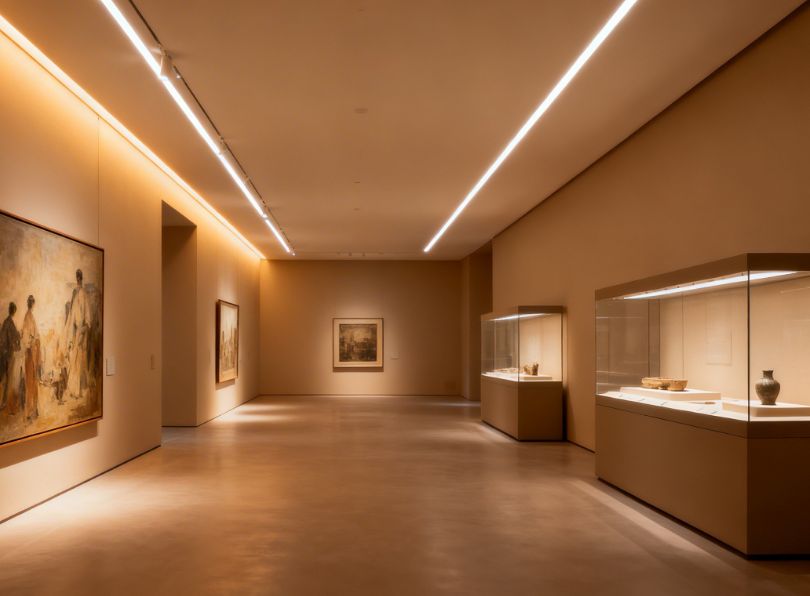
L'éclairage muséal est l'une des disciplines les plus techniquement exigeantes et culturellement déterminantes dans l'ensemble de la conception de l'éclairage architectural. Il se situe à l'intersection complexe entre photométrie, biologie de la conservation, psychologie du visiteur et narration curatoriale, exigeant que chaque système d'éclairage introduit dans un espace d'exposition serve simultanément la cause de la préservation, de l'esthétique et de l'expérience humaine.
Ce guide explore chaque dimension de l'éclairage muséal professionnel : de la physique du CRI et des rayonnements UV aux normes internationales de conservation, de la géométrie de positionnement des projecteurs aux technologies les plus récentes de gradation intelligente et de blanc ajustable. Que vous soyez directeurs de musée, architectes concepteurs d'espaces culturels, conservateurs engagés dans la protection de collections précieuses, ou techniciens spécialisés en éclairage muséal, cette ressource vous fournit la profondeur, la précision et les conseils pratiques nécessaires pour prendre des décisions destinées à durer dans le temps.
Qu'est-ce que l'éclairage muséal ?
Le concept d'éclairage muséal ou éclairage de musée a profondément évolué au cours du dernier siècle, passant d'un artisanat intuitif guidé principalement par l'instinct esthétique à une discipline scientifique rigoureuse fondée sur la photométrie, la photobiologie, la chimie de la conservation et la psychologie cognitive. Au niveau le plus fondamental, l'éclairage muséal peut être défini comme la gestion délibérée et ingénierisée du rayonnement électromagnétique, principalement la lumière visible mais aussi les portions proche-ultraviolettes et proche-infrarouges du spectre, invisibles à l'œil humain, à l'intérieur des espaces destinés à l'exposition, à l'étude et à la conservation du patrimoine culturel. La discipline ne comprend pas simplement le choix de luminaires et de sources, mais la conception holistique d'un environnement lumineux entier : l'intensité et la directionalité de la lumière sur chaque objet individuel, la luminance ambiante des surfaces environnantes, les qualités chromatiques de l'éclairage, sa variabilité dans le temps et son effet cumulatif à long terme sur les matériaux irremplaçables.
Comprendre l'éclairage muséal dans sa plénitude nécessite d'apprécier le double mandat, souvent conflictuel, que portent les institutions culturelles. D'un côté se pose l'impératif conservatoire : chaque photon qui frappe une surface peinte, un tissu, un manuscrit ou une photographie porte avec lui le potentiel d'un dommage photochimique qui est cumulatif, irréversible et accéléré par le temps. De l'autre se pose l'impératif d'accès : les musées existent pour rendre visibles, compréhensibles et émotionnellement significatives leurs collections aux visiteurs. L'obscurité conserve parfaitement, l'obscurité rend l'exposition impossible. L'éclairage muséal est l'art et la science de négocier cette tension avec rigueur et créativité. Chaque choix d'éclairage, chaque lux ajouté ou soustrait, chaque degré Kelvin de température de couleur, chaque angle de pointage d'un projecteur, est un acte d'équilibre entre le passé que l'on souhaite préserver et le présent que l'on souhaite illuminer.
Le rôle de l'éclairage dans les musées va bien au-delà du purement fonctionnel. La lumière façonne la perception de l'espace par le visiteur : elle crée des hiérarchies d'attention, guidant l'œil d'un objet à l'autre à travers des contrastes calculés d'intensité et de direction. Elle établit le registre émotionnel de l'expérience, l'éclairage chaud et bas invoque l'intimité et la contemplation tandis que la lumière brillante et diffuse communique l'accessibilité et l'énergie. La lumière équilibre le rapport entre une œuvre et son contexte physique, intégrant l'objet dans l'architecture qui l'accueille ou l'isolant comme un bijou contre l'ombre. Un grand éclairage pour musées est en définitive une forme de curation : un acte éditorial qui interprète la collection à travers la grammaire de la lumière et de l'ombre. L'importance de l'éclairage dans les expositions ne peut être surestimée : des études systématiques démontrent que la qualité de l'environnement lumineux figure parmi les trois premiers facteurs influençant la satisfaction du visiteur, aux côtés de la qualité de la collection et de la clarté des matériels interprétatifs.
Développement historique de l'éclairage muséal
L'histoire de l'éclairage muséal est inséparable de l'histoire des technologies de la lumière. Les premiers musées publics des XVIIIe et XIXe siècles, le British Museum (1759), le Louvre (1793), l'Altes Museum de Berlin (1830) s'appuyaient entièrement sur la lumière naturelle. Les architectes de l'époque comprenaient que la lumière du jour offrait un rendu chromatique et une qualité de modelage inégalés. Ils consacrèrent un ingéniosité considérable à sa gestion : galeries avec lanterneaux zénithaux et jalousies réglables, ouvertures orientées au nord pour garantir un éclairage constant et sans éblouissement direct. Les grands musées de la tradition néoclassique étaient fondamentalement des machines à lumière, dont les enveloppes maçonnées étaient ingénierisées pour capturer, filtrer et distribuer l'énergie solaire de manières contrôlées qui valorisaient les œuvres exposées.
L'arrivée de l'éclairage au gaz au milieu du XIXe siècle permit pour la première fois l'ouverture vespérale des musées, élargissant dramatiquement l'accessibilité aux classes laborieuses. Il introduisit aussi de nouveaux risques conservatoires que les conservateurs de l'époque n'avaient pas les outils pour évaluer : les produits de combustion, anhydride sulfureux, oxydes d'azote, vapeur d'eau, contribuaient à l'acidification des matériaux cellulosiques et protéiques. La transition ultérieure vers l'éclairage électrique à incandescence à partir des années 1880 représenta une révolution dans la contrôlabilité, mais la nature spectrale de la lumière incandescente, fortement déséquilibrée vers le rouge, introduisait une distorsion chromatique systématique non pleinement comprise jusqu'au développement de la colorimétrie au début du XXe siècle.
L'après-guerre apporta la lumière fluorescente dans les intérieurs muséaux : efficace et durable, mais avec des discontinuités spectrales qui produisaient des échecs de métamérisme et une émission UV significative nécessitant des filtres additionnels coûteux. La fin du XXe siècle vit s'affirmer les halogènes et iodures métalliques comme sources préférées pour l'accentuation sur les tableaux : excellent rendu chromatique, mais émission thermique et infrarouge élevée. Toutes ces technologies sont aujourd'hui complètement dépassées par la technologie LED, une transition dont les implications pour l'éclairage muséal sont approfondies dans la Section 8 de ce guide.
Signification culturelle et économique de l'éclairage muséal
Les éclairages muséaux portent un poids économique rarement reconnu dans les discussions purement techniques. Selon les données de l'UNESCO, le tourisme culturel génère environ 330 milliards d'euros de dépenses annuelles dans l'Union européenne, et les musées constituent l'une des principales motivations du voyage culturel. L'expérience du visiteur, dont la qualité de l'environnement lumineux est un déterminant primordial, influence directement les données d'affluence, le temps de séjour, les taux de retour et les recettes provenant du merchandising et de la billetterie.
| Indicateur | Donnée | Source |
|---|---|---|
| Dépenses annuelles tourisme culturel UE | ~330 milliards € | UNESCO 2024 |
| Augmentation satisfaction visiteurs après mise à niveau éclairage | +18% | American Alliance of Museums 2019 |
| Augmentation visites répétées après mise à niveau éclairage | +12% (horizon 24 mois) | American Alliance of Museums 2019 |
| Part des coûts de conservation préventive attribuables aux dommages lumineux (musées pré-LED) | 15–20% | Getty Conservation Institute 2022 |
| Économie énergétique moyenne LED vs halogène dans les rénovations muséales | 60–75% | Ledpoint données internes 2025 |
| Valeur de marché mondiale éclairage muséal LED (2025) | 1,87 milliard USD | MarketsandMarkets 2025 |
| Valeur de marché mondiale prévue (2030) | 3,4 milliards USD | MarketsandMarkets 2025 |
| TCAM marché éclairage muséal 2025–2030 | 12,7% | MarketsandMarkets 2025 |
La physique de la lumière et son impact sur les œuvres d'art
Pour concevoir l'éclairage muséal avec une véritable maîtrise, le professionnel doit comprendre la lumière non simplement comme phénomène visuel, mais comme processus énergétique avec des effets physiques mesurables sur les matériaux qu'elle éclaire. La lumière est un rayonnement électromagnétique : dans le contexte de l'éclairage muséal, la portion pertinente du spectre s'étend d'environ 200 nm (ultraviolet profond) à environ 2 500 nm (infrarouge à ondes courtes). À l'intérieur de cet intervalle, le spectre visible, la bande 380–780 nm perceptible par l'œil humain, est d'importance esthétique primordiale. Les régions ultraviolette (UV : 100–380 nm) et infrarouge (IR : 780 nm–1 mm) sont d'importance conservatoire primordiale, chacune avec des mécanismes de dommage distincts et bien caractérisés.
Énergie photonique et dommage photochimique
Le dommage photochimique causé par la lumière aux matériaux organiques, colorants, pigments, liants, fibres, cellulose du papier, dérive directement de la nature quantique du rayonnement électromagnétique. Selon la relation de Planck-Einstein, l'énergie transportée par un photon est inversement proportionnelle à sa longueur d'onde : E = hc/λ. Cela signifie que les longueurs d'onde plus courtes transportent plus d'énergie par photon et sont donc plus destructrices pour les liaisons moléculaires des matériaux sensibles. Un photon à 300 nm (UVB) transporte environ 4,1 eV d'énergie, suffisant pour rompre directement les liaisons C–C et C–H de 3,1–3,5 eV qui forment l'épine dorsale des chaînes polymères de cellulose et de protéines.
Le rayonnement ultraviolet, en particulier UVB (280–315 nm) et UVA (315–380 nm), produit la cosiddette photodégradation : blanchiment des matériaux colorés, jaunissement des liants organiques, fragilisation du papier et des textiles. Même le violet-bleu visible (380–450 nm) contribue de manière significative au dommage photochimique dans les matériaux sensibles, raison pour laquelle même des sources dépourvues d'UV peuvent causer des dommages cumulatifs à long terme. La protection des œuvres contre l'éclairage requiert donc une attention non seulement au contenu UV mais à l'ensemble du profil énergétique photonique de la source utilisée à proximité d'objets sensibles.
Le rayonnement infrarouge ne transporte pas d'énergie photonique suffisante pour rompre directement les liaisons moléculaires, mais produit des effets thermiques : le chauffage localisé accélère le taux des réactions chimiques (oxydation, hydrolyse) d'un facteur 2–4 tous les 10°C selon l'équation d'Arrhenius, favorise la migration de l'humidité dans les matériaux hygroscopiques et, dans le cas des peintures sur panneau, produit des variations dimensionnelles différentielles entre couches de couleur, préparation et support qui se traduisent en craquelures et soulèvements. L'apport thermique des sources lumineuses est donc un paramètre critique dans l'éclairage pour musées, non seulement une question de confort environnemental.
La loi de réciprocité et le budget en lux-heures
Un principe fondamental qui gouverne la gestion du dommage lumineux dans les musées est la Loi de Réciprocité (loi de Bunsen-Roscoe) : l'effet photochimique total sur un matériau photosensible est proportionnel à la dose totale de rayonnement reçue, exprimée comme produit entre l'éclairement (intensité) et la durée d'exposition. Mathématiquement : Effet ∝ E × t, où E est l'éclairement en lux et t le temps en heures. Cela signifie qu'exposer une aquarelle à 50 lux pendant 100 heures produit le même dommage photochimique cumulatif que l'exposer à 500 lux pendant 10 heures.
La conséquence pratique pour l'éclairage pour musées est le concept de budget annuel en lux-heures : un plafond à la dose totale de lumière qu'un objet sensible peut recevoir au cours de l'année, indépendamment de la distribution de cette dose dans le temps. Les budgets les plus largement acceptés, établis par le Groupe Bizot et codifiés dans la norme CIE 157:2004, sont illustrés dans le tableau suivant.
| Classe de sensibilité | Exemples | Éclairement max. (lux) | Budget annuel (lux-heures) |
|---|---|---|---|
| Extrêmement sensible (Classe ISO 1) | Aquarelles, textiles teints, photographies, manuscrits, spécimens d'histoire naturelle | 50 lux | 50 000 lux-h/an |
| Sensible (Classe ISO 2) | Peintures à l'huile, tempera, fibres naturelles non teintes, cuir, bois | 150–200 lux | 150 000–200 000 lux-h/an |
| Modérément sensible (Classe ISO 3) | Os, ivoire, céramiques, verre, la plupart des métaux | 300 lux | Aucune limite annuelle recommandée |
| Non sensible (Classe ISO 4) | Pierre, la plupart des métaux, céramiques vitrifiées | Aucune restriction | Aucune restriction |
Mettre en œuvre un budget lux-heures requiert de réduire les niveaux d'éclairement, de réduire les horaires d'ouverture, ou de combiner des systèmes de contrôle basés sur des capteurs de présence qui abaissent ou éteignent les projecteurs en l'absence de visiteurs devant une œuvre sensible. Cette dernière approche, facilitée par les modernes systèmes d'éclairage intelligent comme la plateforme DALI, peut réduire la dose annuelle de lux-heures sur les œuvres sensibles de 40–60% par rapport aux installations à intensité constante, sans aucune réduction perçue de la qualité d'exposition du point de vue du visiteur.
La courbe de Kruithof et le confort visuel dans les galeries
Au-delà du domaine conservatoire, la physique de la lumière gouverne aussi le confort visuel et la qualité perceptive de l'expérience muséale. La courbe de Kruithof, observation empirique publiée par le physicien néerlandais Arie Kruithof en 1941, décrit les combinaisons de niveau d'éclairement et de température de couleur corrélée (CCT) que les observateurs humains perçoivent comme naturellement confortables et agréables. À l'intérieur de la zone de Kruithof, des niveaux d'éclairement plus élevés s'associent à des CCT plus élevés (lumière blanche plus froide), tandis que des niveaux d'éclairement plus bas s'associent à des CCT plus basses (lumière blanche plus chaude et ambrée). Cette heuristique, bien qu'objet de débat scientifique, reste utile dans la pratique de l'éclairage muséal : elle suggère que les typiques 150–200 lux d'une galerie de peinture s'associent le plus confortablement à une CCT dans l'intervalle 2700–3500 K, blanc chaud ou neutre, donnée qui confirme à la fois la bonne pratique conservatoire et l'expérience accumulée par les concepteurs d'éclairage pour musées du monde entier.
CRI — Indice de Rendu des Couleurs dans les environnements muséaux
Parmi tous les paramètres photométriques pertinents pour l'éclairage muséal, le CRI, Colour Rendering Index, Indice de Rendu des Couleurs, est peut-être le plus déterminant pour la représentation fidèle des œuvres d'art. Il est aussi parmi les plus fréquemment mal compris, en particulier par les commanditaires qui s'en approchent pour la première fois dans le contexte des spécifications de l'éclairage pour musées. Une compréhension approfondie du CRI (ce qu'il mesure, ce qu'il ne mesure pas et comment il doit être appliqué dans ce contexte spécifique) est indispensable pour quiconque est impliqué dans la spécification ou l'évaluation de systèmes d'éclairage muséal.
Ce que mesure le CRI et comment il se calcule
Le CRI mesure la capacité d'une source lumineuse à révéler les couleurs des objets de manière fidèle par rapport à un illuminant de référence, un radiateur planckien (corps noir) pour des CCT inférieures à 5000 K, ou une phase de lumière diurne (illuminant CIE série D) pour des CCT égales ou supérieures à 5000 K. Le calcul, standardisé dans la publication CIE 13.3:1995, évalue l'effet de la source sur un ensemble de 14 échantillons de couleur de test (TCS), chacun un échantillon de couleur Munsell à saturation modérée distribué le long du spectre visible. Les huit premiers échantillons (TCS01–TCS08) sont utilisés pour calculer le CRI général Ra, qui est la moyenne arithmétique des huit indices spéciaux R1–R8. TCS09–TCS14 sont rapportés séparément ; le TCS09 (un échantillon rouge saturé) a une importance particulière dans le contexte muséal car il trace directement le rendu des pigments aux tons chauds, rouges, rouge-orange, vermillons, abondants dans l'histoire de la peinture occidentale.
| Plage Ra | Classification | Application dans le musée |
|---|---|---|
| Ra ≥ 98 | Exceptionnel — museum grade premium | Galeries de peinture avec exigences de précision chromatique absolue, éclairage pour examen de conservation |
| Ra 95–97 | Excellent — museum grade standard | Galeries de peinture, expositions de textiles et costumes, aquarelles et œuvres sur papier, standard minimum pour toute exposition sérieuse de collection |
| Ra 90–94 | Très bon — standard galerie | Éclairage général de la galerie, sculpture, arts décoratifs, minimum acceptable pour l'exposition de la collection |
| Ra 80–89 | Bon — standard commercial | Acceptable pour espaces muséaux annexes (circulation, lobby, cafétéria) mais insuffisant pour l'exposition de la collection |
| Ra < 80 | Médiocre — non adapté | Inacceptable dans aucun contexte d'exposition de collection |
Les limites du Ra et les métriques avancées de qualité des couleurs
Malgré son usage répandu, le paramètre Ra a des limitations documentées particulièrement pertinentes dans le contexte muséal. La plus significative est que le Ra n'est pas sensible à la saturation des couleurs : une source qui désature systématiquement toutes les couleurs, rendant tout légèrement pâli, peut néanmoins obtenir un score Ra 95 ou supérieur. Les métriques avancées les plus importantes pour l'éclairage muséal sont :
- R9 (Indice Spécial pour le Rouge Saturé) : le neuvième indice spécial, calculé pour TCS09 (un échantillon rouge saturé). Il n'est pas inclus dans la moyenne Ra et peut être dramatiquement inférieur à Ra dans certains produits LED. Un musée qui éclaire des peintures vénitiennes, des tapis persans ou des peintures rupestres avec une source Ra 92 et R9 20 voit ces rouges profonds se déformer gravement. La spécification professionnelle doit toujours exiger R9 ≥ 50, idéalement R9 ≥ 90. Les projecteurs Ledpoint MUSEO PRO garantissent R9 ≥ 90.
- TM-30 (IES Technical Memorandum 30) : remplace les huit échantillons Munsell par 99 échantillons réels. Rapporte Rf (Indice de Fidélité, analogue au Ra) et Rg (Indice de Gamut, qui mesure la saturation moyenne rendue). Une source avec Rf 90 et Rg 105 rend les couleurs avec haute fidélité et un léger renforcement de la saturation — souvent préférée dans les musées car elle rend les œuvres légèrement plus vives et tridimensionnelles sans distorsions de teinte.
- Diagramme Vectoriel des Couleurs (CVG) : sortie graphique du TM-30, qui montre direction et amplitude des écarts chromatiques dans 16 secteurs angulaires. Révèle d'un coup d'œil si une source LED déforme des régions chromatiques spécifiques, essentiel pour la spécification professionnelle d'éclairage pour musées.
CRI et le rendu des pigments historiques — Lumière d'art
La spécification du CRI dans l'éclairage pour musées n'est pas un exercice technique abstrait : elle a des conséquences directes sur la manière dont des pigments historiques spécifiques sont perçus par les visiteurs et, de manière critique, sur la manière dont les décisions de conservation sont prises par les professionnels qui examinent les œuvres sous l'éclairage de la galerie. Les principaux pigments historiques avec des profils de réflectance spectrale qui requièrent attention dans la spécification de la lumière d'art incluent plusieurs options, voyons lesquelles.
- Outremer naturel (lapis-lazuli) : pic de réflectance à 450–470 nm (violet-bleu). Les LED avec pompe bleue à 450–455 nm peuvent produire un rendu légèrement hyper-saturé et fluorescent non fidèle à l'apparence sous lumière diurne équilibrée.
- Vermillon (sulfure mercurique, HgS) : pic de réflectance à 590–620 nm (rouge-orange). Requiert des valeurs R9 élevées pour un rendu fidèle ; des sources avec R9 bas le rendent comme un rouge terne et brunâtre.
- Vert-de-gris (acétate basique de cuivre) : réflectance large 490–560 nm (bleu-vert). Sensible aux sources avec déficiences spectrales dans la région cyan entre 490 et 510 nm.
- Émail (verre dopé au cobalt) : large pic à 450–480 nm. Apparaît gris-vert au lieu de bleu sous des sources chaudes pauvres en violet-bleu — problème critique dans les galeries de peinture hollandaise et flamande du XVIIe siècle.
- Colorants organiques naturels (garance, indigo, pastel, kermès) : profils spectraux complexes et riches en métamérisme ; parmi les plus difficiles à rendre avec précision et parmi les plus photosensibles — une combinaison qui rend la spécification précise de l'éclairage muséal particulièrement critique pour les collections de textiles.
Rayonnement UV dans l'éclairage muséal : risques et solutions
Le rayonnement ultraviolet (UV) est le composant du spectre électromagnétique le plus aiguëment dommageable pour les matériaux organiques qui constituent la grande majorité des collections muséales. Il est présent dans la lumière solaire (environ 5–7% de l'irradiance totale en conditions de ciel serein), dans de nombreuses sources artificielles conventionnelles et, en traces, dans certains produits LED. Comprendre et contrôler l'UV dans le contexte de l'éclairage pour musées n'est pas optionnel : c'est une obligation professionnelle et éthique pour quiconque est impliqué dans la prise en charge du patrimoine culturel. Les dommages des sources lumineuses aux œuvres d'art attribuables à l'exposition UV représentent une perte permanente et irréversible de valeur culturelle qu'aucune restauration ultérieure ne peut pleinement compenser.
Mécanismes de dommage UV dans les matériaux du patrimoine culturel
Dans les matériaux cellulosiques (papier, coton, lin, bois), l'exposition UV promeut la scission oxydative des chaînes polymères de la cellulose, réduisant le degré de polymérisation et produisant la perte progressive de résistance mécanique, le jaunissement et la fragilité caractéristiques du papier vieilli exposé à la lumière. Dans les matériaux protéiques (soie, laine, parchemin, cuir, liant à tempera à l'œuf), l'UV promeut à la fois la scission des chaînes et des réactions de réticulation, produisant le durcissement, l'assombrissement et la fragilisation caractéristiques des fibres organiques vieillies.
Pour les matériaux photographiques, tirages à l'albumine, cyanotypes, tirages aux sels d'argent, photographies couleurs chromogènes, tirages par transfert de colorant, l'exposition UV active directement la même chimie de l'argent et des colorants responsable de la formation de l'image, produisant un délavage et des variations chromatiques qui peuvent être hautement non uniformes sur la surface de l'image. Pour les peintures, l'UV agit principalement à travers les couches de vernis et de liant : les vernis à résine naturelle (mastic, dammar) jaunissent rapidement sous l'exposition UV au fur et à mesure que leurs composants triterpénoïdes polymérisent et s'oxydent, obscurcissant progressivement les relations chromatiques originales des couches de couleur sous-jacentes.
Mesurer l'UV dans les environnements muséaux
La métrique conventionnelle pour le contenu UV dans l'éclairage muséal est le contenu UV exprimé en microwatts par lumen (μW/lm). Le seuil internationalement accepté pour l'UV dans l'éclairage muséal est ≤ 75 μW/lm, comme spécifié par l'IES et largement partagé par l'ICOM, l'IIC et le BSI (PD 6662:2000). Les meilleures pratiques contemporaines réduisent ce seuil à ≤ 10 μW/lm pour les matériaux les plus sensibles.
| Type de source | Contenu UV typique (μW/lm) | Classification UV pour usage muséal |
|---|---|---|
| Lumière du jour (fenêtre non filtrée) | 150–250 | Inacceptable sans filtration UV |
| Fluorescente non filtrée (blanc froid) | 80–100 | Inacceptable |
| Fluorescente filtrée UV | 10–30 | Marginale, condition du filtre à surveiller |
| Halogène au tungstène (non filtré) | 70–90 | Marginalement acceptable avec filtre UV additionnel |
| Iodures métalliques (revêtus) | 30–60 | Nécessite un filtre UV |
| LED commercial standard (blanc phosphore) | 0–10 | D'acceptable à excellent, vérifier avec le fabricant |
| LED museum-grade (Ledpoint MUSEO PRO) | <1 μW/lm | Excellent, UV pratiquement absent, aucun filtre nécessaire |
| Fibre optique (source distante) | 0 au point lumineux | Idéal, UV complètement éliminé par la fibre de verre |
LED et UV : le cas pour un Éclairage muséal à UV quasi nul
L'avantage le plus significatif de la technologie LED à phosphore blanc du point de vue de la conservation est son émission UV négligeable. Les LED blanches produisent leur émission à large bande en combinant une puce de pompe bleue InGaN (typiquement à 450–455 nm, entièrement dans le visible, au-dessus de la frontière UV à 380 nm) avec un ou plusieurs matériaux phosphore qui absorbent le rayonnement bleu et le réémettent comme large émission jaune-verte-rouge. Le spectre résultant ne contient pratiquement pas d'énergie photonique en dessous de 400 nm, sauf que le fabricant n'ait délibérément inclus des composants émettant des UV pour des applications spéciales.
Cette absence intrinsèque d'UV est un changement de paradigme pour l'éclairage muséal. Avec les sources halogènes et fluorescentes conventionnelles, le contrôle UV requérait l'ajout de filtres, gaines ou verres filtrants, avec des coûts additionnels, une complexité de maintenance et le risque de dégradation du filtre dans le temps. Avec les LED museum-grade, le contrôle UV est intrinsèque à la technologie : aucune filtration additionnelle n'est nécessaire, et les performances quasi-nulles en UV ne se dégradent pas au cours de la vie du luminaire. Cela permet d'éliminer la gestion UV du programme de maintenance, un bénéfice opérationnel significatif pour les institutions avec de grandes collections et des budgets de maintenance limités.
Température de couleur : choisir la CCT pour chaque collection
La Température de Couleur Corrélée (CCT), mesurée en Kelvin (K), est le paramètre qui de manière la plus immédiate et viscérale détermine la "sensation" d'un environnement d'exposition. Son choix est parmi les décisions les plus déterminantes dans la conception de l'éclairage muséal, et une qui est souvent effectuée trop hâtivement ou sur la base de pure intuition esthétique, plutôt que de la combinaison de science de la conservation, psychologie du visiteur et photométrie spécifique de la collection qu'une approche professionnelle rigoureuse requiert. La CCT n'est pas un choix purement stylistique : elle affecte la couleur perçue des œuvres d'art, le registre émotionnel de l'espace, l'efficacité énergétique de l'installation et la dose photonique pondérée pour le dommage délivrée aux matériaux sensibles.
Lignes directrices pour le choix de la CCT en fonction du type de collection
| Collection / Contexte | CCT recommandée | Motivation |
|---|---|---|
| Peinture ancienne (pré-1800, huile et tempera) | 2700–3000 K | Approxime les conditions historiques de vision (lumière de bougie ~1800 K, premières lampes à huile ~2200 K), le chaud valorise les palettes dominées par ocres et sienne de la Renaissance et du Baroque |
| Peinture impressionniste et post-impressionniste | 3000–3500 K | Équilibre les tons chauds de la palette avec la qualité de la lumière en plein air, conserve la luminosité caractéristique de ces peintures |
| Peinture moderne et contemporaine | 3500–4000 K | Rendu neutre qui préserve la précision chromatique intentionnelle d'œuvres conçues sous lumière diurne ou fluorescente d'atelier, évite une dérive chaude non voulue |
| Œuvres sur papier et aquarelles | 2700–3000 K (à 50 lux) | Sources à basse CCT à niveaux d'éclairement conservatoires créent des conditions de vision intimes adaptées à l'échelle de l'œuvre |
| Photographie en noir et blanc (sels d'argent, albumine) | 3000–4000 K | Chaud neutre pour tirages aux sels d'argent, plus froid pour tirages inkjet et pigment qui requièrent rendu neutre |
| Photographie couleurs (chromogène, dye transfer, inkjet) | 3500–4000 K | Blanc neutre pour le rendu le plus équilibré de l'entière gamme chromatique des médias photographiques couleurs |
| Sculpture classique (marbre blanc, albâtre) | 3000–3500 K | Les sources chaudes valorisent la luminosité et la chaleur du marbre blanc, les sources froides aplatissent la qualité superficielle et introduisent une dominante bleuâtre indésirable |
| Sculpture en bronze et métaux patinés | 3000–3500 K | La lumière chaude accentue les tons riches et la complexité superficielle des patines bronzées, la lumière froide désature le caractère chromatique de la patine |
| Textiles, tapisseries, tapis | 2700–3000 K (à 50 lux) | Niveaux d'éclairement conservatoires avec CCT chaude ; le ton chaud valorise la profondeur et la richesse des fibres naturelles teintes |
| Arts décoratifs historiques (céramiques, porcelaines) | 3000–3500 K | Rendu de chaud à neutre qui valorise la luminosité des majoliques et des porcelaines historiques |
| Arts décoratifs contemporains (verre artistique) | 3500–4000 K | Blanc neutre pour la précision chromatique maximale dans des œuvres où la couleur exacte est la qualité esthétique primaire |
| Histoire naturelle (spécimens géologiques) | 4000–5000 K | Températures plus froides révèlent la variation chromatique des spécimens minéraux avec plus grande précision |
| Objets archéologiques | 3000–3500 K | Rendu neutre-chaud qui ne surchauffe pas la terre cuite ni ne refroidit la pierre et l'os |
| Parcours, lobbies, halls d'entrée | 3000–3500 K | Chaleur modérée qui accueille le visiteur sans concurrencer chromatiquement avec les zones d'exposition de la collection |
Tunable White : contrôle dynamique de la CCT dans les musées
La technologie Tunable White (TW), avec la capacité de varier continuellement la CCT d'un luminaire sur un intervalle défini (typiquement 2700–6500 K, en mélangeant électroniquement les sorties de canaux LED blanc-chaud et blanc-froid à l'intérieur d'un seul appareil) est émergée comme l'un des outils les plus puissants disponibles au professionnel de l'éclairage muséal. Les applications dans les musées sont multiples :
- adaptation d'exposition en exposition : un espace d'exposition qui accueille des expositions différentes — manuscrits médiévaux un mois et photographie contemporaine le suivant — peut être recalibré à la CCT optimale pour chaque exposition sans remplacer aucun luminaire ;
- éclairage human-centric pour le personnel : profils d'éclairage supportant le rythme circadien, CCT et éclairement plus élevés durant les heures de travail diurnes, plus chauds et bas en soirée, pour le bien-être et la productivité du personnel muséal ;
- gestion du métamérisme : les systèmes TW permettent aux conservateurs d'explorer les relations de métamérisme conditionnel entre œuvres durant l'installation et de choisir la CCT qui révèle ou minimise de telles paires selon l'intention interprétative.
Normes et standards internationaux pour l'éclairage muséal
La pratique de l'éclairage muséal ne se déroule pas dans un vide normatif. Elle est gouvernée par un corpus substantiel et en continuelle évolution de standards internationaux, normes nationales, lignes directrices professionnelles et cadres de bonnes pratiques institutionnelle qui définissent collectivement les exigences minimales et les cibles aspirationnelles pour un éclairage muséal responsable. Comprendre ce paysage normatif est essentiel pour directeurs de musée, architectes, conservateurs et éclairagistes. La conformité aux standards applicables n'est pas seulement une question d'intégrité professionnelle : elle est de plus en plus requise par assureurs, organismes prêteurs et entités financeuses comme condition pour accords de prêt, permis d'exposition et subventions pour le patrimoine culturel.
Principales normes CIE pour l'éclairage muséal
- CIE 157:2004 — Control of Damage to Museum Objects by Optical Radiation : le standard fondamental de conservation, qui établit la classification de sensibilité des matériaux, le concept de budget annuel en lux-heures, le seuil UV de ≤ 75 μW/lm et le concept de dose pondérée pour le dommage.
- CIE 228:2017 — Recommendations on Lighting for Artworks : met à jour CIE 157 avec attention spécifique à la technologie LED, révisant les seuils UV (recommande ≤ 10 μW/lm pour les matériaux les plus sensibles) et introduisant des exigences de rendu chromatique (Ra ≥ 90 minimum, Ra ≥ 95 recommandé).
- CIE 13.3:1995 — Method of Measuring and Specifying Colour Rendering Properties : le standard de calcul du Ra, actuellement en révision pour incorporer les principes TM-30.
- CIE S 026:2018 : cadre métrologique pour les métriques de la lumière pertinentes pour le système circadien (mEDI), de plus en plus pertinent pour les musées intégrant des principes d'éclairage human-centric.
Standards européens et nationaux
- EN 12464-1:2021 — Éclairage des lieux de travail intérieurs : standard européen de référence pour tous les systèmes d'éclairage intérieur, incluant les dispositions sur éclairement minimum, rendu chromatique (Ra ≥ 90 recommandé pour tâches visuelles chromatiquement critiques), uniformité de luminance et limitation de l'éblouissement (seuils UGR).
- EN 62471:2008 — Sécurité photobiologique des lampes et systèmes de lampes : classe les sources en groupes de risque (RG0–RG3) en fonction du risque photobiologique — danger de lumière bleue, UV, IR — à des distances de mesure spécifiées. Les projecteurs LED museum-grade doivent être classés RG0 ou RG1 aux distances normales d'exposition.
- EN 1838:2013 — Éclairage de secours : spécifie les exigences minimales pour les systèmes d'éclairage de secours incluant l'éclairage des voies d'évacuation (minimum 1 lux horizontal) et des points de sécurité à haut risque.
- D.Lgs. 81/2008 (Texte Unique Sécurité au Travail) : réglemente la sécurité photobiologique pour les employés muséaux, se référant aux classifications de risque EN 62471.
- Lignes Directrices MiC (Ministère de la Culture) : établissent des limites de lux et lux-heures cohérentes avec CIE 157:2004 et exigences minimales de CRI (Ra ≥ 90) pour l'éclairage dans les zones d'exposition des musées d'État italiens.
Groupe Bizot — Standards pour les prêts internationaux
Le Groupe Bizot, association informelle des directeurs des plus grands et prestigieux musées mondiaux (Louvre, British Museum, Metropolitan Museum of Art, Rijksmuseum, Prado, Offices), a développé des exigences de Standard Facilities Report qui régissent les conditions environnementales requises par les institutions membres lorsqu'elles prêtent des œuvres à d'autres lieux. La conformité aux standards du Bizot est un prérequis pour tout musée souhaitant participer aux réseaux de prêt international qui soutiennent les grands programmes d'exposition.
| Catégorie de matériau | Éclairement max | Limite annuelle lux-heures | UV maximum |
|---|---|---|---|
| Extrêmement photosensible (aquarelles, manuscrits, photographies, textiles teints) | 50 lux | 50 000 lux-h/an | ≤75 μW/lm (cible ≤10 pour nouvelles installations) |
| Photosensible (peintures à l'huile, matériaux naturels non teints, bois, cuir) | 150 lux | 150 000 lux-h/an | ≤75 μW/lm |
| Non photosensible (pierre, métaux, céramiques vitrifiées, verre) | 300 lux (aucune limite annuelle) | Illimité | ≤75 μW/lm |
Typologies d'éclairage muséal
L'éclairage muséal professionnel comprend une hiérarchie de fonctions lumineuses distinctes, chacune avec un but perceptif spécifique et une approche photométrique différente. Un projet d'éclairage muséal sophistiqué intègre toutes ces typologies en un ensemble cohérent, créant une expérience qui guide l'attention du visiteur à travers l'espace et d'une œuvre à l'autre avec apparente naturalité.
Éclairage général (ambiant)
L'éclairage général établit la luminance globale de l'espace d'exposition et détermine le niveau d'adaptation du système visuel. Dans les environnements muséaux il est délibérément maintenu bas, typiquement 50–100 lux, pour augmenter le contraste perçu entre environnement et accent lighting sur les œuvres, réduire la dose de lumière par spill light sur les œuvres indirectement illuminées, et créer l'atmosphère contemplative caractéristique des grandes galeries muséales européennes.
Éclairage focalisé et d'accentuation
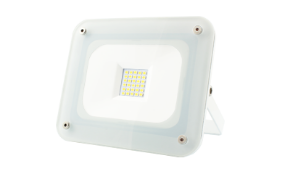
L'éclairage focalisé, le faisceau directionnel et contrôlé qui tombe sur un objet individuel, est l'outil principal de l'éclairage pour musées : il sépare l'œuvre de son contour, révèle la forme tridimensionnelle, la texture superficielle et la couleur. Le rapport accent/ambiance, typiquement de 3:1 à 15:1 dans les galeries européennes, est l'un des principaux paramètres du vocabulaire expressif du lighting design muséal. Il est délivré presque toujours par les projecteurs pour musées montés sur système de rails ou points fixes au plafond.
Éclairage des vitrines et présentoirs
Les vitrines présentent des défis spécifiques : sources internes (bandes LED ou mini-projecteurs cachés dans la structure de la vitrine) éliminent le problème des reflets sur les surfaces vitrées, le verre antireflet (AR) réduit les réflexions superficielles du typique 4–8% du verre float à moins de 0,5%, les mini-projecteurs individuels pointés sur chaque objet garantissent la maximale efficacité visuelle.
Éclairage de lavage de murs (wall wash)
Le wall washing, la distribution uniforme et continue de lumière sur une surface verticale, sert à deux fins : fournir la luminance de fond par rapport à laquelle les œuvres accrochées sont perçues, et illuminer des surfaces architecturales (murs peints, revêtements textiles, enduit décoratif) qui sont elles-mêmes partie de l'environnement visuel du musée.
Éclairage architectural et de caractère
De nombreux musées, en particulier les bâtiments historiques, utilisent la lumière pour célébrer l'architecture elle-même : lumière rasante sur maçonneries ou stucs révèle la texture et la qualité artisanale des surfaces, luminaires suspendus peuvent être objets d'intérêt esthétique autonome, lumière colorée sur éléments architecturaux crée des fonds chromatiques qui interagissent avec les collections exposées.
Éclairage de secours et de sécurité
L'éclairage de secours doit respecter EN 1838:2013 et D.M. 22 février 2006 (prévention incendie dans les musées). Éclairement minimum sur les voies d'évacuation : 1 lux (horizontal) ; passage à batterie dans les 5 secondes suivant l'interruption de réseau ; autonomie minimum 1 heure (3 heures pour structures complexes). La conception doit tenir compte de la transition d'environnements à basse luminance (50 lux) au mode secours (1 lux), un facteur de réduction 50 qui peut désorienter les visiteurs durant l'évacuation s'il n'est pas géré avec des zones de transition adéquates.
Technologie LED pour musées : pourquoi la LED est devenue le standard de référence
La transition de l'éclairage muséal des sources halogènes, fluorescentes et aux iodures métalliques vers la technologie LED est aujourd'hui substantiellement complétée dans les nouvelles constructions muséales et bien avancée dans la rénovation des institutions existantes. Les LED museum-grade représentent aujourd'hui l'incontesté état de l'art dans l'éclairage pour musées, combinant performances conservatoires, qualité chromatique, efficacité énergétique et longévité opérationnelle de manière qu'aucune technologie concurrente ne parvient à égaler.
Efficacité énergétique et coût total de possession
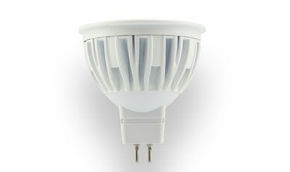
Un projecteur halogène typique (50W MR16, ~600 lm) comparé avec un équivalent LED museum-grade délivrant les mêmes 600 lm à 8–12W, économie de 75–85% des consommations électriques à égalité de output lumineux. Sur des milliers de projecteurs dans un musée de dimensions moyennes, cela se traduit en économies annuelles très significatives.
| Paramètre | Halogène (50W MR16) | LED museum-grade (10W) | Économie annuelle |
|---|---|---|---|
| Puissance par appareil | 50 W | 10 W | -80% consommations |
| Consommation annuelle (200 app. × 3 000 h) | 30 000 kWh | 6 000 kWh | 24 000 kWh (~3 600 € à 0,15 €/kWh) |
| Vie de la source | 2 000–4 000 h | 50 000 h (L70/B10) | ~15× plus durable — 15× moins de remplacements |
| Coût annuel remplacement lampes | ~1 200 € | ~80 € | 1 120 €/an |
| Économie main-d'œuvre maintenance (estimée) | — | — | ~2 500 €/an |
| Filtres UV éliminés | ~800 €/an | 0 € | 800 €/an |
| Réduction charge HVAC (estimée) | — | — | ~1 500 €/an |
| Économie annuelle totale estimée | — | — | ~9 500 €/an |
| Période de retour sur investissement en rénovation LED | — | — | 3–5 ans |
Qualité spectrale de la LED museum-grade
Les modules LED museum-grade contemporains utilisent des architectures multi-phosphore : combinant deux, trois ou quatre matériaux phosphore différents pour produire un profil d'émission spectrale substantiellement plus continu, qui s'approche de la régularité du spectre d'un radiateur planckien. Ces produits atteignent Ra 95–98 et R9 80–95, avec une fidélité spectrale proche de celle des sources halogènes au tungstène qu'elles remplacent, sans les désavantages thermiques, UV et énergétiques associés.
Stabilité chromatique dans le temps : ellipses de MacAdam
Les LED se déplacent en CCT en vieillissant : dégradation du phosphore, stress thermique sur l'électronique et vieillissement du driver causent une dérive de la couleur émise, typiquement vers des tons plus chauds et jaunâtres. Si cette dérive n'est pas contrôlée ou est non uniforme entre les projecteurs d'une galerie, elle produit des différences visibles de température de couleur qui détruisent la cohérence chromatique de l'environnement d'exposition. Les produits museum-grade doivent maintenir la couleur dans les 3 SDCM (ellipse de MacAdam 3-pas) par rapport à la spécification initiale pour toute la vie opérationnelle déclarée de 50 000 heures.
Projecteurs pour musées : optiques, angles de faisceau et géométrie de positionnement
Le projecteur, le luminaire directionnel réglable, est l'outil fondamental de l'éclairage focalisé dans les musées. La sélection, la spécification et le positionnement des projecteurs pour musées est l'une des décisions pratiquement les plus déterminantes dans l'ensemble du processus de conception, avec des effets directs sur la qualité perçue des œuvres individuelles, sur l'efficacité énergétique de l'installation, sur les performances conservatoires du système et sur la facilité avec laquelle l'éclairage peut être adapté à des expositions différentes.
Systèmes optiques dans les projecteurs pour musées
- Optiques à réflecteur : réflecteur poli ou semi-spéculaire qui redirige l'émission du module LED en un faisceau directionnel. Robustes, efficaces et économiques — les plus répandus dans les projecteurs standard. Limite principale : angle de faisceau fixe en production ;
- Optiques à lentille et systèmes zoom : lentille (ou combinaison de lentilles) de précision qui réfracte l'émission en un faisceau contrôlé avec excellent cutoff. Dans les configurations zoom, l'angle est continuellement réglable sur un intervalle défini (typiquement 10°–50° ou 12°–60°) via anneau de réglage externe sans remplacer le luminaire. Idéaux dans les musées avec rotation fréquente des aménagements ;
- Optiques TIR (Réflexion Totale Interne) : combinent principes réfractifs et réflexifs dans un unique élément optique moulé, atteignant une efficacité optique très élevée (85–92% du flux du module LED converti en faisceau utile) et excellente uniformité de faisceau. Compactes, légères, disponibles en large gamme d'angles fixes.
Guide pour le choix de l'angle du faisceau lumineux
| Angle du faisceau | Classification | Application typique dans le musée |
|---|---|---|
| 5°–10° | Very Narrow Spot (VNSP) | Accentuation ponctuelle sur petits objets (bijoux, monnaies, médailles, petites sculptures), mise en évidence d'un détail spécifique dans une composition plus large |
| 12°–18° | Narrow Spot (NSP) | Tableaux individuels jusqu'à ~0,6 m de largeur, objets hauts et étroits, éclairage intérieur vitrines basses |
| 24°–36° | Spot (SP) | Projecteur standard pour tableaux, l'angle le plus commun pour tableaux accrochés à normales hauteurs de plafond (3–4 m), sculptures de dimensions moyennes |
| 40°–60° | Flood (FL) | Tableaux de grands formats (>1,5 m de largeur), grandes tapisseries et textiles, wall wash adjacent aux œuvres, groupes sculpturaux |
| 60°–90° | Wide Flood (WFL) | Contribution ambiante depuis projecteurs sur rail, wall washing large, sculptures ou éléments architecturaux très grands |
| Asymétrique/Linéaire | Spécial | Wall washing en proximité rapprochée, lumière rasante sur surfaces texturées, éclairage étagères intérieures vitrines linéaires |
Géométrie de positionnement : à quelle distance placer les projecteurs ?
La question à quelle distance placer les projecteurs pour musées n'a pas de réponse universelle : la distance correcte est fonction de l'intensité lumineuse du luminaire (candela), de l'éclairement cible sur la surface (lux) et de l'angle de pointage. La formule de référence est la loi du cosinus modifiée :
E = (I × cos θ) / d²
E = éclairement sur la surface (lux) | I = intensité lumineuse dans la direction de pointage (candela) | d = distance de la source à la surface (mètres) | θ = angle d'incidence (entre axe du faisceau et la normale à la surface)
Cette formule a des implications pratiques immédiates : doubler la distance réduit l'éclairement à un quart (réduction 4× pour 2× de distance) ; à 30° d'angle de pointage depuis la verticale, E = cos(30°) = 0,87 de l'incidence normale ; à 45°, E = cos(45°) = 0,71 — le 45° requiert donc environ 40% de lumens en plus par rapport au 0° pour le même éclairement central.
| Hauteur œuvre | Centre œuvre du sol | Distance horizontale du mur | Angle de pointage (depuis la verticale) | Angle de faisceau conseillé |
|---|---|---|---|---|
| Jusqu'à 0,5 m | 1,55 m | 0,8–1,0 m | 30°–33° | 18°–24° |
| 0,5–1,0 m | 1,3–1,5 m | 1,0–1,3 m | 31°–34° | 24°–36° |
| 1,0–1,5 m | 1,2–1,4 m | 1,2–1,5 m | 32°–35° | 36°–50° |
| 1,5–2,0 m | 1,1–1,3 m | 1,4–1,8 m | 33°–36° | 50°–60° ou 2 projecteurs |
| >2,0 m | Variable | 1,8–2,5 m | Variable | Minimum 2 projecteurs ; simulation photométrique obligatoire |
Systèmes de contrôle intelligent et gradation pour l'éclairage muséal
L'intelligence incorporée dans un moderne système de contrôle de l'éclairage muséal est aussi importante que les performances photométriques des luminaires individuels. Sans contrôle sophistiqué, même les LED les plus performantes délivreront des niveaux d'éclairement insensibles à l'occupation, incapables de s'adapter aux variations de la lumière naturelle, impossibilités à implémenter les budgets lux-heures et inefficaces du point de vue énergétique. Les modernes systèmes de contrôle transforment une collection de luminaires individuels en un système intégré, programmable et data-driven de gestion de l'environnement lumineux.
DALI-2 : le protocole de contrôle professionnel
DALI (Digital Addressable Lighting Interface), dans la version actuelle DALI-2 (IEC 62386), est le protocole digital standardisé pour les systèmes d'éclairage professionnel. Chaque luminaire a une adresse digitale unique et peut être gradé, commuté et interrogé pour informations d'état (heures de fonctionnement, anomalies, output effectif) sur le même bus à deux fils qui transporte le signal de contrôle. Le DALI-2 Device Type 8 (DT8), le profil tunable white, étend le protocole au contrôle simultané de l'output lumineux et de la température de couleur des LED TW.
Capteurs de présence et contrôle du budget lux-heures
Dans l'implémentation pratique du budget lux-heures : capteurs de présence PIR ou à micro-ondes détectent la présence et l'absence des visiteurs dans chaque zone de la galerie : en l'absence de visiteurs, le système réduit l'éclairement des œuvres sensibles à un niveau de veille (typiquement 20–30% de l'output nominal, ou extinction complète pour les matériaux les plus sensibles) après un délai configurable de 2–5 minutes. Le système enregistre les lux-heures cumulatives pour chaque zone d'exposition au cours de l'année, comparant la dose effective avec le budget annuel et réduisant automatiquement l'éclairement si le budget est consommé trop rapidement, les outils de reporting génèrent une documentation de conformité pour accords de prêt et exigences normatives. Les implémentations de cette approche dans les principaux musées européens ont démontré des réductions de la dose annuelle de lux-heures de 40–65% par rapport à des installations non contrôlées avec niveaux d'éclairement d'exposition équivalents.
Éclairer des catégories spécifiques d'œuvres d'art
Nous passons maintenant en revue plusieurs catégories d'œuvres muséales pour comprendre comment doit être géré l'éclairage muséal dans les différents contextes.
Comment éclairer un tableau dans un musée
L'angle de pointage standard est 30°–35° depuis la verticale. Pour des surfaces hautement empâtées (Van Gogh, Rembrandt tardif, Titien empasto) des angles plus bas de 20°–25° exaltent la modélisation tridimensionnelle de la matière picturale. Pour des surfaces lisses, des angles plus raides de 40°–45° maximisent l'uniformité. Les surfaces vernies créent des reflets spéculaires de la source : s'assurer que l'angle de pointage dirige le reflet spéculaire en dessous du niveau des yeux des visiteurs debout. Tableaux plus larges que 1,5 m requièrent en général deux ou plusieurs projecteurs symétriques à output équivalent pour atteindre une uniformité acceptable (Uo ≥ 0,7 sur la surface peinte).
Comment éclairer une sculpture
Éviter l'éclairage frontal plat qui aplatit la tridimensionnalité en silhouette. La combinaison efficace pour la sculpture comprend : lumière clé (key light) à 30°–45° au-dessus de l'horizontale et 30°–60° latéralement, pour la modélisation principale, lumière de remplissage (fill light) du côté opposé à 30–50% de la key light, pour adoucir les ombres sans les éliminer, optionnellement lumière de contour (rim light) pour séparer la sculpture du fond. Pour le marbre blanc : CCT 3000–3500 K valorise la luminosité et la chaleur du matériau. Pour le bronze : CCT 3000–3500 K accentue les tons riches de la patine.
Comment éclairer une vitrine
Préférer des sources internes à la vitrine (bandes LED ou mini-projecteurs cachés dans la structure) pour éliminer les reflets sur les surfaces vitrées. Utiliser du verre AR (antireflet) pour réduire les réflexions de 4–8% du verre float à moins de 0,5%. Mini-projecteurs individuels pointés sur chaque objet pour la maximale efficacité visuelle sur objets petits et précieux. Gestion thermique : la source ne doit pas élever la température interne de la vitrine de plus de 0,5°C par rapport à l'ambiance, pour ne pas mettre en risque des objets sensibles à la chaleur (sceaux en cire, spécimens d'histoire naturelle, artefacts organiques).
Comment éclairer les fresques
Lumière rasante à bas angle pour surfaces planes (révèle la texture de l'enduit et les traces du pinceau), wash diffus depuis des sources en faux-plafond pour surfaces courbes (coupoles, voûtes), garantissant un éclairement uniforme sur géométries complexes, accentuation directionnelle pour éléments figuratifs ou décoratifs spécifiques dans le cadre d'un plus large programme pictural. Aucune source ponctuelle rapprochée générant des gradients thermiques sur l'enduit, particulièrement critique en présence de sels solubles qui cristallisent et provoquent des dommages mécaniques sous cycle thermique.
Comment éclairer les statues et la sculpture monumentale
Pour la sculpture monumentale à grande échelle à l'intérieur d'atriums et salles hautes : considérer des projecteurs à faisceau étroit (10°–18°) montés sur rails à plafond haut ou sur balcons architecturaux pour minimiser la distance effective tandis que pour des œuvres à l'extérieur dans les jardins muséaux : projecteurs LED IP65 à faisceau étroit montés au sol en uplighting, CCT 2700–3000 K pour atmosphère nocturne accueillante, alimentation avec systèmes solaires intelligents pour installations en zones vertes sans tranchées.
Conception durable de l'éclairage dans les musées
L'intersection entre éclairage muséal et durabilité environnementale est l'un des fronts les plus dynamiques de la pratique muséale contemporaine. Les institutions culturelles du monde entier abordent l'impératif de réduire leur impact environnemental en ligne avec les objectifs de l'Accord de Paris et les engagements nationaux de net-zero. L'éclairage est une dimension particuliquement traitable de ce défi : les avantages d'efficacité énergétique de la technologie LED sont bien documentés et immédiatement réalisables au moment de la rénovation, les économies opérationnelles sont significatives et clairement attribuables, et les améliorations conservatoires sont elles-mêmes une forme de durabilité, préserver un patrimoine culturel irremplaçable pour les générations futures est parmi les actes les plus profonds de tutelle environnementale possibles.
Certifications énergétiques : LEED, BREEAM et Protocole ITACA
De nombreux nouveaux bâtiments muséaux visent la certification LEED, BREEAM ou Protocole ITACA. Les exigences clés liées à l'éclairage incluent : densité de puissance lumineuse (LPD) inférieure à des seuils spécifiés (typiquement 5–8 W/m² pour les galeries muséales dans LEED v4), systèmes de contrôle avec capteurs de présence obligatoires, capteurs de lumière diurne et daylight harvesting dans les espaces illuminés naturellement, CRI minimum 80, élimination de lampes contenant du mercure (fluorescentes, iodures métalliques) de toutes les nouvelles installations.
Comptabilité carbone et parcours net-zero
Un typique musée régional italien de dimensions moyennes avec 500 points lumière à moyenne 40W, ouvert 3 000 heures par an, consomme environ 60 000 kWh annuels de la seule illumination, correspondant à environ 13,8 tonnes de CO2e aux facteurs d'émission du réseau italien (environ 0,23 kgCO2e/kWh en 2025). Une rénovation LED atteignant 75% d'économie énergétique économiserait environ 45 000 kWh/an, équivalents à environ 10,3 tonnes de CO2 annuelles. Sur une vie utile de 20 ans des corps LED, l'économie cumulative de CO2e d'une seule rénovation de musée moyen dépasse les 200 tonnes, une contribution matérielle à tout programme de réduction des émissions d'une institution culturelle.
Éclairage muséal : la profession et le processus de conception
La conception de l'éclairage muséal à niveau professionnel est une entreprise multidisciplinaire impliquant des spécialistes provenant de divers domaines professionnels. Comprendre rôles, qualifications et processus collaboratifs d'un projet d'éclairage muséal est essentiel tant pour les directeurs et conservateurs qui commanditent et gèrent de tels projets, que pour les professionnels souhaitant développer ou approfondir leur compétence dans cette spécifique et exigeante zone.
Qui conçoit l'éclairage dans un musée ?
La conception de l'éclairage pour musées est confiée à un éclairagiste (lighting designer) spécialisé en architecture culturelle, qui combine connaissance technique de photométrie, ingénierie électrique et systèmes de contrôle avec sensibilité esthétique et conscience des spécifiques exigences conservatoires. En Italie le professionnel de référence a typiquement une licence en architecture ou ingénierie, complétée par formation post-universitaire spécialisée. Les principales associations professionnelles sont : AIDI (Association Italienne d'Éclairage), IALD (International Association of Lighting Designers), PLDA (Professional Lighting Designers' Association).
Comment devenir éclairagiste muséal ?
Le parcours typique vers la spécialisation en éclairage muséal : (1) licence en architecture, ingénierie ou design industriel ; (2) formation spécialisée post-universitaire en lighting design (Politecnico di Milano, Politecnico di Torino, cours AIDI) ; (3) expérience pratique comme assistant dans des projets d'éclairage muséal ; (4) inscription à AIDI et/ou IALD, qui signale engagement professionnel et pratique éthique. La dimension conservatoire requiert étude intégrative d'histoire de l'art, science de la conservation et muséologie, une combinaison de connaissances techniques et humanistiques qui rend le professionnel de l'éclairage muséal authentiquement interdisciplinaire.
Qu'est-ce qu'un projet d'éclairage pour un musée ?
Le projet d'éclairage muséal est le document technique complet qui spécifie le système d'éclairage : rapports photométriques (simulations DIALux evo ou Relux) démontrant la conformité aux niveaux d'éclairement cible et à l'uniformité, nomenclatures matérielles avec données techniques complètes de chaque appareil, plans avec positions et angles de pointage, schémas électriques et plan de câbles ; documentation de l'architecture du système de contrôle, calculs du budget lux-heures pour chaque zone d'exposition, documentation CRI, UV et sécurité photobiologique, calculs de conformité énergétique (densité de puissance W/m² vs LEED/EN 12464-1) et fiches de réception pour la vérification photométrique sur place.
Le processus de conception : de la commande à la réception
Il y a plusieurs phases à suivre scrupuleusement avant de pouvoir réaliser l'éclairage muséal, voyons lesquelles.
Phase 1 — Analyse pré-projet : relevé des conditions existantes (pour rénovations) ; analyse des exigences conservatoires de la collection ; analyse des contraintes architecturales ; vérification des standards applicables et des exigences des prêteurs.
Phase 2 — Projet de concept : développement du cadre conceptuel et présentation au directeur et au conservateur pour approbation.
Phase 3 — Projet photométrique définitif : modèles photométriques complets en DIALux/Relux.
Phase 4 — Prototype / Mock-up : pour les projets significatifs, aménagement d'une galerie entière échantillon en échelle réelle pour évaluation et approbation des parties prenantes avant de s'engager à l'installation complète.
Phase 5 — Installation et mise en service : installation par électriciens spécialisés, vérification photométrique sur place, programmation du système de contrôle, documentation as-built.
Phase 6 — Révision post-occupation : révision structurée 3–6 mois après l'installation, avec relevés photométriques annuels pour monitorer le maintien du flux et la dérive chromatique au cours de la vie de l'installation.
Données de marché, statistiques et tendances de l'éclairage muséal
Le marché global de l'éclairage muséal enregistre une croissance robuste et soutenue, tirée par la convergence de trois forces macro : l'expansion globale des infrastructures muséales (en particulier en Asie-Pacifique et dans le Golfe), la restructuration des musées européens et nord-américains (beaucoup desquels ont effectué la dernière grande mise à niveau de l'éclairage en ère halogène ou fluorescente), et la transition LED qui améliore simultanément la qualité d'éclairage et réduit les coûts opérationnels.
| Indicateur | Valeur / Donnée | Source |
|---|---|---|
| Valeur de marché mondiale éclairage muséal LED (2025) | 1,87 milliard USD | MarketsandMarkets 2025 |
| Valeur de marché prévue (2030) | 3,4 milliards USD | MarketsandMarkets 2025 |
| TCAM 2025–2030 | 12,7% | MarketsandMarkets 2025 |
| Part LED dans les nouvelles installations muséales (2025) | 87% | MarketsandMarkets 2025 |
| Pénétration systèmes de contrôle smart dans nouveaux projets muséaux | 64% | Zion Market Research 2025 |
| Adoption tunable white dans segment premium | 38% | Zion Market Research 2025 |
| Économie énergétique moyenne dans rénovations LED muséales | 68% | Ledpoint données 2025 |
| Période de retour moyenne sur investissement rénovation LED | 3,8 ans | Ledpoint données 2025 |
| Marché régional à croissance plus rapide | Asie-Pacifique (TCAM 18,2%) | MarketsandMarkets 2025 |
| Part marché régional plus grande | Europe (43% du marché global) | MarketsandMarkets 2025 |
| Musées d'État italiens ayant complété la rénovation LED (2025) | ~62% | Rapport Annuel MiC 2025 |
Tendances technologiques émergentes
Nous pouvons ainsi résumer les technologies qui émergent aussi dans l'éclairage muséal :
- ingénierie spectrale avancée : la prochaine génération de projecteurs LED pour musées offrira non seulement température de couleur réglable mais distribution de puissance spectrale programmable — la capacité de modeler le spectre d'émission sur plusieurs bandes de longueur d'onde pour optimiser le rendu chromatique pour pigments spécifiques ;
- Li-Fi (Light Fidelity) : l'usage de la modulation de la lumière visible pour transmission données à haute largeur de bande ouvre la possibilité d'utiliser les luminaires muséaux aussi comme points d'accès pour la connectivité des smartphones des visiteurs dans des applications AR, sans les interférences électromagnétiques du Wi-Fi traditionnel dans les environnements conservatoires ;
- intégration Digital Twin : les plateformes BIM (Building Information Modelling) et digital twin s'étendent à inclure les données complètes du système d'éclairage, permettant aux responsables des structures de monitorer les performances en temps réel et optimiser les budgets lux-heures depuis une unique interface digitale ;
- éclairage adaptatif avec IA : algorithmes de machine learning analysent les flux de visiteurs et optimisent automatiquement les scènes lumineuses en temps réel — maximisant l'impact visuel sur les œuvres recevant le plus grand afflux à chaque moment, minimisant énergie et dose de lumière sur les expositions moins fréquentées.
Études de cas : projets iconiques d'éclairage muséal
Galerie des Offices, Florence — Programme de transformation LED 2016–2022
La Galerie des Offices a complété un programme de rénovation LED complet entre 2016 et 2022, remplaçant environ 3 000 projecteurs halogènes par équivalents LED museum-grade. Économie énergétique : 72%. Amélioration du CRI : de Ra 92 (halogène) à Ra 97 (LED) dans toutes les galeries. Pour la Salle de Botticelli, siège de la Naissance de Vénus et du Printemps, ont été commandés des luminaires LED avec composition spectrale optimisée pour les tons charnels délicats et les transitions chromatiques subtiles de la technique à tempera de Botticelli. La dose UV annuelle sur les peintures a été réduite de plus de 95% par rapport à la précédente installation halogène ; l'uniformité d'éclairement mesurée a atteint Uo ≥ 0,65 sur les œuvres principales.
Rijksmuseum, Amsterdam — Éclairage de La Ronde de Nuit
L'éclairage de La Ronde de Nuit de Rembrandt, probablement le projet d'éclairage d'un tableau individuel techniquement le plus exigeant au monde, a été complètement redessiné en concomitance avec un important projet de restauration complété en 2021. L'installation actuelle utilise des LED wall wash de précision délivrant 200 lux uniformément sur la toile de 3,63 × 4,37 m, avec CRI mesuré Ra 97 et CCT 3000 K. Le système est intégré avec capteurs de présence qui réduisent l'éclairement à 50 lux dans les périodes de faible affluence, étendant le budget annuel de lux-heures et permettant à l'œuvre de rester en exposition continue.
Louvre, Paris — Schéma Directeur d'Éclairage
Le Louvre a implémenté un Plan Directeur de l'Éclairage qui gouverne l'éclairage muséal de plus de 60 000 m² d'espace d'exposition et 35 000 objets en montre. Le plan, développé avec Agence Concepto, établit des CCT spécifiques par zone (2700 K pour Antiquités et Moyen Âge, 3000 K pour les galeries de peinture européenne, 3500 K pour les arts décoratifs), CRI minimum Ra 95 dans toutes les zones d'exposition, et budgets maximaux annuels de lux-heures pour chaque catégorie de sensibilité. Le Plan Directeur du Louvre est largement considéré comme le cadre d'éclairage muséal le plus complet et rigoureusement documenté au monde.
MAXXI — Musée National des Arts du XXIe Siècle, Rome
Le MAXXI à Rome, Zaha Hadid Architects, ouvert en 2010, présente un défi d'éclairage muséal radicalement différent : volumes de galerie fluides et non orthogonaux, pénétration étendue de lumière naturelle à travers un élaboré système de lanterneaux, et une collection d'art contemporain s'étendant de peinture et sculpture à vidéo, installation et médias digitaux. Le projet d'éclairage, développé par Arup, intègre des verres électrochromes dynamiques dans les lanterneaux pour moduler l'entrée de la lumière diurne et maintenir des conditions photométriques constantes au niveau du sol des galeries à toutes les heures du jour et en toutes saisons.
Les questions les plus fréquentes sur l'éclairage muséal
Et maintenant donnons un rapide aperçu des questions qui plus fréquemment sont posées concernant l'éclairage muséal.
Qu'entend-on par éclairage muséal ?
Définition de l'éclairage muséal : le système intégré de sources lumineuses, optiques, contrôles et stratégies de gestion conçu pour illuminer les espaces et œuvres des musées dans le respect simultané des exigences de conservation préventive, valorisation visuelle et bien-être du visiteur. Ses fonctions principales sont : préserver (contrôler la dose de rayonnement sur les matériaux sensibles), révéler (rendre visibles les qualités esthétiques des objets exposés), orienter (guider le mouvement des visiteurs dans l'espace), interpréter (renforcer la narration curatoriale à travers la lumière) et identifier (établir le caractère atmosphérique distinctif d'une institution ou d'une exposition).
Quel CRI est nécessaire pour l'éclairage muséal ?
Minimum Ra 90 pour espaces de support, Ra ≥ 95 pour les galeries d'exposition des collections, Ra 97–98 avec R9 ≥ 90 pour les galeries de peinture et les dépôts d'œuvres sur papier.
Quel est le niveau maximum de lux pour les œuvres d'art ?
Selon CIE 157:2004 et Groupe Bizot : 50 lux max pour matériaux extrêmement sensibles (aquarelles, textiles teints, photographies, manuscrits) avec budget annuel de 50 000 lux-heures ; 150–200 lux pour peintures à l'huile et bois ; 300 lux ou plus pour matériaux non sensibles (pierre, céramiques, métaux).
À quelle distance placer les projecteurs pour musées ?
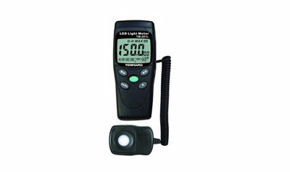
Il n'existe pas de distance universelle. Comme point de départ pour un projecteur de 15W (800 lm) dans un plafond à 3,5 m illuminant un tableau avec le centre à 1,3 m de hauteur : distance horizontale du mur 1,2–1,5 m, angle de pointage 30°–35° depuis la verticale. Le positionnement définitif requiert vérification photométrique sur place avec luxmètre calibré et approbation du conservateur responsable des œuvres en exposition.
Quelle température de couleur utilise-t-on dans les musées ?
2700–3000 K pour peinture ancienne et collections classiques, 3000–3500 K pour peinture du XIXe siècle et Impressionnisme, 3500–4000 K pour art moderne et contemporain et photographie couleurs. Systèmes tunable white (2200–6500 K) pour expositions temporaires et espaces multifonctions.
Combien d'UV est admissible dans l'éclairage pour musées ?
Seuil standard CIE/IES/Bizot : ≤ 75 μW/lm. Meilleures pratiques et nouvelles installations : ≤ 10 μW/lm. Les LED museum-grade Ledpoint atteignent <1 μW/lm sans filtres additionnels d'aucun type.
Qui conçoit l'éclairage dans un musée ?
Un éclairagiste (lighting designer) spécialisé en architecture culturelle, en collaboration avec architecte, conservateur et conservateur-restaurateur. Parcours de formation italiens : Politecnico di Milano, Politecnico di Torino, cours AIDI. Associations professionnelles : AIDI, IALD, PLDA.
Qu'est-ce qu'un projet d'éclairage pour un musée ?
Le document technique complet qui spécifie le système : simulations photométriques (DIALux/Relux), nomenclatures matérielles, plans avec positions et angles, schémas électriques, architecture du système de contrôle, calculs budget lux-heures, documentation CRI/UV/sécurité photobiologique, calculs conformité énergétique, procès-verbaux de réception photométrique sur place.
Comment éclaire-t-on un tableau dans un musée ?
Avec un projecteur à 30°–35° depuis la verticale (plus oblique pour surfaces empâtées, plus raide pour surfaces lisses), positionné de manière que le reflet spéculaire du vernis tombe en dessous du niveau des yeux des visiteurs. Pour tableaux >1,5 m de largeur utiliser deux ou plusieurs projecteurs symétriques. Angle de faisceau : 24°–50° en fonction du format. Éclairement cible : 100–150 lux pour huile, 30–50 lux pour aquarelles et tempera.
Comment éclaire-t-on les fresques ?
Lumière rasante à bas angle pour surfaces planes (révèle texture et coups de pinceau), wash diffus depuis sources en faux-plafond pour surfaces courbes, accentuation pour éléments spécifiques. Aucune source ponctuelle rapprochée générant des gradients thermiques sur l'enduit, surtout en présence de sels solubles.
Que sont les standards muséaux ?
Les standards muséaux italiens sont les critères technico-scientifiques établis par le Ministère de la Culture pour la reconnaissance et l'accréditation des musées. Ils comprennent des standards relatifs à l'environnement physique (température, humidité, éclairage), à la catalogation, à la sécurité, à l'accessibilité et aux services au public. Pour l'éclairage ils renvoient à CIE 157, EN 12464-1 et aux lignes directrices MiC.
Que sont les réseaux muséaux et les pôles muséaux régionaux ?
Les réseaux muséaux sont des systèmes de coordination entre plusieurs instituts d'un territoire qui partagent services, ressources et objectifs de valorisation. Les pôles muséaux régionaux sont des structures du MiC gérant le patrimoine étatique sur base régionale, coordonnant musées, zones archéologiques et monuments de compétence étatique dans chaque région italienne. Pertinents aux fins de l'éclairage car les politiques d'intervention sur les installations sont souvent coordonnées au niveau de pôle.
Qu'est-ce que l'éclairage circadien ?
L'éclairage circadien (human-centric lighting) est la conception de systèmes d'éclairage artificiel supportant le rythme circadien naturel des personnes, principalement en délivrant une illuminance mélanopique adéquate durant les heures de travail diurnes et réduisant le contenu de lumière bleue en soirée. Dans les musées il est plus pertinent pour les zones de travail du personnel et pour les parcours de visite ; les contraintes conservatoires dans les zones d'exposition limitent l'applicabilité directe aux luminaires sur les œuvres.
Quelles sont les professions muséales ?
Selon la Charte Nationale des Professions Muséales (ICOM Italie) : direction et gestion, curation et recherche (conservateur, conservateur-restaurateur, restaurateur) ; communication et éducation, services au public, sécurité et surveillance, gestion des collections. L'éclairagiste muséal est une figure technique externe collaborant transversalement avec conservateurs et conservateurs-restaurateurs.
Quand naissent les premières institutions muséales ?
Les premières institutions muséales publiques naissent au XVIIIe siècle : le British Museum ouvre au public en 1759, le Capitole à Rome en 1734 est considéré le premier musée public moderne, le Louvre ouvre comme musée en 1793 durant la Révolution Française. En Italie, la Galerie des Offices est ouverte au public depuis 1769. La professionnalisation de l'éclairage muséal comme discipline scientifique est cependant phénomène de la seconde moitié du XXe siècle.
Éclairage muséal : richesse de conception et avant-garde
Le champ de l'éclairage muséal se trouve aujourd'hui à un moment de maturité technique et de richesse de conception extraordinaires. La révolution LED a définitivement résolu la tension historique entre efficacité énergétique et qualité conservatoire : les LED museum-grade atteignent Ra 97–98, UV pratiquement absent, IR négligeable et 50 000 heures de vie opérationnelle, avec consommations égales à 15–20% de la technologie halogène qu'elles remplacent. Les systèmes de contrôle intelligent ont transformé la gestion des doses de lumière d'une approximation imprécise à un processus monitoré avec précision et géré automatiquement, rendant concrètement praticable le respect des plus sévères standards Bizot et CIE 157 même dans les institutions avec ressources de personnel limitées.
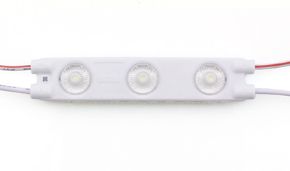
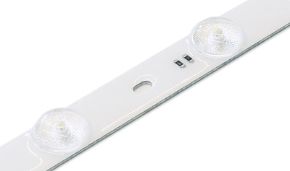
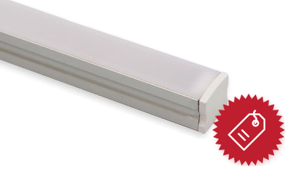
Les conseils pour les professionnels muséaux à considérer avant de commander des bandes LED sont :
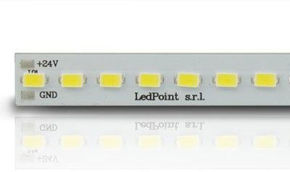
- le CRI est fondamental : spécifier Ra ≥ 95 et R9 ≥ 80 pour toutes les zones d'exposition. Ne rien accepter de moins, et toujours demander aussi les valeurs TM-30 (Rf, Rg) et la courbe SPD ;
- le contrôle UV n'est pas optionnel : spécifier ≤ 10 μW/lm pour les matériaux sensibles. Les LED museum-grade le garantissent nativement, sans filtres additionnels sujets à dégradation ;
- la température de couleur est une décision curatoriale : la choisir délibérément, ensemble à l'équipe de conservation et curation, pour chaque type de collection et contexte d'exposition. Ne pas laisser ce choix au fournisseur de l'installation électrique ;
- le budget lux-heures doit être monitoré : implémenter capteurs de présence et systèmes de monitoring des doses comme standard de projet, non comme optionnels. L'économie de dose sur les œuvres les plus sensibles est de l'ordre de 40–65% par rapport à installations non contrôlées ;
- la stabilité chromatique est critique : spécifier ≤ 3 SDCM de dérive au cours de la vie déclarée du luminaire. Refuser produits qui ne peuvent démontrer cette spécification avec documentation de laboratoire certifiée et accréditée ;
- Le projet d'éclairage est un document de conservation : le traiter comme partie intégrante et formelle du registre de conservation préventive, avec le même rigueur réservé au monitoring microclimatique de température et humidité relative.
Dans ce scénario d'excellence technique disponible actuellement sur le paysage de l'éclairage, le dernier kilomètre à parcourir est culturel et méthodologique. Intégrer le projet d'éclairage dans le registre de conservation préventive signifie élever la lumière à matière d'étude et de soin au pair du microclimat. Le véritable saut de qualité pour les musées ne sera donc pas se doter de la dernière bande LED, mais assimiler ces critères comme partie intégrante de leur propre langage curatorial. Seulement ainsi l'éclairage cessera d'être un simple implant technique pour devenir une pratique vivante de connaissance et médiation culturelle, capable de conjuguer l'avant-garde technologique avec la tutelle d'une richesse qui, par définition, doit durer pour toujours. Cet article a été élaboré avec le soutien de l'intelligence artificielle, puis relu, corrigé et validé par l'équipe technique de Ledpoint.it, ce qui garantit sa fiabilité et sa conformité aux sources officielles.