








Mean Well: why these power supplies are used in industrial settings
In the industrial sector, Mean Well power supplies are increasingly requested, as the power supply represents the beating heart of every system. From highway signage to pharmaceutical production lines, from hydroponic greenhouses to industrial ports, Mean Well—with over thirty years of experience in designing switching power supplies—stands as the preferred choice for major system integrators.
This is also because Mean Well offers diverse solutions adaptable to highly varied scenarios. Today, we will examine the differences among power supply series HLG, LRS, ELG, and NPF—including derating regimes, electromagnetic compatibility, dimming protocols, and mandatory certifications frequently required in public tenders.
Mean well: power supply series HLG, LPH, ELG, NPF
The primary selection criterion for a Mean Well power supply concerns the installation environment and required protection ratings.
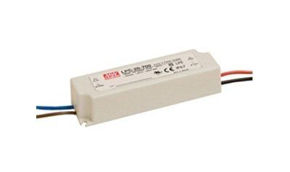
The LPH series represents the cost-effective indoor solution, featuring an IP20 rating and natural convection cooling. These units are widely used in electrical panels, machine automation, and optical benches. However, they are unsuitable for environments with significant temperature fluctuations.
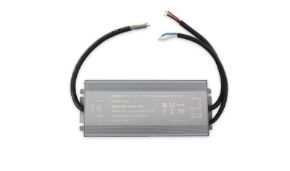
The HLG series introduces IP65/IP67 protection, double insulation, mechanical overload protection, and adjustable output via potentiometer or analog/PWM dimming. The HLG-H (High Power) sub-family also includes an integrated fan for power ratings up to 1500W.
The ELG series is optimized for outdoor street and industrial lighting, featuring enhanced protection against transients (6kV) and superior EMC robustness.
Finally, the NPF series is designed for compact LED projectors with an ultra-slim profile (thickness under 30mm) and IP67 rating.
Table 1 – Comparison of Main Mean Well power supply families for industrial use and professional lighting
| Technical parameter | LPH series | HLG series (-H) | ELG series | NPF series |
|---|---|---|---|---|
| Protection Rating | IP20 | IP65/IP67 | IP67 | IP67 |
| Nominal Power | 35W – 350W | 40W – 600W (1500W with fan) | 75W – 300W | 20W – 100W |
| Output Voltage | 12V, 24V, 36V, 48V | 12V, 15V, 20V, 24V, 30V, 36V, 42V, 48V, 54V | 12V, 24V, 36V, 48V, 54V | 12V, 24V, 36V, 48V |
| Integrated Dimming | No | Yes (1–10V, PWM, resistance) | Yes (1–10V, PWM, optional DALI) | Yes (PWM, DALI) |
| MTBF @ 25°C (hours) | 200,000 | 311,700 | 296,000 | 250,000 |
| Input/Output Isolation | 3kVAC | 3.75kVAC | 4kVAC | 3.75kVAC |
| Operating Temperature Range | -20°C ~ +70°C | -40°C ~ +70°C (with derating) | -40°C ~ +70°C | -40°C ~ +70°C |
| Key Certifications | CB, CE, UL, BSMI | UL/CUL, ENEC, CE, CCC, PSE, RCM | UL/CUL, ENEC, CE, CCC, RCM | UL, CE, ENEC, CCC |
Mean Well power supplies for outdoor environments: selection based on IP rating, surge protection, and thermal cycling
For outdoor installations, the critical parameters are enclosure protection rating and surge withstand capability. The EN 60529 standard defines IP67 as complete dust protection and temporary immersion resistance (1m for 30 minutes).
Climate chamber tests confirm that HLG and ELG series maintain full functionality after 500 hours of salt spray exposure. Therefore, for coastal installations or condensation-prone tunnels, we recommend the ELG-150-24 with enhanced 6kV surge protection.
In environments with extreme thermal swings (e.g., alpine shelters), the HLG series—with startup capability down to -40°C—represents the safest choice. Note: models with the "A" suffix include dimming functionality and ±10% output voltage adjustment.
Nominal power calculation
We have previously discussed the importance of calculating the required power for a system, but reinforcing this concept remains vital to prevent irreversible damage.
Correct load determination accounts for 70% of long-term reliability. The standard formula is: P_supply = (P_total_load / η_wiring) × 1.20, where the 1.20 factor provides a safety margin to avoid continuous operation at maximum capacity.
For 24V LED strips, measure actual current draw with a clamp meter (including inrush current).
Practical example: 190W load on a line with 3% voltage drop → Corrected power = 190 / 0.97 ≈ 196W; multiplied by 1.20 = 235W. Select a Mean Well 24V power supply rated at 240W.
We strongly advise against using consumer-grade 12V transformers for continuous industrial loads: their ripple and load regulation parameters are incomparable.
PWM dimming in mean well power supplies
Over the years, Mean Well has implemented three distinct dimming methods:
1) Analog 1–10V
2) PWM (10V signal)
3) Adjustable resistance regulation
HLG models (suffix B, AB) and ELG support all three methods. During testing, we confirmed full compatibility with DALI controllers from multiple brands, provided an active DALI-to-1–10V converter is used.
Mean Well PWM dimming typically operates between 300Hz and 1kHz. For video applications (flicker-free requirement), set frequency >1kHz or use newer HLG models with "flicker-free" functionality. Correct polarity is essential: dimming failure is often caused by reversed DIM+ and DIM- signals.
Certifications for industrial use: regulatory framework
Beyond CE marking (self-declaration), Mean Well power supplies intended for heavy industry and critical infrastructure carry third-party product certifications, including:
ENEC (European safety mark based on ENEC 30303 standards)
UL 8750 (LED lighting equipment safety)
UL 60950-1 (information technology equipment, often required in automation)
CAN/CSA-C22.2 for the North American market.
For ATEX zones, Mean Well does not offer intrinsically safe certified versions, but HLG units can be housed in Ex-e enclosures. Technical datasheets list UL and ENEC recognition numbers; verify them with accredited bodies during detailed design phases.
Connecting power supplies to led strips: voltage drop analysis
A common systematic error involves connection topology. Constant voltage (CV) power supplies like LRS, HLG, and ELG deliver stabilized voltage. For LED strips exceeding 5 meters, a star (parallel) architecture is mandatory. Conductor sizing must ensure voltage drop remains below 4%.
For a 24V supply: use 1.5mm² cable up to 10m at 8A load; beyond that, use 2.5mm². HLG output terminals accept up to 4mm². For loads >300W, distribute across multiple Mean Well 24V units in separate zones. Series connection is strictly discouraged with switching power supplies, as active load compensation is unsupported.
Operational lifespan of Mean Well power supplies
Mean Well publishes MTBF (Mean Time Between Failures) values calculated per the MIL-HDBK-217F predictive method. For the HLG-240H-24, this is 311,700 hours at 25°C and 80% load—translating to an annual failure rate below 0.5% under ideal conditions.
However, actual service life depends on electrolytic capacitors. Mean Well uses Japanese components (Rubycon, Nippon Chemi-Con) with a nominal lifespan of 10,000 hours at 105°C.
Applying the Arrhenius equation, every 10°C reduction doubles expected life. Thus, at 50°C environments, derate to 70% load and consider HLG models with conformal coating (suffix "D2") where feasible.
Table 2 – Estimated service life by ambient temperature
| Series | Load | Ambient temp 30°C | Ambient temp 50°C | Ambient temp 60°C |
|---|---|---|---|---|
| LRS-150-24 | 80% | 82,000 h | 44,000 h | 22,000 h |
| HLG-240H-24A | 80% | >95,000 h | 53,000 h | 31,000 h |
| ELG-200-24 | 80% | 88,000 h | 48,000 h | 27,000 h |
| NPF-90-24 | 75% | 79,000 h | 42,000 h | 20,000 h |
Series and parallel connections: constraints
Connecting multiple Mean Well power supplies in parallel to increase total current is permissible only for models with current sharing capability (e.g., RSP, PSP, SE series).
HLG, LRS, and ELG series are not designed for direct parallel operation: minor voltage differences cause current imbalance.
For redundancy setups, use external ORing modules (e.g., Mean Well DRDN20) to isolate a failed unit.
Series connection (e.g., 24V + 24V = 48V) is discouraged and may compromise isolation. Only consider in exceptional cases with floating-output models (HLG, ELG) and blocking diodes—but protection features will be lost.
Integrated protections in Mean Well power supplies
All Mean Well power supplies include:
OVP (Over Voltage Protection) – typically latching or auto-recovery;
OCP (Over Current Protection) with automatic reset;
SCP (Short Circuit Protection);
OTP (Over Temperature Protection).
In HLG and ELG models, OTP triggers gradual power reduction (thermal derating) before shutdown. During stress testing, an HLG-600H at 110% load and 55°C reduced output current to 70% while maintaining integrity—critical for 24/7 installations.
Constant voltage vs. constant current: key differences
When selecting a power supply, a frequent question arises: "Should I choose constant voltage or constant current?" Clarity matters—it’s not just technical specs, but understanding what connects downstream.
For LED strips, panels, or projectors with built-in drivers (or inputs designed for stable voltage), a constant voltage (CV) supply is required. It functions like a wall outlet: delivering fixed 12V, 24V, or 48V while the load determines current draw. This is the most common scenario—covered by HLG, LRS, and ELG CV-series units.
However, bare LED modules, high-power arrays, or single chips without onboard drivers require constant current (CC). Here, CC supplies (LDD, LCM, or ELG "-C" variants) deliver fixed current (e.g., 350mA, 700mA, 1050mA) while voltage auto-adjusts to the load. This direct approach is essential for driving high-power LEDs without intermediaries.
Mean Well simplifies selection with dual-mode models like the HLG-60H-C, which operate in both CV and CC modes. Configuration depends entirely on the connected load.
Always verify the load first: check the strip label, projector datasheet, or consult the manufacturer. "24V DC input" indicates constant voltage; "350mA" or "constant current" requires a CC supply.
Reliability in continuous 24/7 operation
Industrial applications requiring uninterrupted operation (data centers, control rooms, surveillance systems) demand power supplies built for longevity. Mean Well addresses this with RST and HRP series (up to 5000W), while properly derated HLG units also ensure >60,000 hours of continuous service.
Key practices: passive cooling, output voltage set to 95% of nominal rating, and protection against micro-power interruptions.
Operating temperatures and derating curves
Datasheets are essential—they specify operational temperature limits. A Mean Well HLG-240H delivers 100% power up to 50°C, then linearly derates to 70% at 70°C. Conversely, an LRS-100-24 begins derating at 40°C.
For enclosed panels, mount the unit in the lower section and add auxiliary forced ventilation if needed.
Thermal management for high-density Mean Well power supplies
HLG units above 350W use variable-speed fans. We recommend a predictive maintenance plan with biannual inspections and filter cleaning where applicable.
IP67 certified Mean Well series
For humid environments (tunnels, parking structures, greenhouses, ports), recommended series include: HLG (IP67), ELG (IP67), OWA (IP67), DLP (IP67), NPF (IP67).
Key differences lie in power-to-size ratio and dimming capabilities.
ELG is predominant in municipal street lighting; HLG suits general industrial applications; NPF excels in compact fixture integration.
All IP67 models feature pre-wired cables with connectors or gland entries (standard length: 30–50 cm).
Datasheet reading: critical parameters
While Mean Well datasheets contain dozens of specs, focus on:
1) CV/CC operating zone (for dual-mode models);
2) Derating curve vs. temperature;
3) Efficiency at various loads;
4) Ripple & noise (typically <1% in quality units; budget models may show higher peaks);
5) Isolation voltage;
6) Pollution degree rating;
7) Overvoltage category (OVC II or OVC III).
For sensitive loads, "start-up time" and "hold-up time" matter—Mean Well units typically exceed 6ms.
ELG, HLG, NPF: in-depth comparison for real-world scenarios
Beyond tabulated data, field experience shows the ELG series features a more robust EMI front-end, with common-mode filters reducing conducted emissions by ~15% versus HLG.
The NPF series stands out for its minimal thickness (25mm), ideal for recessed luminaires.
The HLG series offers maximum flexibility with wide output voltage ranges (e.g., adjustable 12–24V). For retrofitting legacy 12V systems, the IP67-rated HLG-40H-12 has delivered excellent results.
External heat sinks: when are they necessary?
Additional heat sinks are rarely needed—HLG and LRS metal enclosures act as integrated heat sinks. However, in sustained high-ambient conditions (~65°C) at 100% load, industrial practice includes mounting an auxiliary aluminum plate with thermal coupling. Ensure convective airflow paths remain unobstructed.
Energy efficiency: measurements and classifications
Mean Well switching power supply efficiency ranges from 85% to 95%, depending on model and load. Precision wattmeter measurements show the HLG-320H-24 achieves 94.5% efficiency at 230Vac and 80% load—dissipating only 18W for 320W output. Compared to traditional transformers (70–80% efficiency), energy savings significantly reduce total cost of ownership (TCO). Many models also comply with ErP Stage 2 and Level VI (CoC) energy regulations.
Accessories for industrial installations: when the power supply alone isn't enough
Industry professionals know the power supply is the system's heart—but critical accessories are often overlooked during design:
Redundancy modules: for non-stop environments (security systems, operating rooms, data centers, production lines), 1+1 redundant configurations allow seamless takeover if one unit fails.
EMC filters: switching supplies generate high-frequency noise that can disrupt nearby sensors, DAQ systems, or audio equipment. In industrial settings with motors, inverters, or welders, external line filters clean power delivery and prevent elusive intermittent faults—especially vital near measurement instrumentation or during stringent EMC compliance testing.
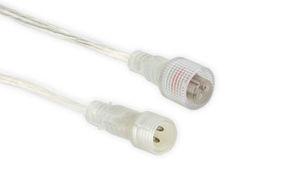
Waterproof connectors: while IP67 units (HLG, ELG) include pre-wired cables (0.75mm² or 1mm²), field conditions may require larger conductors or routing through congested conduits. Using genuine Mean Well connectors avoids cable cutting and heat-shrink repairs—critical in humid or dusty environments. For DIN-rail mounting of LRS units inside panels, dedicated mounting plates convert screw-mount units to tool-free snap-in components.
Dimming resistors: stabilize dimming inputs for units operated at full brightness.
Thermal enclosures and auxiliary heat sinks: aftermarket solutions isolate power supplies from extreme ambient heat (e.g., foundries).
Mean Well and industry 4.0: remote control and diagnostics
Modern industry demands more than power delivery—units must communicate with supervision systems, report faults, and warn before failure. Mean Well addresses this through:
Fault signaling: select HLG and ELG models feature relay outputs or transistor contacts that trigger during protection events or shutdowns—providing immediate PLC/SCADA alerts without dispatching technicians.
Integrated DALI interface: eliminates external converters. These units communicate directly with building automation systems, enabling not only dimming but also operational data retrieval (runtime hours, internal temperature, cycle count).
UHP series: engineered for heavy industry, featuring PMBus or CANbus protocols for centralized monitoring, remote adjustment, and alarm management of dozens of units within a single cabinet.
Common mistakes to avoid (even with Mean Well power supplies!)
Based on years of technical support and field feedback, recurring errors include:
1 – Installing an IP20 unit outdoors: dust, moisture, and site chaos lead to premature failure. Always specify an IP67 power supply from the start. Saving €20 risks €100 in replacement costs plus labor.
2 – Ignoring voltage drop: a 100W, 24V LED strip on a 25m run with 0.75mm² cable may receive only 21.5V—causing yellowish output mistakenly blamed on poor LEDs. Solution: use 1.5mm² beyond 10m; 2.5mm² beyond 20m. For long runs, consider 48V systems to halve current and minimize drop.
3 – Incorrect dimming potentiometer: using a 10kΩ pot with an HLG unit expecting 100kΩ causes unstable or non-functional dimming. Always consult the datasheet for correct component values or prefer active 1–10V signals.
4 – Mounting near heat sources: placing a supply above a rectifier or hot contactor accelerates capacitor aging. Just 10cm of clearance and airflow can double service life.
5 – Overlooking residual current protection: EMI filters in switching supplies generate ground leakage currents. Multiple units on one RCD may cause nuisance tripping. Solution: use 300mA RCDs or segregate circuits.
These may seem minor, but awareness prevents costly diagnostics and downtime.
Why choose Mean Well despite the higher initial cost?
Our catalog includes many quality power supply brands—all rigorously tested before selection. Yet in demanding environments (extreme temperatures, critical uptime requirements), Mean Well consistently emerges as our top recommendation.
While Mean Well units carry a modest price premium, they deliver superior value in hard-to-access installations where maintenance, downtime, and replacement costs dominate lifecycle expenses.
Engineered for endurance under extreme conditions—like large-scale industrial plants—this is why we detail their capabilities today, without diminishing alternatives.