















RGB LED, RGBW and tunable white: which LED strip to choose?
Navigating the world of LED lighting can seem like a real challenge: faced with terms like RGB, RGBW, tunable white, CCT, CRI, it's easy to get confused, and the wrong choice can compromise the entire project. Choosing the wrong technology can result in environments with dull colors, unwanted color casts, or an installation that needs to be dismantled and redone at double the cost.
With this guide, our goal is to provide the tools to select the technology best suited to specific needs with full awareness. We will explore the electronic architecture of printed circuits, differences in LED chips (SMD 2835, 5050, 2110), microprocessor control logic, and the most complex photometric implications such as emission spectrum, light beam homogeneity, and color rendering on different surfaces. We will accompany you on a journey that starts from semiconductor physics and goes straight to the heart of your next lighting project.
RGB LED, RGBW and tunable white: beyond color
The choice between an RGB LED strip, an RGBW LED strip, and a tunable white (or Dimmable White) strip is not just an aesthetic matter, but a true design decision that transversely impacts the perceived atmosphere, the functionality of spaces, and the overall energy efficiency of an environment. We are not simply deciding whether to illuminate in red or blue: we are defining the luminous identity of a project. A conscious choice can enhance materials and architectures, while a choice dictated only by price or trends risks translating into disappointing results and hidden costs.
It is often thought that illuminating with more colors automatically means illuminating better, in an outlook of "more functions = more value," but the technical reality is much more nuanced. The integration of a dedicated white chip in an RGBW LED strip or the total specialization in color temperature in a tunable white strip are not simple market upgrades, but respond to profoundly different design needs. On one hand, we have the color rendering of objects (CRI), a scientific parameter that measures how faithfully a light source reproduces the real colors of a fabric, furnishing, or work of art. On the other, we have the ability to create complex architectural scenographies, where light becomes a design material and the possibility of alternating functional whites with saturated colors opens up unprecedented expressive scenarios. It is not a battle between "good" and "bad," but between "suitable" and "unsuitable."
Fundamentals of photometry and colorimetry for LEDs and RGB LEDs
Before comparing technologies, it is crucial to take a step back and thoroughly understand the objective parameters with which we measure light. It is not just about turning on a color or achieving a pleasant atmosphere to the naked eye, but about entering the concept of light quality understood as a measurable physical quantity.
Two parameters are fundamental in this context: Color Temperature (CCT - Correlated Color Temperature) and the Color Rendering Index (CRI - Color Rendering Index). CCT, measured in Kelvin (K), defines the perceived tone of white, along a range that goes from warm and enveloping (2700K-3000K, typical of incandescent bulbs) to neutral and natural (4000K-4500K, ideal for offices and commercial spaces) up to cool and stimulating (5000K-6500K, which simulates daylight). But be careful: color temperature says nothing about the quality of that light; it only defines its hue. This is where the second parameter comes into play.
The CRI (Color Rendering Index) is perhaps the most misunderstood and underestimated parameter, yet it is the one that makes the difference between light that merely illuminates and light that enhances. The CRI measures, on a scale from 0 to 100, the ability of a light source to faithfully reproduce the colors of illuminated objects compared to a reference source (sunlight or an incandescent lamp). A low CRI means that colors are distorted, flattened, or altered: a red fabric may appear orange or dull, human skin may take on cadaverous or yellowish tones, a fruit may look artificial. The CRI scale is composed of 15 sample colors (R1-R15), and the most critical values are often R9 (saturated red) and R13 (skin tone), which budget sources sacrifice first.
Professional-quality LED strips, especially those dimmable white and tunable white designed for critical applications, boast very high CRIs, generally above 90 and often exceeding 95 or even 98. These values are essential in contexts where faithful color perception is an integral part of the experience or business: think of a clothing store where the customer must see the true color of the garment they are buying, an automotive showroom where the car's paint must shine in its original hue, a photography or videography studio where the light must be neutral and faithful to avoid correcting every shot in post-production, or a museum where works of art must be illuminated without altering the original chromatics intended by the artist. Light with a low CRI (often below 80, typical of budget RGB strips) brutally distorts perception, making colors appear dull, washed out, or unnatural, and nullifying every design and furnishing effort.
This is the first great dividing line, the fork from which the paths of different technologies diverge: budget RGB strips, designed for scenic effects and entertainment, almost systematically sacrifice CRI (and often stable CCT as well) to achieve saturated colors and contained costs. Their chips are optimized for color purity, not for white rendering or color fidelity. Conversely, professional-quality Tunable White strips place CRI first in the design phase, using selected chips and phosphors to guarantee a continuous and balanced spectrum at every point of the color temperature range. It is a philosophical difference before even a technical one: on one side, spectacle; on the other, fidelity.
Finally, there is the concept of luminous efficacy, measured in lumens per watt (lm/W). This parameter indicates how much light (luminous flux) we can obtain for each watt of electrical energy consumed. For the same declared consumption, a Tunable White strip generally produces more lumens than an RGBW strip when both are set to produce white light. The reason is strictly physical: the Tunable White strip uses LED chips specifically designed to emit high-efficiency white light, with optimized phosphor layers. The RGBW strip, on the other hand, when it needs to produce white, can use the dedicated chip (and in that case, efficiency is good) or, if the white were obtained by mixing RGB (an operation not recommended but sometimes used), it would waste energy because it would have to combine three chips to obtain a low-quality white with lower lumen/watt output.
RGB LED: the additive synthesis of colors
RGB technology represents the historical and technical foundation of colored LED light. Its operating principle is rooted in additive synthesis, the same mechanism that governs the operation of a monitor or TV. In practice, by combining the light from the three LED chips dedicated to the primary colors – red, green, and blue – in varying proportions, a wide color gamut can be obtained that covers a good part of the visible spectrum, technically including white. But it is precisely on the definition and quality of this white that lies the deepest and often misunderstood structural limitation of this technology.
To fully understand the problem, we need to understand the functioning of semiconductors well. When an RGB LED strip needs to produce white light, it simultaneously turns on the three chips at their respective nominal intensities. The result is light that to the human eye, with its physiological limits, may superficially appear white, but which in reality is the algebraic sum of three peaks of extremely narrow and distinct wavelengths: a peak in red (typically around 620-630nm), one in green (520-530nm), and one in blue (450-460nm). This means that the emission spectrum is not continuous like that of a natural white light source (the sun) or an incandescent lamp, but is a line spectrum with large "gaps" of luminous energy in the intermediate zones (cyan, yellow-orange, purple). This is where the limitations of the RGB LED strip are encountered.
First limitation: color rendering (CRI) is intrinsically low. Since the luminous spectrum is not continuous, the colors of illuminated objects that fall into those spectral shadow zones are not correctly reproduced. For example, illuminating a pale yellow fabric or an orange surface with an RGB light in white mode: those colors will not receive sufficient luminous energy to be reflected correctly, and will appear dull, dirty, or tending toward the primary colors present. The CRI of an RGB LED white typically falls between values of 50 and 70, completely unacceptable for any context requiring minimal visual fidelity.
Second limitation: the difficulty of obtaining a balanced and stable white. To obtain a neutral white from the RGB mix, extremely precise balancing of the intensities of the three chips is necessary. This balancing is influenced by a thousand variables: operating temperature (LEDs change emission with heat), component aging (red, green, and blue chips degrade at different speeds), and production tolerances. The practical result is that RGB LED white tends to shift toward undesired color casts (a dull pink if red prevails, a washed-out blue if blue prevails, a sickly green if green prevails) and requires continuous adjustments. Furthermore, luminous efficacy is reduced: to produce what should be white light, we are powering three chips simultaneously, consuming three times the energy compared to a single dedicated white chip, but obtaining a fraction of the real brightness (lumens) and inferior quality.
Let us now delve into the electronic architecture, because this is where the battle for versatility is fought. In a standard RGB LED strip, the heart of the system is the controller that manages three separate and independent channels. Voltage and current are modulated through the PWM (Pulse Width Modulation) technique, i.e., by turning the chips on and off thousands of times per second with pulses of variable duration to create the illusion of the desired intensity. This three-way control system is relatively simple and economical, and it is precisely this simplicity that makes the RGB strip the ideal tool for certain application contexts.
What are these contexts? The RGB strip excels where color is the absolute protagonist and the quality of white light is entirely irrelevant. We are talking about entertainment and scenic effect applications: disco parties, concerts, temporary events, Christmas decorations, lighting trees and gardens for events. Another prime area is accent lighting on neutral or artificially colored surfaces: think of plasterboard false ceilings, niches housing design objects, illuminated bed headboards, or backlighting for TVs and gaming desks. In these cases, colored light creates atmosphere, emphasizes volumes and geometries, but it does not need to illuminate in the functional sense of the term: it does not need to allow you to read, work, or see the colors of a painting or a garment faithfully. The surface it illuminates (often the white of a wall or the glass of a shelf) is itself a neutral element that reflects the pure color. This is where RGB gives its best, offering a vast and saturated color palette at a contained cost.
RGBW LED: one more chip compared to RGB LED
The logical evolution of RGB was the addition of a dedicated white chip. An RGBW LED strip contains, in each cuttable segment, four distinct chips: red, green, blue, and white. This seemingly simple addition revolutionizes the product's capabilities, solving the problem of false white and opening up new mixing possibilities.
The presence of the dedicated white chip means that when white is selected, only that chip turns on. The result is a pure white, with a fixed color temperature (usually 4000K or 6000K, depending on the model) and, above all, with a much higher CRI compared to white obtained from the RGB mix. This makes RGBW strips suitable for environments where white light is necessary for specific tasks (reading, working) but color flexibility is desired for atmosphere.
From an electronic point of view, an RGBW strip requires a 4-channel controller. Management complexity increases, but it also offers finer control. One can, for example, mix white with colors to obtain pastels and saturated tones, or use white to increase the overall brightness of a scene. It is the ideal choice for those who want everything in one, but with a compromise on white quality compared to a specialized strip.
RGB vs RGBW LED strip
To understand the difference at the hardware and performance level, let's analyze the data.
| Characteristic | RGB LED strip | RGBW LED strip |
|---|---|---|
| Chip configuration | RGB (3-in-1 or 3 separate chips) | RGB + W (4 separate chips) |
| White quality | Low (mixed, low CRI) | High (dedicated chip, high CRI) |
| White brightness | Low (sum of 3 chips) | Very high (dedicated high-efficiency chip) |
| Number of channels | 3 (Requires RGB controller) | 4 (Requires RGBW controller) |
| Ideal applications | Effects, entertainment, backlighting | Residential, commercial lighting, scenographies with functional white |
Table 1: differences between RGB and RGBW technology.
Tunable white (dimmable and variable white)
If RGBW is a "jack-of-all-trades," tunable white is a specialist. This technology, also known as dimmable white or CCT (Correlated Color Temperature) adjustable, uses two types of white chips on the same strip: a series of LEDs with warm temperature (e.g., 2700K) and a series with cool temperature (e.g., 6500K). By varying the relative intensity between the two, the light can be "tuned" to any intermediate color temperature.
This is the technology chosen by architects and lighting designers for its ability to adapt to human circadian rhythms (warm light in the evening, cool and activating light in the morning). In a tunable white strip, the CRI is always very high (often >95), because these are high-quality white chips. There is no spurious color component. It is the perfect solution for those seeking maximum quality and flexibility in white light, without any interest in RGB colors.
The architecture is similar to that of RGB, but with two channels (warm and cool). It requires a specific controller for tunable white. Often integrated with home automation systems such as DALI or KNX, it allows the creation of dynamic lighting scenes that follow the time of day, improving people's well-being and productivity.
Dimmable white vs RGBW: the decisive comparison
This is perhaps the most common crossroads in professional choice. On one side, total versatility (RGBW); on the other, specialization in white light quality (tunable white). Let's analyze it point by point.
| Characteristic | RGBW LED strip | Tunable white (dimmable white) |
|---|---|---|
| Luminous spectrum | Discontinuous (R, G, B peaks) + white | Continuous and full (high quality) |
| Color quality (CRI) | Medium/high (only on W channel) | Very high (across the entire white spectrum) |
| Color gamut | Thousands of colors + fixed white | Shades of white (from 2700K to 6500K) |
| Luminous efficacy | Lower (RGB chips consume but do not illuminate in white) | Maximum (all energy is converted into white light) |
| Applications | Versatile environments (home, fashion stores, bars) | Offices, medical studios, art galleries, kitchens, architectural lighting |
Table 2: technical choice between color versatility and white specialization.
Which type of colored LED strip is better? It depends on the project
If the project involves lighting a plasterboard false ceiling in a minimalist living room, the answer is almost certainly tunable white. The atmosphere can be adjusted from the warm, relaxing light of the evening to the more vivid light of the day, and objects in the room (furniture, paintings) will be illuminated with maximum fidelity. If you are setting up a venue with changing scenography, a fashion store where showcases change color depending on the collection, or a children's room where you want to play with tones, then RGBW is the obligatory choice, thanks to its flexibility.
Guide to choosing in specific environments
Here is how to orient yourself in different home and professional environments.
Residential lighting: living room and bedroom
In these environments, the priority is visual well-being and atmosphere. We advise against using pure RGB as main lighting. For a niche or bookshelf, tunable white with CRI >90 is ideal for enhancing objects and books. In the bedroom, the ability to switch from warm, relaxing light (2700K) before sleep to more neutral light (4000K) for getting dressed in the morning makes dimmable white LED strips a superior ergonomic choice. RGBW can find space in bed headboards or small niches as emotional accent lighting if that extra possibility is desired.
Commercial environments: stores and showrooms
Here the stakes are high: light must sell. In a store of clothing, the ability to alternate natural white light (4000K) for normal display and colored light for events or thematic showcases makes RGBW LED an extremely flexible choice. However, for spot lighting on premium garments, nothing beats a track with tunable white with CRI 95+, which makes the true colors of fabrics stand out. In a jewelry store, RGBW can be used to create atmosphere, but the light on the jewelry must be absolutely high quality, so again Tunable White or fixed high-CRI white.
The role of control systems
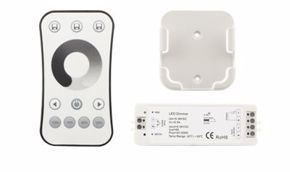
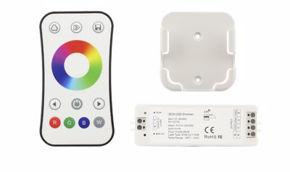
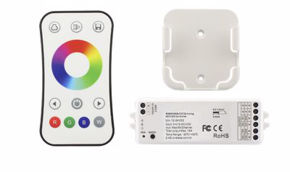
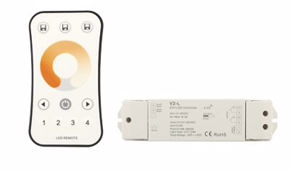
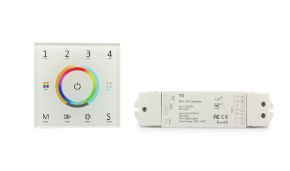
Choosing the strip is only half the job: to fully exploit the potential of RGB vs RGBW LED strips or tunable white, a good control system is indispensable. From simple IR remote controls to complex DMX processors and WiFi/Zigbee bridges for home automation, the controller must be up to the level of the chips. An installation with high-quality Tunable White strips but controlled by a cheap, rudimentary dimmer would nullify the efforts, not allowing smooth, flicker-free transitions.
Decoding the datasheet: voltage, power and density
The choice of voltage (12V or 24V) is fundamental for voltage drop over long distances. 24V strips are generally preferable for runs longer than 5 meters, as they suffer less from luminous decay. Power (Watts per meter) determines maximum brightness. A 14.4W/m RGBW strip will be much less bright than a 24W/m one.
LED density (LEDs/m) influences light linearity. To have a homogeneous beam without hot spots, especially in strips visible indirectly (e.g., behind a wall profile), densities of 120 LEDs/m or higher (double density) are recommended. A low-density strip will show the classic dotted effect on the illuminated surface.
Finally, the LED beam angle. To illuminate a surface, LEDs with a 120° angle are used. For backlighting effects or to illuminate very narrow profiles, LEDs with a narrower angle (60°) can be used. All these parameters interact with the choice of technology (RGB, RGBW, tunable white) and must be considered as a whole.
Summary and professional advice
After dissecting every technical detail, the message that must remain impressed is that there is no universally superior technology. There is the technology most suitable for your specific project. The following table summarizes the macro use cases.
| Application scenario | Recommended technology | Technical rationale |
|---|---|---|
| Scenic effects, parties, bars | RGB LED | Maximum color variety at minimum cost. |
| Homes, functional and atmospheric lighting with color options | RGBW LED | Total flexibility: quality white for daily use and colors for leisure. |
| Offices, studios, kitchens, bedrooms, work environments | Tunable white (dimmable white) | Maximum color rendering, respect for circadian rhythms, and purity of white light. |
Table 3: final summary for LED technology selection.
RGBW LED: choosing color consciously
As we have seen, there is no universally better technology, but only the one most suitable for a specific project and your idea of light. RGB LED is the ally for dynamic scenographies, saturated chromatic effects, and pure entertainment, where color is the protagonist and functional white is not required. RGBW LED represents the ideal compromise for those who do not want to give up anything, offering color flexibility and the dignity of a clean, bright white thanks to the dedicated chip. Tunable white (dimmable white) is the choice of purists, architects, and those who place the quality of white light, color fidelity, and visual well-being above all other considerations, with the possibility of modulating color temperature in harmony with the natural rhythms of the environment and the people who inhabit it.
Light is not just a functional accessory: it is the invisible material with which we sculpt spaces, define atmospheres, enhance materials, and influence our emotions. Choosing the right LED strip means taking care of this precious material, investing in a technology that does not just illuminate, but communicates, transforms, and enriches every environment. It means avoiding disappointments, hidden costs, and the need to dismantle and redo an installation unsuited to real needs.