








5V LEDs: Applications and Length Limits
In the universe of solid-state lighting, 5V LEDs occupy a particularly unique position: they stand at the crossroads between the world of consumer electronics, with the possibility of a USB port connector, and that of professional lighting design, where precision in electrical parameters makes the difference between a perfect installation and a problematic one. Understanding in depth the operation, potential, and limitations of LEDs powered at 5 volts is fundamental for anyone working with modern LED lighting, from the hobbyist maker to the electronic engineer, from the interior designer to the professional electrician.
The growing adoption of USB standards as a universal power source has radically transformed the landscape of 5V LED strips: today it is possible to power ambient lighting directly from a television, a smartphone charger, a power bank, or a computer, eliminating the need for dedicated transformers for small-scale applications. At the same time, advances in intelligent LED chips, such as the WS2812B, have made 5V LED strips with Arduino and other microcontrollers an extremely popular solution for interactive lighting projects, artistic displays, and IoT applications.
In this in-depth technical guide, we will explore every aspect of 5V LEDs: from basic physics to selecting the correct power supply, from calculating resistors to the length limits of strips, from comparing supply voltages to the most innovative professional applications. 5V LEDs operate in a voltage range compatible with USB power (4.75V – 5.25V), require current-limiting resistors when used individually, and in integrated LED strips manage current autonomously via pre-mounted resistors or driver ICs. The maximum length manageable with single-point power supply is approximately 3-5 meters for standard strips and up to 10 meters with multiple current injection.
What is a 5V LED?
Before delving into the practical applications of 5V LED strips, it is essential to build a solid understanding of the physical principles governing the operation of these devices. A 5V LED is not a component with a fixed 5-volt characteristic: it is a light-emitting diode that, to function correctly with a 5-volt power supply, requires a current-limiting element, typically a resistor, or is integrated into a circuit that autonomously manages its power supply.
The LED diode
A LED (Light Emitting Diode) is a semiconductor device that emits light through electroluminescence: when an electric current passes through the p-n junction of the semiconductor in forward bias, electrons recombine with holes, releasing energy in the form of photons. The wavelength, and therefore the color, of the emitted light depends on the energy difference between the conduction and valence band levels, which is in turn determined by the composition of the semiconductor material.
Materials and colors of common LEDs
| Color | Semiconductor material | Forward voltage (Vf) | Wavelength | Typical current (If) |
|---|---|---|---|---|
| Red | AlGaAs, GaAsP | 1.8 – 2.2 V | 620 – 750 nm | 20 mA |
| Orange | GaAsP, AlGaInP | 2.0 – 2.2 V | 590 – 620 nm | 20 mA |
| Yellow | GaAsP, AlGaInP | 2.0 – 2.4 V | 565 – 590 nm | 20 mA |
| Green (standard) | GaP, AlGaInP | 2.0 – 2.5 V | 520 – 565 nm | 20 mA |
| Green (pure) | InGaN | 2.9 – 3.4 V | 505 – 520 nm | 20 mA |
| Blue | InGaN, GaN | 3.0 – 3.5 V | 450 – 500 nm | 20 mA |
| White (warm) | InGaN + yellow phosphors | 2.9 – 3.5 V | 2700 – 3200 K | 20 – 30 mA |
| White (cool) | InGaN + phosphors | 3.0 – 3.6 V | 5000 – 6500 K | 20 – 30 mA |
| UV | InGaN, AlGaN | 3.1 – 4.0 V | 355 – 420 nm | 20 mA |
| IR (infrared) | GaAs, AlGaAs | 1.2 – 1.8 V | 800 – 1000 nm | 20 – 100 mA |
As can be seen from the table, no LED has a native operating voltage of exactly 5V. When we talk about 5V LEDs, we mean an LED or LED system designed to be powered by a 5-volt source, with the necessary management of the difference between the supply voltage and the component's forward voltage.
V-I characteristics of an LED: why voltage alone is not enough
One of the most important, and often misunderstood, characteristics of LEDs is their current-voltage characteristic curve (I-V curve). Unlike an ohmic resistor, an LED is not a linear device: its dynamic resistance varies enormously with the applied voltage. Below the forward voltage threshold (Vf), the LED is practically open (does not conduct); just above the threshold, the current increases exponentially with small voltage variations.
This behavior has two fundamental practical implications:
1. you cannot power an LED directly with a constant voltage without a current-limiting element, unless you use a constant-current driver. A small overvoltage would cause an exponential increase in current, resulting in overheating and burning out the LED within milliseconds;
2. the brightness of an LED is proportional to the current flowing through it, not to the applied voltage. To control brightness efficiently, PWM (Pulse Width Modulation) technique is used, or the current is varied with a dedicated driver.
Types of 5V LEDs: classification and usage
There are several categories of 5V LEDs available on the market, with distinct characteristics and applications:
Single LEDs (through-hole and SMD)
Through-hole 5mm and 3mm LEDs are classic discrete components, used in prototypes, indicator panels, and DIY installations. SMD (Surface Mount Device) LEDs such as 0402, 0603, 0805, 1206, 3528, 5050 are mounted on PCBs and require a resistor calculated based on the specific Vf of the component.
5V LED modules
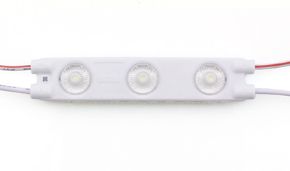
5V LED modules are small PCBs with one or more LEDs already equipped with an integrated current-limiting resistor, designed to be connected directly to a 5V source without additional calculations. They are widely used in Arduino and Raspberry Pi applications.
5V LED strips (5V LED strip lights)
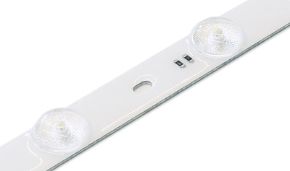
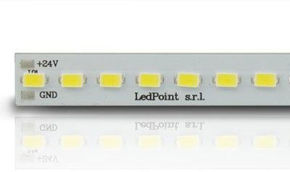
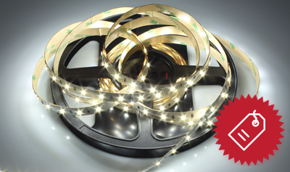
5V LED strips are flexible tapes with SMD LEDs mounted on a flexible PCB, equipped with integrated current-limiting resistors. Each cuttable segment contains one or more LEDs with the corresponding resistor, already calibrated for 5V. The main types include monochrome (warm white, cool white, colors), RGB, RGBW, and intelligent LEDs with integrated IC (WS2812B, SK6812).
5V RGB LEDs with integrated IC
Intelligent 5V RGB LEDs such as the WS2812B integrate within the LED package itself a driver IC that manages the current of each channel (R, G, B) via a single-wire serial communication protocol. This makes them ideal for installations with individual control of each LED.
Voltage, current, and power in LEDs: the complete guide to volts
Among the most frequently asked questions by those approaching the world of LEDs are always how many volts are needed to turn on an LED and what voltage do LEDs have. The answer, as we have begun to see, is not trivial and requires an understanding of the relationship between voltage, current, and power in semiconductor devices. In this section, we will systematically analyze all the electrical aspects of LEDs, with particular attention to 5-volt applications.
The forward voltage: how many volts to turn on an LED
The voltage required to turn on an LED depends exclusively on the type of semiconductor and the color of the LED. This voltage is called the forward voltage or threshold voltage (Vf, forward voltage). Below this threshold, the LED does not emit light (or emits a negligible amount); above it, the current grows rapidly.
For a 5-volt power supply, all common LED colors can be powered, since forward voltages range from 1.8V (red) to a maximum of 3.6V (cool white), always lower than 5V. The difference between 5V and the LED's Vf must be "absorbed" by the current-limiting resistor, which converts this excess into heat.
Nominal current: how much current for an LED
The nominal current of a standard LED is typically 20 mA (0.02 A) for signal and indicator LEDs. High-brightness LEDs and power LEDs may require currents from 50 mA up to several amperes per single device. LED strips typically use 20 mA LEDs (standard strips) or 60 mA per LED (high-density and high-brightness strips).
LED power: what does a 5-watt LED correspond to?
The power of an LED is calculated with the simple formula P = V × I. A standard 20 mA LED with a Vf of 3V dissipates P = 3V × 0.02A = 0.06 W, i.e., 60 milliwatts. When talking about 5W LEDs, we refer to the power dissipated by the component, not its supply voltage.
Equivalences between LEDs and traditional lamps for brightness
| LED power | Approx. luminous flux | Incandescent equivalent | Halogen equivalent | Notes |
|---|---|---|---|---|
| 1W LED | 80 – 100 lm | 10 W | 10 W | Indicator/spot LED |
| 3W LED | 250 – 300 lm | 25 – 30 W | 25 W | Standard power LED |
| 5W LED | 400 – 500 lm | 40 – 50 W | 40 W | Domestic light bulb |
| 7W LED | 600 – 700 lm | 60 – 65 W | 55 W | E27 60W replacement |
| 9W LED | 800 – 900 lm | 75 – 80 W | 70 W | High brightness |
| 10W LED | 900 – 1100 lm | 80 – 100 W | 80 W | Power LED |
| 18W LED | 1600 – 1800 lm | 150 W | 130 W | Industrial lighting |
It is important to clarify that "5-watt LED" and "5-volt LED" are completely different concepts. A 5W LED indicates the absorbed power, a 5V LED indicates the supply voltage. A 5V LED strip can have a total power from a few watts to several tens of watts, depending on its length and density.
Voltage table for LEDs: complete guide
The following table constitutes a practical reference guide for the voltage values of the main types of LEDs available on the market:
| LED type | Vf min (V) | Typical Vf (V) | Vf max (V) | Nominal If (mA) | Powerable at 5V? | Resistor at 5V (ohm) |
|---|---|---|---|---|---|---|
| Standard red | 1.6 | 1.9 | 2.2 | 20 | Yes | 150 Ω |
| Orange | 1.8 | 2.1 | 2.4 | 20 | Yes | 130 Ω |
| Yellow | 1.8 | 2.1 | 2.4 | 20 | Yes | 130 Ω |
| Green | 1.9 | 2.2 | 2.6 | 20 | Yes | 130 Ω |
| Pure green | 2.8 | 3.2 | 3.6 | 20 | Yes | 90 Ω |
| Blue | 2.8 | 3.3 | 3.6 | 20 | Yes | 85 Ω |
| Warm white | 2.7 | 3.0 | 3.4 | 20 | Yes | 100 Ω |
| Neutral white | 2.9 | 3.2 | 3.6 | 20 | Yes | 90 Ω |
| Cool white | 3.0 | 3.4 | 3.8 | 20 | Yes* | 80 Ω |
| UV 365-380nm | 3.2 | 3.6 | 4.0 | 20 | Tight margin | 70 Ω |
| IR LED 850nm | 1.2 | 1.5 | 1.8 | 50 | Yes | 70 Ω |
| 1W power LED | 2.8 | 3.4 | 3.8 | 350 | With driver | CC driver |
*For cool white LEDs with Vf up to 3.8V, the available difference for the resistor is only 1.2V, which with 20mA gives R = 60 Ω — it works but with reduced margins. It is recommended to use the typical Vf=3.4V value in calculations.
How to measure LED voltage with a multimeter
Measuring the forward voltage of an LED with a multimeter is a simple operation but requires attention to polarity and measurement range; let's see how to proceed.
Method 1 — Diode test mode: most modern multimeters have a "diode test" function (diode symbol). In this mode, the instrument applies a small test current and displays the forward voltage drop. Connect the red probe (positive) to the LED anode and the black probe (negative) to the cathode: the display will show the Vf in volts (e.g., 1.89 for a red LED). The LED will light up weakly during the test.
Method 2 — Test circuit: build a simple circuit with a known power supply (e.g., 9V battery), a 470Ω resistor, and the LED. Measure the voltage across the LED with the multimeter in DC Volt mode. The reading is the Vf of the LED under real operating conditions.
How to identify anode and cathode: in through-hole LEDs, the longer terminal is the anode (+), the inside of the LED shows a flat part (the flat side of the dome corresponds to the cathode). In SMD LEDs, the cathode is marked with a line or triangle on the package.
Resistor for 5V LED: calculation, formulas, and practical tables
Calculating the resistor for 5V LED is a fundamental skill for anyone working with single LEDs or custom assemblies. Without the correct current-limiting resistor, an LED connected to 5V, especially with low forward voltages like red (Vf ≈ 1.9V), would be subjected to excessive current that would cause its rapid deterioration or immediate destruction. This section provides all the tools to calculate the right resistor in any practical scenario.
Ohm's law applied to LEDs: basic formula
The formula for calculating the 5V LED resistor is derived directly from Ohm's law applied to the LED-resistor series circuit:
This is the fundamental formula. Let's see some practical examples:
Example 1: red LED, 5V supply, 20mA current
Example 2: white LED, 5V supply, 20mA current
Example 3: blue LED, 5V supply, 10mA current (low brightness)
Complete table of resistors for 5V LEDs
The following table reports the calculated resistor values for the most common combinations of LED color and operating current with 5-volt power supply:
| LED color | Typical Vf (V) | If = 5 mA (Ω) | If = 10 mA (Ω) | If = 15 mA (Ω) | If = 20 mA (Ω) | If = 30 mA (Ω) | Recommended E12 value (20mA) |
|---|---|---|---|---|---|---|---|
| Red | 1.9 | 620 | 310 | 207 | 155 | 103 | 150 Ω |
| Orange | 2.1 | 580 | 290 | 193 | 145 | 97 | 150 Ω |
| Yellow | 2.1 | 580 | 290 | 193 | 145 | 97 | 150 Ω |
| Green | 2.2 | 560 | 280 | 187 | 140 | 93 | 120 Ω |
| Pure green | 3.2 | 360 | 180 | 120 | 90 | 60 | 100 Ω |
| Blue | 3.3 | 340 | 170 | 113 | 85 | 57 | 82 Ω |
| Warm white | 3.0 | 400 | 200 | 133 | 100 | 67 | 100 Ω |
| Cool white | 3.4 | 320 | 160 | 107 | 80 | 53 | 82 Ω |
| UV | 3.6 | 280 | 140 | 93 | 70 | 47 | 68 Ω |
Resistors for parallel LEDs at 5V
When connecting multiple LEDs in parallel with a single common resistor, care must be taken: since LEDs have slightly different V-I characteristics even of the same type, the current does not distribute evenly. Professional practice recommends an individual resistor for each LED, especially in high-reliability applications.
If parallel LEDs with a common resistor must be used:
LEDs in series: the more efficient alternative at 5V
Connecting LEDs in series reduces the number of resistors needed, but requires that the sum of forward voltages does not exceed the supply voltage. With 5V, it is possible to connect in series a maximum of 2 red/yellow/orange LEDs (Vf ≈ 2V each = 4V total, with 1V for the resistor):
For white and blue LEDs in series, higher voltages are required (12V or 24V), where it is possible to connect 3 or more in series.
Power dissipated in resistors: thermal safety
An often overlooked aspect is the power that the resistor must dissipate. Standard 1/4W (250mW) resistors are adequate for the vast majority of applications with single 5V LEDs at 20mA. However, when using higher currents or low-value resistors, calculating the power becomes critical:
As a rule of thumb, the chosen resistor must have a nominal power rating at least double the calculated power to ensure reliability and long life.
5V LED strips: types, density, and technical characteristics
5V LED strips represent the most versatile and widespread form of low-voltage LED lighting. These are flexible PCB tapes (generally 8, 10, or 12 mm wide) on which SMD LEDs are soldered at regular intervals, together with the necessary current-limiting resistors. Their compatibility with USB power has made them extremely popular in domestic, automotive, maker, and professional environments. Let's analyze in detail the main types available on the market.
SMD LEDs used in 5V strips: package comparison
The brightness, consumption, and optical characteristics of an LED strip depend decisively on the type of SMD LED used:
| LED package | Dimensions (mm) | Available colors | Power per LED | Luminous flux/LED | Typical use | Notes |
|---|---|---|---|---|---|---|
| SMD 2835 | 2.8 × 3.5 | White, colors | 0.06 – 0.2 W | 15 – 40 lm | Lighting, backlight | Good lm/W ratio |
| SMD 3528 | 3.5 × 2.8 | White, colors, RGB | 0.06 W | 6 – 8 lm | Decoration, accent | Classic, low power |
| SMD 5050 | 5.0 × 5.0 | RGB, RGBW, white | 0.15 – 0.25 W | 18 – 22 lm | Lighting, RGB | 3 chips per package |
| SMD 5630/5730 | 5.6 × 3.0 | White | 0.5 W | 50 – 70 lm | High brightness | Requires heat dissipation |
| WS2812B | 5.0 × 5.0 | Programmable RGB | 0.3 W (max) | ~20 lm | Arduino, IoT, displays | Integrated IC |
| SK6812 | 5.0 × 5.0 | Programmable RGBW | 0.3 W (max) | ~25 lm | Arduino, IoT | Extra white channel |
| APA102 | 5.0 × 5.0 | Programmable RGB | 0.3 W (max) | ~20 lm | High update frequency | SPI, anti-flickering |
LED density: 30, 60, 144 LEDs per meter
The LED density per meter is one of the most important parameters when choosing a 5V LED strip. It determines brightness, consumption, and the granularity of light distribution.
| Density (LEDs/m) | Pitch (mm) | Consumption (W/m) at 5V | Current (A/m) | Relative brightness | Typical application |
|---|---|---|---|---|---|
| 30 LEDs/m | 33.3 mm | 3 – 4.5 W | 0.6 – 0.9 A | Low | Accent, light signs |
| 60 LEDs/m | 16.7 mm | 6 – 9 W | 1.2 – 1.8 A | Medium | Ambient lighting |
| 96 LEDs/m | 10.4 mm | 10 – 14 W | 2.0 – 2.8 A | Medium-high | TV backlight |
| 144 LEDs/m | 6.9 mm | 14 – 20 W | 2.8 – 4.0 A | High | Displays, video walls |
Important note on USB consumption: a standard USB 2.0 port delivers a maximum of 500mA. This means that with USB 2.0 power, it is possible to power a maximum of 0.5 – 0.8 meters of 60 LED/m strip. For longer lengths, a dedicated USB power supply (USB charger) with 2A or higher capacity is required.
IP classification: 5V LED strips for humid environments
For installations in humid environments, outdoors, or in places subject to water contact, it is essential to choose LED strips with adequate IP protection rating:
| IP rating | Description | Water protection | Typical application | Notes for 5V |
|---|---|---|---|---|
| IP20 | Unprotected | None | Dry indoor | Standard, maximum brightness |
| IP44 | Water droplets | Splashes from any direction | Bathroom (areas away from shower) | Partial silicone coating |
| IP65 | Splash resistant | Water jets from any angle | Covered outdoor, bathroom zone 1 | Complete silicone coating |
| IP67 | Temporary immersion | Immersion up to 1m for 30min | Fountains, pools (edge) | Closed silicone tube |
| IP68 | Permanent immersion | Continuous immersion beyond 1m | Underwater, pools | Sealed silicone tube |
Color temperatures in 5V LED strips
For interior designers and lighting professionals, the color temperature of 5V LED strips is a critical parameter:
5V LED strips are available in all standard color temperatures: 2700K (warm white, amber tone, ideal for relaxation areas and living rooms), 3000K (neutral warm white, ideal for kitchens and bathrooms), 4000K (neutral white, ideal for offices and work environments), 5000K (daylight white, excellent for laboratories and work areas), 6000-6500K (cool white, maximum visual clarity). RGBW strips allow dynamic variation of color temperature by mixing the white channel with the RGB channels.
5V WS2812B LED strip and Arduino: integration and intelligent control
The combination of 5V LED strip with Arduino WS2812B represents one of the most widespread intelligent lighting systems in the maker world, electronic hobby, and increasingly in professional architectural lighting installations. The WS2812B, also known as "NeoPixel" thanks to the library developed by Adafruit, has revolutionized the way RGB lighting systems are designed, bringing the complexity of electronics to a level manageable by anyone with basic programming skills.
WS2812B architecture: how the intelligent LED works
The WS2812B is an RGB LED with an integrated driver IC in the 5050 package. Internally it contains three LEDs (red, green, blue) and a digital controller that receives data via a single-wire serial protocol. The main characteristics are:
| Parameter | WS2812B value | Notes |
|---|---|---|
| Supply voltage | 4.5 – 5.5 V | Nominal 5V |
| Max current per LED | 60 mA (20mA per channel) | All 3 channels at maximum |
| Color resolution | 8 bits per channel (R, G, B) | 16.7 million colors |
| Data protocol | NRZ single-wire 800kHz | Single data wire |
| Cascading | Unlimited (in theory) | Practical limits: timing and current |
| Package dimensions | 5 × 5 mm | Standard SMD |
| Operating temperature | -25°C to +80°C | IC thermal resistance |
| Full power consumption | 60 mA per LED | Pure white = all channels 100% |
Current calculation for WS2812B strips: sizing guide
Correct power supply sizing is critical with WS2812B strips. Calculating the maximum required current is simple but essential to avoid problems:
Practical note: In real use, it is rare to drive all WS2812B LEDs to 100% brightness on all channels simultaneously. For ambient lighting applications, typical operation is at 30-60% of maximum brightness, which proportionally reduces consumption. However, the power supply must always be sized for the maximum theoretical peak current, not the average usage current.
Arduino – WS2812B connection: wiring diagram
The physical connection between Arduino and a WS2812B strip requires few components but must follow precise guidelines:
Required components
A 1000µF / 6.3V (or higher) capacitor connected between VCC and GND of the power supply (filters current spikes at startup); a 300-500Ω resistor on the data wire between Arduino and the strip (protects the IC from signal ringing and reflections); a dedicated external 5V power supply for the strip (do not power long strips directly from Arduino's 5V pin).
Wiring diagram
Critical warning
Arduino UNO's 5V pin is connected to the internal regulator that can deliver a maximum of 500mA. Never connect the strip directly to this pin for more than 10-15 WS2812B LEDs. For longer strips, always use a dedicated external power supply, connecting only the GND in common with Arduino.
FastLED and NeoPixel libraries: practical guide
There are two most-used Arduino libraries for controlling WS2812B strips:
FastLED (recommended for advanced projects): optimized for speed and functionality, supports numerous types of programmable LEDs (WS2812B, SK6812, APA102, WS2801, etc.), offers mathematical functions for color gradients, gamma correction, and advanced brightness management. It is the reference choice for professional installations and complex projects.
Adafruit NeoPixel: simpler, ideal for beginners and simple projects. Mainly supports WS2812B and variants. Excellent documentation and wide community support.
5V RGB LED strip: colors, temperature, and decorative applications
The 5V RGB LED strip is the most versatile and popular decorative lighting solution for domestic, commercial, and architectural applications. The ability to generate any color of the visible spectrum by mixing the three primary color channels—red, green, and blue—opens practically unlimited possibilities for personalizing the luminous atmosphere of any space. In this section, we explore in depth the technical characteristics, control possibilities, and practical applications of 5-volt RGB LED strips.
How a 5V RGB LED strip works
In a traditional 5V RGB LED strip (non-addressable), each SMD 5050 LED contains three separate emitter chips: one red, one green, and one blue. These three chips share a common cathode (or, in some models, common anode), while each has its own anode (or cathode) for control. The resulting color is determined by the ratio between the intensities of the three channels, typically controlled via PWM.
5V RGB LEDs in standard strips (non-digital) have all LEDs connected in parallel per channel: all reds together, all greens together, all blues together. This means that color can be varied but not pixel-per-pixel effects. For this reason, standard RGB strips have 4 connection wires: one common (+5V or GND) and three for the R, G, B channels.
RGB controllers for 5V LED strips: available options
Controlling 5V RGB LED strips requires a controller that manages PWM switching of the three channels. Let's look at the options.
| Controller type | Characteristics | Pros | Cons | Application |
|---|---|---|---|---|
| IR controller | Infrared remote, 44-key or 24-key | Economical, simple | Line-of-sight, no automation | Simple home use |
| RF controller (radio) | 2.4GHz radio remote | Greater range, no line-of-sight | No automation | Environments where IR doesn't work |
| WiFi controller | Smartphone app, Alexa/Google compatible | Smart home, automation, timers | Requires WiFi network | Smart home, daily use |
| Bluetooth controller | Smartphone app, ~10m range | Simple, no network required | Limited range | Personal use, bedroom |
| DMX512 controller | Professional theater/event protocol | Professional, total precision | Cost, complexity | Professional installations |
| Arduino / MCU | Custom programming | Maximum flexibility | Requires programming | Makers, prototypes, installations |
Colors and color temperatures: guide for designers
For interior designers, understanding the color possibilities of 5V RGB LEDs is essential for creating effective atmospheres. The RGB system can theoretically generate 16.7 million colors (256³), but in practice, the quality of white generated by pure RGB is inferior to that of a dedicated white LED, with lower color rendering (CRI).
RGBW strips, with the fourth dedicated white channel, solve this problem, allowing both RGB color flexibility and native white light quality. Available in RGBWW (warm white, 2700-3000K) and RGBNW (neutral white, 4000K) variants, RGBW strips are the excellence choice for interior design installations where both color and white light quality are required.
5V USB LED strip: connection, limits, and complete practical guide
The 5V USB LED strip (or USB 5V LED strip) represents perhaps the most accessible and immediate form of customizable LED lighting: connectable directly to the USB port of a television, computer, charger, or power bank, without the need for any dedicated transformer. However, the simplicity of connection hides a series of technical limitations that are essential to understand in order to choose and use this type of strip correctly. We will delve into every aspect to ensure safe, efficient, and durable installations.
USB standards and their current delivery capabilities
Not all USB ports are equal in terms of deliverable current. Before connecting a 5V USB LED strip, it is essential to verify the specifications of the USB source.
| USB standard | Voltage (V) | Max current (A) | Max power (W) | Supported strip length (60 LED/m) |
|---|---|---|---|---|
| USB 1.1 (low power) | 5 | 0.1 | 0.5 | ~5 cm (5 LEDs) |
| USB 2.0 (standard) | 5 | 0.5 | 2.5 | ~25 cm (15 LEDs) |
| USB 3.0/3.1 Gen 1 | 5 | 0.9 | 4.5 | ~45 cm (27 LEDs) |
| USB BC 1.2 (Battery Charging) | 5 | 1.5 | 7.5 | ~80 cm (48 LEDs) |
| Standard USB charger | 5 | 1 – 2 | 5 – 10 | ~50 cm – 1 m |
| Fast USB charger 5V/3A | 5 | 3 | 15 | ~1.5 m |
| Power bank (standard) | 5 | 1 – 2.4 | 5 – 12 | ~60 cm – 1.2 m |
| USB-C PD (5V profile) | 5 | up to 3 | 15 | ~1.5 m |
Connecting an LED strip that requires more current than available from the USB port causes a drop in supply voltage, overheating of the USB cable, and in worst cases can permanently damage the device's USB port or cause sudden shutdowns. Always verify the strip's consumption before connecting it.
How to choose and connect a USB LED strip: step-by-step guide
To correctly connect a 5V USB LED strip, it is necessary to follow the next simple 4 steps.
Step 1 — Determine strip consumption: the required current is calculated as number of LEDs × current per LED. For example, a standard pre-wired 50 cm USB strip with 30 SMD 3528 LEDs consumes approximately 30 × 20mA = 600mA. Always verify manufacturer data.
Step 2 — Verify the USB source: check the label of the USB power supply or the specifications of the device port (computer, TV, USB hub). Ensure that the available current is at least 20-30% higher than the strip's consumption.
Step 3 — Verify USB cable quality: a low-quality USB cable may have high internal resistance, causing significant voltage drop. For strips with consumption near the limit, use quality USB cables with 28AWG conductors for data and 24AWG for power.
Step 4 — Connection and testing: connect the strip to the USB source, verify that all LEDs light up uniformly. A drop in brightness toward the end of the strip indicates excessive voltage drop and suggests the need for current injection from the opposite end.
USB TV LED strips: Bias Lighting illumination
One of the most widespread applications of 5V LED light strips USB is the so-called bias lighting or TV backlighting: an LED strip positioned on the back of the television that reduces the perceived contrast between the bright screen and the dark wall, reducing eye strain during prolonged viewing and improving contrast perception.
For this application, the television's USB port is the ideal power source: the strip turns on automatically with the television and turns off when it is turned off. The typical length needed for a 55" television is approximately 2.5-3 meters, so it is necessary to verify that the television's USB port delivers at least 1A (many recent televisions deliver 500mA-1A from the USB port).
For more sophisticated solutions with synchronization of the strip color with on-screen content, there are kits like Ambilight-clones that use 5V WS2812B strips controlled by a Raspberry Pi or Arduino with dedicated software (Hyperion, Prismatik, etc.).
USB desk and reading LED strips
Beyond TV use, 5V USB LED strips find very wide application in:
Flexible desk lighting: small strips with gooseneck or clip, powered by computer or power bank, for localized illumination of keyboard, work document, or model under construction.
Keyboard backlighting: thin 8mm strips positioned behind gaming or work keyboards.
IKEA furniture and bookshelf lighting: USB ports of smart hubs or bedside chargers easily power 1-2 meters of strip to illuminate shelves and compartments.
Smart bedside lamps: USB WS2812B strips controlled via Bluetooth to simulate sunrise (sunrise alarm), program color sequences, or integrate your application.
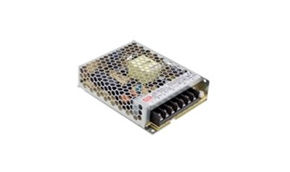
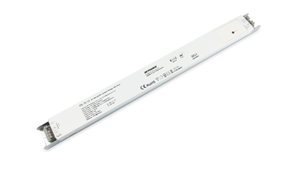
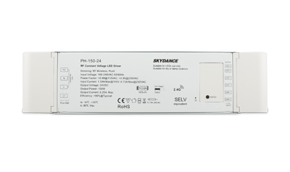
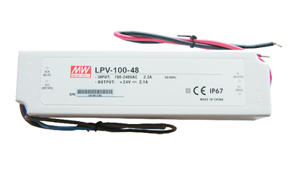
5V LED power supply: how to choose and size it correctly
The choice of the correct 5V LED power supply is probably the single most important factor in ensuring reliable, safe, and long-lasting operation of a 5-volt LED strip installation. An undersized power supply causes malfunctions, overheating, and permanent damage to the strips; a poor-quality power supply can introduce noise, flicker, and instability in the power supply. In this section, we will provide a complete and professional guide to the selection and sizing of 5V LED power supplies.
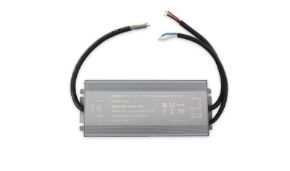
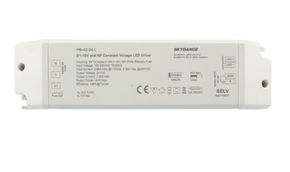
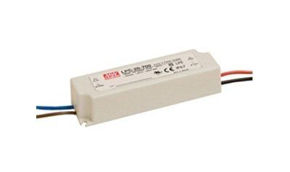
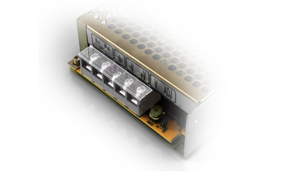
Types of 5V LED power supplies
There are several types of 5V LED power supplies on the market, each with characteristics suitable for different usage contexts:
| Type | Typical power | Application | Efficiency | Characteristics |
|---|---|---|---|---|
| USB power supply (charger) | 5W – 65W | USB strips, small projects | 85 – 90% | Compact, plug-and-play |
| DIN rail switching power supply | 15W – 480W | Fixed installations, electrical panels | 88 – 93% | Professional, for panels |
| Open frame switching power supply | 10W – 300W | Panels, displays, custom installations | 86 – 91% | PCB or chassis mounting |
| Desktop switching power supply | 15W – 150W | General use, laboratory, DIY | 85 – 90% | AC cable + DC output with terminals |
| USB-C PD power supply | 18W – 100W | Modern devices, USB-C strips | 88 – 93% | Multi-profile (5V, 9V, 12V, 20V) |
| 5V Power bank | 10Wh – 100Wh (energy) | Portable installations, events | Varies | Variable autonomy |
How to choose a 5V LED power supply: professional procedure
Correct sizing of a 5V LED strip power supply follows a precise procedure that every professional must know.
Step 1 — Calculate total strip consumption
Step 2 — Apply safety margin (80% rule)
Step 3 — Verify output voltage and regulation
A good LED power supply must have output voltage regulation within ±2% under variable load. The voltage must not drop below 4.75V even at maximum load, to avoid malfunctions of WS2812B LEDs that require at least 4.5V.
Step 4 — Verify ripple and noise
Voltage ripple (residual oscillation of DC output voltage) must be less than 50mV (or 100mV for less critical applications). High ripple causes flicker in LED strips, visible especially with high-speed cameras or in video, and can cause communication problems in WS2812B strips.
Additional features of quality LED power supplies
A professional 5V LED power supply must incorporate certain protections and features; let's discover which ones.
Overcurrent protection (OCP): automatically limits current in case of short circuit, protecting both the power supply and the LEDs.
Overvoltage protection (OVP): shuts off output if voltage exceeds a safety threshold (typically 5.8-6V).
Thermal protection (OTP): reduces power or shuts off output in case of power supply overheating.
Wide-range AC input: compatibility with 100-240V AC, 50-60Hz, for international use.
Safety certifications: CE, RoHS, and for professional applications also TÜV or UL.
Length limits of 5V LED strips: voltage drops and solutions
One of the most critical and often underestimated technical aspects in installations with 5V LED strips is the problem of voltage drop along the power cable and along the strip itself. Due to the electrical resistance of the copper conductors in the LED tape, the voltage available to the LEDs farthest from the power source is lower than that to the LEDs closest, causing a visible decrease in brightness and, in extreme cases, the failure of the most distant sections.
This phenomenon is particularly critical at 5V, much more so than at 12V or 24V, for fundamental physical reasons that we will analyze in detail.
Why voltage drop is more critical at 5V
Voltage drop on a conductor follows Ohm's law: ΔV = R_cable × I. The cable resistance is determined by its resistivity (typically 0.017 Ω·mm²/m for copper), its length, and its cross-sectional area.
For the same transmitted power, a lower voltage requires a higher current (P = V × I → I = P/V). At 5V, the current is higher than at 12V or 24V, and therefore a greater absolute voltage drop. But even more important is the percentage voltage drop: at 5V, a drop of 0.5V represents 10% of the nominal voltage; at 12V the same drop is only 4.2%; at 24V it is barely 2%.
WS2812B LEDs require a minimum voltage of 4.5V to function correctly. This means that with nominal 5V, there is only 0.5V of "budget" for total voltage drop from the generator to the last LED, a very tight margin compared to the 2-3V available at 12V and 4-5V at 24V.
Calculating voltage drop in a 5V LED strip
The resistance of copper in standard LED strips is approximately:
| Strip type | Copper section (AWG) | Resistance (Ω/m) | Per 1m total (A+R) (Ω) |
|---|---|---|---|
| Standard 8mm strip | ~28 AWG (0.08 mm²) | ~0.22 Ω/m per conductor | ~0.44 Ω/m |
| Standard 10mm strip | ~26 AWG (0.13 mm²) | ~0.13 Ω/m per conductor | ~0.26 Ω/m |
| Heavy duty 12mm strip | ~24 AWG (0.20 mm²) | ~0.085 Ω/m per conductor | ~0.17 Ω/m |
Practical maximum lengths with 5V power supply
The following table indicates the recommended maximum lengths for 5V LED strips with single-point power supply, maintaining a voltage drop of less than 5% (0.25V).
| Strip type | Consumption (W/m) | Current (A/m) | Max length 1 point (m) | Max length with injection (m) |
|---|---|---|---|---|
| WS2812B 30 LED/m (10% brightness) | ~0.9 | 0.18 | ~3 | ~10 |
| WS2812B 60 LED/m (10% brightness) | ~1.8 | 0.36 | ~2 | ~8 |
| SMD 3528 30 LED/m | ~3 | 0.6 | ~1.5 | ~6 |
| SMD 5050 60 LED/m | ~9 | 1.8 | ~0.8 | ~4 |
| SMD 2835 60 LED/m high brightness | ~12 | 2.4 | ~0.5 | ~3 |
Technical solutions to overcome length limits
There are several professional strategies for managing 5V LED strip installations over lengths exceeding the theoretical limit; let's look at them.
1. Multiple current injection (Power Injection): connect the power supply not only at the beginning of the strip but also every 1-2 meters along the strip itself (or at the opposite end). The additional power cables must connect to the + and – pads of the strip PCB, bypassing the cumulative resistance of the tape. This is the standard solution for WS2812B installations longer than 2-3 meters.
2. Use of separate power cables of adequate gauge: bring the 5V power with large-section cables (e.g., 1.5mm² or 2.5mm²) to the injection point, reducing voltage drop in the power cable.
3. Supply voltage slightly higher than 5V: setting the power supply to 5.1-5.2V can partially compensate for voltage drop, but must be done with caution to not exceed the maximum LED voltage (typically 5.5V for WS2812B).
4. Switch to 12V strips for long installations: for installations over 5 meters where multi-point power distribution is inconvenient, consider 12V strips that tolerate much longer lengths with a single power point.
5V vs 12V LED strips: complete technical comparison
The comparison between 5V vs 12V LED strips is one of the most debated topics among those approaching the world of LED strips, and the answer, as often happens in electronics, is: it depends on the application. There is no absolute winner between the two voltages: each has advantages and disadvantages that make it more suitable for specific use contexts. In this section, we will provide an objective and complete technical analysis to help you make the right choice.
Comparison table 5V vs 12V vs 24V
| Characteristic | 5V LED strips | 12V LED strips | 24V LED strips |
|---|---|---|---|
| USB compatibility | ✅ Direct (USB port) | ❌ Requires dedicated power supply | ❌ Requires dedicated power supply |
| Arduino/RPi compatibility | ✅ Native | ⚠️ Requires level shifter | ⚠️ Requires level shifter |
| Addressable LEDs (WS2812B) | ✅ Standard 5V | ❌ Not available (WS2815 at 12V) | ❌ Not available |
| Max length (1 point) | ⚠️ 1-3 m (low brightness) | ✅ 5-10 m | ✅ 10-20 m |
| Voltage drop | ⚠️ Critical | ✅ Manageable | ✅ Minimal |
| Electrical safety | ✅ SELV (extra-low safe voltage) | ✅ SELV | ✅ SELV |
| Energy efficiency | ⚠️ Average (higher resistive losses) | ✅ Good | ✅ Excellent |
| Minimum LED section size | Variable | 3 LEDs/segment typical | 6 LEDs/segment typical |
| Cutting flexibility | ✅ Every LED (WS2812B) or every 3 (standard) | ⚠️ Every 3-6 LEDs (every 50mm-100mm) | ⚠️ Every 6 LEDs (every 100mm) |
| System costs | ⚠️ More expensive power supply/cables for lengths | ✅ Economical for medium installations | ✅ Optimal for long installations |
| Typical applications | USB, Arduino, TV environments, displays | Domestic lighting, furniture | Commercial, architectural, long runs |
When to choose 5V
5V LED strips are the optimal choice in the following scenarios: when the available power source is a USB port (televisions, computers, chargers), when integrating with Arduino, ESP32, Raspberry Pi, or other microcontrollers that operate at 5V; when using addressable WS2812B LEDs for dynamic and interactive lighting, for short-length installations (less than 2-3 meters with a single power point), for portable applications powered by battery/power bank.
When to choose 12V
12V LED strips are preferable when installing over lengths from 3 to 10 meters with a single power point; in permanent residential installations where a 220V→12V transformer is available, for furniture and kitchen backlighting where length is variable; when maximum installation simplicity is desired without managing multi-point power distribution.
When to choose 24V
24V strips are the professional solution for large-length architectural installations (over 10 meters per section); in commercial environments where energy efficiency and maintenance simplicity are priorities; for outdoor installations with long connection cables.
How to convert a 12V LED strip to 5V
Other very frequent questions, especially among makers and hobbyists, are about how to convert a 12V LED strip to 5V or, conversely, how to use a 12V strip with 5V power. These scenarios typically arise when you already have a 12V LED strip and want to power it from a 5V USB source, or when you want to connect an LED strip to a 5V microcontroller that cannot provide 12V. We will analyze the available technical options with their pros and cons.
Boost converter 5V → 12V: the correct solution
The technically correct solution to power a 12V LED strip from a 5V source is to use a boost converter (DC-DC step-up voltage converter). This integrated circuit converts the input voltage (5V) to a higher output voltage (12V) while maintaining good efficiency (typically 85-92%).
Ready-to-use boost converters are easily available as laboratory modules (e.g., MT3608, XL6009, LM2577) and are ideal for testing and prototyping. For permanent installations, quality modules with integrated protections (OCP, OVP, soft start) are preferred.
Why not power a 12V strip directly at 5V
Directly powering a 12V strip with only 5V would cause: a drastic drop in brightness (LEDs would be powered at a voltage well below the correct threshold), uneven current distribution among LEDs in the segment (in a 3-LED series segment, each receives approximately 5/3 ≈ 1.7V — insufficient to turn on), in blue and white LEDs (Vf > 3V), no light emission, in red LEDs (Vf ≈ 2V) there might be weak emission but with anomalous resistor operation.
Therefore: never connect a 12V strip directly to 5V.
Convert 12V LED strip to 5V: practical options
If the problem is the opposite—you want to power a 5V strip with a 12V power supply—you use a buck converter (DC-DC step-down voltage converter):
| Method | Efficiency | Cost | Suitable for | Notes |
|---|---|---|---|---|
| Switching buck converter | 88 – 95% | Low (modules €1-5) | All power levels | Correct solution |
| Linear regulator (7805) | ~42% (12→5V) | Low (€0.2) | Max 1A (1.5A with heatsink) | Generates much heat |
| Series resistor | Very low | Minimum | Single LEDs, small currents | Not suitable for strips |
| Dedicated 5V power supply | High | Medium | Permanent installations | Professional solution |
For permanent installations, the most professional solution is always to use a dedicated power supply at the correct voltage, avoiding unnecessary conversions that introduce additional components, potential failure points, and efficiency losses.
Energy consumption of 5V LED strips: calculations, optimization, and savings
Understanding and optimizing the energy consumption of 5V LED strips is fundamental both for correctly sizing the electrical system, for estimating operating costs, and for designing battery-powered solutions with correct autonomy. In this section, we will provide all the tools to accurately calculate the consumption of any 5V LED strip configuration.
Consumption of a 5V LED strip: fundamental parameters
The consumption of a 5V LED strip depends on many factors; let's discover them.
SMD LED type: 3528 LEDs consume approximately 0.06W each, 5050 RGB about 0.15-0.25W, WS2812B up to 0.3W at full white power.
LED density/meter: 30, 60, 96, or 144 LEDs/m.
Set brightness: in dimmable LEDs and WS2812B, current is proportional to set brightness.
Set color: in RGB LEDs, consumption depends on which channels are active and at what intensity; pure white (R+G+B at 100%) has maximum consumption.
| Strip type | Consumption W/m | 1m (W) | 2m (W) | 5m (W) | 5m Current (A) | Annual cost* (€) |
|---|---|---|---|---|---|---|
| SMD 3528 30 LED/m | 2.4 | 2.4 | 4.8 | 12 | 2.4 | ~5.5 |
| SMD 3528 60 LED/m | 4.8 | 4.8 | 9.6 | 24 | 4.8 | ~11 |
| SMD 5050 30 LED/m | 4.5 | 4.5 | 9 | 22.5 | 4.5 | ~10 |
| SMD 5050 60 LED/m | 9 | 9 | 18 | 45 | 9 | ~20 |
| WS2812B 30 LED/m (100%) | 9 | 9 | 18 | 45 | 9 | ~20 |
WS2812B 60 LED/m (100%) | 18 | 18 | 36 | 90 | 18 | ~41 |
| WS2812B 60 LED/m (30%) | 5.4 | 5.4 | 10.8 | 27 | 5.4 | ~12 |
| SMD 2835 60 LED/m | 6 | 6 | 12 | 30 | 6 | ~14 |
*Cost calculated on 8 hours/day, 365 days/year, rate €0.25/kWh (Italian average 2025).
Consumption comparison: 5V LEDs vs incandescent and fluorescent
To understand the economic and environmental advantage of LEDs compared to previous technologies:
| Technology | Power for 1000 lm | Annual consumption* (kWh) | Annual cost* (€) | Typical lifespan (hours) |
|---|---|---|---|---|
| Incandescent | ~100 W | 292 | 73 | 1,000 |
| Compact fluorescent (CFL) | ~20 W | 58 | 14.5 | 8,000 |
| Halogen | ~75 W | 219 | 54.7 | 2,000 |
| Standard LED | ~10 W | 29 | 7.3 | 25,000 |
| 5V LED strip (high quality) | ~7-10 W | 20-29 | 5-7.3 | 30,000-50,000 |
Battery autonomy: calculation for portable installations
For portable battery or power bank-powered applications, calculating autonomy is fundamental:
Practical applications of 5V LED strips: from domestic to professional
The applications of 5V LED strips cover an extraordinarily wide spectrum, ranging from simple decorative lighting of a domestic bookshelf to luminous effects of large-format artistic installations, from monitor and television backlighting to interactive architectural lighting systems, from electronic wearables to industrial signaling systems. In this section, we will explore the main practical applications, providing technical guidance for each.
Domestic accent and decorative lighting
The 5V USB LED strip is the most immediate solution for those who want to add decorative lighting to domestic environments without interventions on the electrical system. The most common applications include: backlighting of shelves and bookcases (insert the strip in the upper rear part of the furniture, oriented toward the ceiling for an indirect effect), under-cabinet lighting in the kitchen (strip in the lower part of wall cabinets, to illuminate the worktop), luminous edges of mirrors and frames (adhesive strip on the back of the frame, oriented toward the wall), decoration of bed headboards, lighting of showcases and commercial displays.
Bias lighting for televisions and monitors
Bias lighting is the practice of illuminating the wall behind a television or monitor with medium-intensity light, reducing eye strain. The 5V USB LED strip is the ideal solution: powered directly from the television's USB port, it turns on and off automatically with it. For a 55" television, a 2.5-3 meter strip is sufficient. The recommended color temperature is 6500K (cool white D65, the reference standard for monitors) or 3000K for a warmer, more relaxing atmosphere.
Gaming and desk setup lighting
LED lighting for gaming and desk setups has become a real market sector. 5V WS2812B strips controlled via USB (with compatible controllers such as WLED, Hyperion, or proprietary drivers) allow effects synchronized with on-screen content, audio reactivity, and integration with smart lighting systems. Complete kits for monitor and keyboard backlighting with 5V USB LED strips are among the best-selling products in the consumer sector.
Cosplay and wearable applications
WS2812B strips powered by 5V power banks are widely used in wearable applications: illuminated cosplay costumes, theatrical scene accessories, fashion garments with luminous effects, illuminated masks. The flexibility and lightness of LED strips, combined with the practicality of USB power from power banks, make these systems extremely versatile for mobile applications.
Artistic and architectural installations
5V WS2812B strips are one of the preferred platforms for digital artists and light art installers for creating interactive luminous installations. The possibility of addressing each LED individually opens unique creative possibilities: large-scale pixel art, color waves synchronized with music, real-time data visualizations, interactive luminous maps. Controllers like WLED (open source firmware for ESP32/ESP8266) allow managing thousands of WS2812B LEDs via WiFi with browser integration, preset effects, and REST API.
Industrial and signaling applications
5V LED modules and 5V LED strips also find wide use in industrial applications: visual machine status indicators (LED traffic lights, status bars), control panel lighting, LCD display backlighting, localized lighting in low-light work environments, 5V optical sensors and IR transmitters. In these contexts, direct compatibility with the 5V logic of microcontrollers (TTL, CMOS) eliminates the need for level interfaces.
Hobby applications: Arduino, Raspberry Pi, ESP32
5V WS2812B LED strips are the preferred tool of the worldwide maker community for intelligent lighting projects. 5V LED strips with Arduino WS2812 allow creating: analog or digital LED clock on a circular matrix, reactive audio spectrum visualizer, flame simulator and ambient settings, simulated digital Nixie clock, Fibonacci ring for mathematical-visual effects, visual notification system for emails, messages, weather, informational panels with scrolling text (Marquee).
Professional installation: cables, connectors, and best practices for 5V LEDs
The quality of installation of a 5V LED strip is decisive for the longevity, reliability, and safety of the system. A poorly executed installation, with oxidizable connections, undersized cables, insufficient thermal dissipation, is the main cause of premature failures in LED strips. In this section, we will provide professional guidelines for a proper installation.
Cable selection for 5V power supply
The cross-section of the power cable is critical at 5V due to high currents. As a general rule:
| Current (A) | Minimum section (mm²) | Equivalent AWG | Max drop over 1m (V) | Notes |
|---|---|---|---|---|
| 0 – 1 A | 0.5 mm² | 20 AWG | 0.034 | Adequate for low current |
| 1 – 2 A | 0.75 mm² | 18 AWG | 0.046 | Minimum recommended standard |
| 2 – 5 A | 1.0 mm² | 17 AWG | 0.035 | Good for medium installations |
| 5 – 10 A | 1.5 mm² | 15 AWG | 0.023 | Recommended for long WS2812B |
| 10 – 16 A | 2.5 mm² | 13 AWG | 0.014 | For high-power installations |
Connectors for 5V LED strips: types and quality
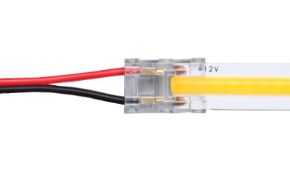
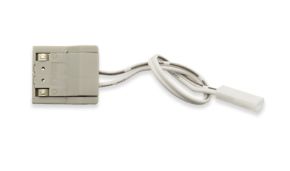
LED strip connectors are one of the weak links in the chain. Inexpensive pressure connectors ("clipper") are convenient but subject to oxidation and loss of contact over time, especially in humid environments. For permanent installations, connection methods in order of increasing reliability are:
- direct soldering (maximum reliability): connection with solder to the LED strip pads is the most reliable method used in professional installations. Requires temperature-controlled soldering iron (320-350°C), flux-core solder, and practice to avoid overheating the LEDs.
- solderable connectors with silicone junction: for IP65-IP67 installations, connectors with silicone sealing gasket soldered to the strip guarantee waterproofing and reliability.
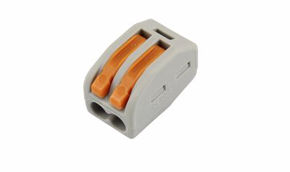
- lever-action pressure connectors (superior quality): connectors with lever mechanism (e.g., Wago-style for LEDs) guarantee a solid and removable connection, superior to simple pressure clips.
Thermal dissipation for high-power 5V LED strips
Although 5V LED strips generate less heat than power LEDs, high-density strips (144 LED/m) and high-brightness strips may require active thermal management to ensure maximum lifespan. Operating temperatures of SMD LEDs should not exceed 60-70°C at the junction (Tj), and the strip PCB temperature should not exceed 40-50°C in continuous operation.
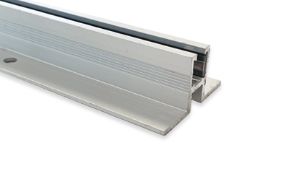
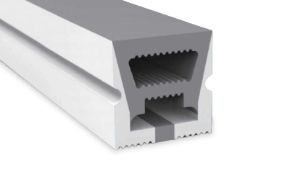
Dissipation solutions include: U-shaped or L-shaped extruded aluminum profiles into which to insert the strip (the profile acts as a heatsink and installation channel), thermally conductive double-sided tape between the strip and mounting surface (avoid standard non-thermally conductive tape for high-power strips), opal diffuser profiles (PMMA or polycarbonate) that attenuate the visible point light of individual LEDs and distribute light more uniformly.
How to connect an LED strip without a transformer
Another frequent question is how to connect an LED strip without a transformer. The answer depends on the available supply voltage: with a 5V power supply (e.g., USB), a 5V LED strip connects directly without any transformer, since it operates natively at that voltage. However, it is important not to confuse "direct connection" with "connection without any protection": even 5V LED strips require a correctly sized power supply (switching power supply), which is technically different from a "transformer" even though it performs similar functions. A transformer is a passive component that only transforms AC voltage, a switching power supply is an active circuit that rectifies and regulates DC voltage, and is what is used with LEDs.
5V LEDs with Arduino and microcontrollers: programming and control guide
The integration between 5V LEDs and microcontrollers such as Arduino, ESP8266, ESP32, Raspberry Pi, and STM32 is one of the most fertile areas of modern creative and professional electronics. The native compatibility between Arduino's 5V logic and the power supply of WS2812B strips has democratized access to highly complex intelligent lighting systems, allowing even beginners to create sophisticated luminous effects with a few lines of code. In this section, we will explore the basics of programming and advanced techniques for controlling 5V LEDs with microcontrollers.
PWM control of single LEDs with Arduino
The simplest method to control the brightness of a single 5V LED with Arduino is pulse width modulation (PWM). Arduino UNO has 6 PWM pins (3, 5, 6, 9, 10, 11) that can generate a PWM signal at 490Hz (pins 3, 9, 10, 11) or 980Hz (pins 5, 6) with 8-bit resolution (0-255).
WS2812B control with FastLED: practical examples
With the FastLED library, controlling WS2812B strips becomes extremely simple:
WLED: open source firmware for WiFi LED strips
WLED is an open source firmware for ESP8266 and ESP32 that transforms these inexpensive microcontrollers into powerful controllers for WS2812B strips with integrated web interface, REST API, MQTT support for home automation, multiple segments, presets, preset effects, and much more. WLED has become the de facto standard for smart LED strip installations in the maker world and increasingly also in professional installations thanks to its reliability and richness of features.
With WLED installed on a few-euro ESP32 module, it is possible to control a 5V WS2812B strip via smartphone, integrate it into Home Assistant, synchronize it with music, program scenes and automations. Initial configuration only requires loading the firmware via browser (without Arduino IDE) and connecting to the home WiFi network.
Controlling 5V LEDs with Raspberry Pi
Raspberry Pi can control 5V WS2812B strips via the rpi_ws281x library (Python or C), using GPIO pin 18 which supports the PWM modulation necessary for the WS2812B protocol. Attention: Raspberry Pi GPIO operates at 3.3V, while WS2812B expects a 5V data signal level. In practice, most WS2812B work correctly with 3.3V signals thanks to the chip's input thresholds, but for critical installations, the use of a level shifter (e.g., 74AHCT125) is recommended.
5V LED market: statistics, trends, and 2025-2026 data
The global LED lighting market is one of the fastest-growing sectors in electronics. Understanding market trends is fundamental for entrepreneurs, designers, and professionals operating in this sector. In this section, we will analyze the main data and trends in the LED market, with a specific focus on the 5V segment and addressable LED strips.
Size and growth of the global LED market
According to estimates from major market research firms, the global LED lighting market had a value of approximately $75 billion in 2024 and is projected to reach $120-130 billion by 2030, with a CAGR (compound annual growth rate) of 7-9%. The LED strip segment, which includes 5V products, represented approximately 15-18% of this market, with a growth rate higher than the sector average (CAGR ~12%) thanks to growing demand for smart and personalized lighting.
| Segment | Market share 2024 | Annual growth (CAGR) | Main driver |
|---|---|---|---|
| General lighting (indoor) | ~35% | 5 – 7% | Replacement of traditional lamps |
| Outdoor/street lighting | ~20% | 6 – 8% | Smart cities, energy efficiency |
| Automotive LED | ~15% | 8 – 10% | Vehicle electrification, ADAS |
| LED strips (incl. 5V) | ~15% | 10 – 14% | Smart home, gaming, maker |
| Horticultural LED | ~5% | 15 – 20% | Indoor farming, cannabis |
| UV LED | ~5% | 18 – 25% | Sterilization, curing |
| Display/backlight | ~5% | 7 – 9% | Mini-LED, Micro-LED |
Technological trends in the 5V LED sector
The main technological trends defining the future of the 5V LED market include:
1. Integration with Matter and Thread standards: the new smart home interoperability standard Matter (supported by Apple, Google, Amazon, Samsung) is accelerating the adoption of intelligent LED lighting systems. 5V LED strips with WiFi/Thread controllers will become increasingly integrated into home automation systems.
2. High-density addressable LEDs (HD and 4K): the demand for ultra-high-resolution LED panels for architectural installations and ambient displays is driving the development of WS2812B strips with ever-greater density (up to 144 LED/m and beyond) and ever-smaller packages (2020, 1515).
3. Bispectral and polychromatic LEDs: beyond traditional RGBW, new LED types combine multiple chips of different wavelengths (e.g., RGBWW+Amber, RGBCCT) to achieve color rendering (CRI) above 95 and sunlight-like light quality.
4. Increasing luminous efficiency: latest-generation LED strips reach efficiencies above 200 lm/W, a milestone that seemed impossible for power LEDs just a few years ago. This further reduces consumption and operating costs.
5. Growth of the DIY and maker market: the availability of open source platforms like WLED, HomeAssistant, Node-RED, and Arduino has democratized access to intelligent lighting, generating a rapidly growing "prosumer" market for WS2812B strips and accessories.
Frequently asked questions about 5V LEDs
Let's now look at the most frequently asked questions we often receive from electricians, makers, designers, and hobbyists about the world of 5V LEDs.
Questions about voltage and power supply
How many volts are needed to turn on an LED?
It depends on the color: red LEDs start lighting at approximately 1.6-1.8V, yellow and orange LEDs at 1.8-2.0V, green LEDs at 1.9-2.5V, blue and white LEDs at 2.8-3.6V, UV at 3.2-4.0V. These are threshold values: below these voltages the LED does not emit light. In practice, for normal brightness, one works with the typical threshold voltage plus the current-limiting resistor.
How many volts can an LED withstand?
The maximum reverse voltage of a standard LED is typically 5-6V. In forward bias, there is no fixed voltage limit: the LED is limited by current. Too high a voltage would cause excessive current that burns out the component in milliseconds. This is why the current-limiting resistor is indispensable.
What cable to use for 5V LEDs?
For currents up to 2A, 0.75mm² cables (18 AWG) are adequate. For currents from 2 to 5A, use at least 1.5mm² (15 AWG). For currents above 5A (long WS2812B strips), use 2.5mm² (13 AWG). Conductor quality is important: use pure copper cables, not aluminum or copper-plated.
What transformer is needed for LEDs?
Technically, for LEDs one does not use a classic "transformer" but a switching power supply (switching power supply) that converts the AC mains voltage (220V in Europe) into stable DC voltage. For 5V LEDs, a 5V DC power supply with sufficient current for the load is needed. For 12V LEDs, a 12V DC power supply. These devices include rectification, filtering, and voltage regulation.
How to power 5V LEDs?
5V LEDs can be powered by: standard USB port (500mA – 900mA), USB charger (from 1A to 3A+), dedicated 5V DC switching power supply (from 1A to several tens of A), power bank (5V, 1A-3A), single LiPo battery (3.7V nominal → requires boost converter for precise 5V), 3 AA batteries in series (4.5V, acceptable for some LEDs but not for WS2812B), 4 AA batteries (6V → requires resistor or buck converter).
Questions about 5V LED strips
How much does a 5V LED strip consume per meter?
Consumption varies from approximately 2.4W/m (SMD 3528 at 30 LED/m) up to 18W/m (WS2812B 60 LED/m at full white power). The most common strip, SMD 5050 60 LED/m, consumes approximately 9W/m. Multiplying by the strip length and dividing by 5V gives the current required from the power supply.
How much does a 5-meter 5V LED strip consume?
With SMD 5050 60 LED/m: 9W/m × 5m = 45W total, current 9A. With WS2812B 60 LED/m at 100%: 18W/m × 5m = 90W, current 18A. With WS2812B at 30% brightness: ~5.4W/m × 5m = 27W, current 5.4A. For 5-meter installations at full power, single-point power supply is not technically feasible for high-density 5V strips due to voltage drops.
What is the maximum length of a 5V LED strip?
With single-point power supply, the practical maximum length varies from 1m (high-density/power strips) to 3m (low-density strips and moderate brightness). With current injection every 1-2 meters and adequate power supply, it is possible to reach 10m or more. For very long installations, it is preferable to switch to 12V or 24V strips.
What is the difference between 12V and 5V for RGB LED strips?
12V RGB LED strips use traditional LEDs without integrated IC, controlled with an external RGB controller via 3-channel PWM. 5V RGB LED strips can be either traditional (4 wires: +5V, R, G, B) or addressable (e.g., WS2812B, 3 wires: +5V, GND, DATA) which allow individual control of each LED. 12V strips are more suitable for long, fixed installations; 5V for microcontroller integration and pixel-per-pixel effect applications.
Questions about resistors
Why is a resistor needed for 5V LEDs?
The resistor limits the current flowing through the LED. Without a resistor, the current would be determined only by the LED's dynamic resistance (very low), causing a current enormously higher than nominal and immediate destruction of the LED. The resistor "absorbs" the excess voltage (Vcc – Vf) converting it into heat.
Do 5V LED strips require external resistors?
No! 5V LED strips already have current-limiting resistors incorporated in the PCB tape circuit. You can physically see a small SMD resistor every two or three LEDs on the strip. For this reason, LED strips connect directly to the 5V power supply without adding external resistors. External resistors are only needed for single LEDs (through-hole or loose SMD) connected directly to 5V.
Questions about LED power
5-watt LED equals how many watts of incandescent?
A 5W LED typically produces 400-500 lumens, equivalent to a 40-50W incandescent bulb. The energy saving is therefore 90%. A 5W LED has a lifespan of 25,000-50,000 hours compared to 1,000 hours for incandescent, with enormously lower operating costs.
How many LEDs for 10 watts, 50 watts, 100 watts of incandescent?
To replace 10W incandescent: approximately 1-2 1W LEDs or one power SMD LED. To replace 50W: approximately 5-6W LED (equivalent to approximately one 5W LED or a 50-60cm LED strip). To replace 100W: approximately 10-12W LED. These values vary with LED efficiency (lm/W): high-quality LEDs with 150-200 lm/W require even fewer watts.
Choosing the right 5V LED products for every application
After this in-depth analysis of the world of 5V LEDs, we can draw some operational conclusions to guide the choice of the most suitable product for each application. 5-volt LEDs and LED strips are a versatile and powerful technology, but require adequate technical understanding to be exploited to the best: from correct management of voltage drops to power supply sizing, from LED type selection to resistor calculation, every detail contributes to the quality and reliability of the final installation.
Decision-making scheme for choosing 5V LEDs
| Application scenario | Recommended solution | |
|---|---|---|
| Domestic decoration, length < 1m, USB power | 5V LED strip SMD 3528/5050 | |
| Dynamic effects, colors, Arduino/ESP32 integration | 5V WS2812B strip 60 LED/m + dedicated 5V power supply | |
| Decorative RGB lighting, IR/WiFi controller | 5V RGB LED strip SMD 5050 + RGB WiFi controller | |
| Fixed installation, length 3-10m, white lighting | 12V LED strip (better at this length) | |
| Humid environment/bathroom/outdoor, IP65+ | 5V LED strip IP65/IP67 with silicone coating | |
| High brightness, aluminum profile, interior design | 5V LED strip SMD 2835 high density + Al profile |
Summary of key points
LED physics: LEDs do not operate natively at 5V; they require current-limiting resistors or integrated drivers to function with a 5V power supply. Forward voltage varies from 1.8V (red) to 3.6V (cool white).
5V LED resistor: use the formula R = (5V – Vf) / If. Typical values range from 68Ω (cool white LED, 20mA) to 150Ω (red LED, 20mA). In LED strips, resistors are already integrated.
Maximum lengths: at 5V, voltage drop is critical. With single-point power, do not exceed 1-3 meters depending on strip power. For longer lengths, use multiple current injection or switch to 12V/24V.
Power supply: always size with 20-30% margin. Use quality power supplies with OCP/OVP/OTP protections and low ripple (<50mV).
WS2812B: the ideal choice for dynamic effects and microcontroller integration. Each LED can consume up to 60mA; size the power supply accordingly.
5V vs 12V: 5V for USB, Arduino, short lengths; 12V for fixed installations, medium lengths, maximum simplicity; 24V for long professional installations.
5V LEDs, sometimes a mandatory choice.
There are application scenarios in which the use of 5V LEDs is not simply a convenient choice, but an absolute technical necessity: contexts where the available supply voltage is exclusively 5V, where compatibility with low-voltage digital logic is essential, or where reduced dimensions and extra-low voltage electrical safety are binding requirements. Knowing these contexts allows for correct design from the start, avoiding unnecessary voltage conversions, additional components, and potential reliability problems.
Mandatory USB power
Whenever the power source is a USB port, and it is not possible or desirable to add a separate power supply, 5V LEDs are the only technically correct choice. This includes backlighting of televisions and monitors powered by the device's own USB port, illumination of keyboards and peripherals connected to computers, decorative strips for cars powered by the dashboard USB port, portable lamps powered by power banks.
Integration with microcontrollers and development boards
Arduino UNO, Arduino Mega, ESP8266, ESP32, STM32, Teensy, and most development boards for makers and engineers operate natively at 3.3V or 5V. Interfacing these boards with 12V LED strips would require level shifters, power MOSFETs, and separate power supplies, increasing complexity and costs.
With 5V LEDs and WS2812B strips, integration is direct, drastically reducing the number of components in the project.
Static and dynamic modeling
In railway modeling, especially in smaller scales (N, Z, TT), 5V LEDs are practically mandatory: electrified tracks in H0 scale operate at 12-16V AC/DC but internal components of locomotives and wagons (cabin lights, headlights, interior lighting) are powered at 5V via internal regulators.
In dioramas and railway layouts, 5V LED strips powered by small transformers or USB allow illuminating buildings, streets, signs, and bridges, faithfully reproducing urban lighting in miniature.
In naval and aeronautical modeling, the same considerations apply to the illumination of navigation lights, cabins, position lights, and internal environments.
Dioramas, scenography, and miniatures
Enthusiasts of military, fantasy, and historical dioramas use single 5V LEDs (often in 0402 or 0603 SMD package) to create fire effects, explosions, window lights, torches, and lanterns in 1:35 or 1:72 scale. The safe voltage and reduced current allow inserting tiny circuits directly into figures or vehicles without risks.
Dollhouses and miniature sets for photography and cinema are another sector in which 5V LEDs powered by USB or battery are the absolute standard for creating credibly illuminated environments in reduced scale.
Theatrical scenography and art installations
In theatrical and scenographic contexts, 5V WS2812B strips controlled via DMX-to-SPI or via WLED/Arduino systems are used to create dynamic light effects integrated into scenography, stage costumes, and luminous props.
Pixel-per-pixel management allows effects impossible with any other conventional lighting system. In luminous art installations and interactive exhibitions, addressable 5V LEDs are the privileged tool of digital artists for creating reactive LED surfaces, luminous sculptures, and immersive environments.
Wearables, cosplay, and technological fashion
Wearable applications necessarily require 5V power from power banks or LiPo batteries with boost converter: illuminated cosplay costumes, garments with integrated LEDs, luminous hats and accessories for events. The lightness, flexibility, and safety of 5V LEDs, which operate at voltages absolutely safe for body contact, make them the only sensible choice for these applications.
Low-voltage automotive and nautical electronics
In some automotive applications where the onboard voltage (12V) is already regulated to 5V for control electronics, using 5V LEDs directly eliminates an additional conversion stage. In nautical contexts, some instrumentation and control panel lighting systems operate at 5V for compatibility with NMEA 2000 instrumentation and navigation systems.
Prototyping, research, and electronics education
In university laboratories, technical institutes, and research centers, 5V LEDs on breadboards are the quintessential educational component for teaching basic electronics principles: Ohm's law, V-I characteristics, PWM, digital logic. The safety of low voltage and connection simplicity make them ideal for educational environments where students without electrical experience operate.
Why rely on Ledpoint.it for all these contexts
Ledpoint.it is the Italian reference point for those who need certified quality LEDs in all these sectors: from the modeler looking for the smallest 0402 SMD LED, to the maker who needs 10 meters of WS2812B with 144 LED/m density, to the lighting professional who must size an installation with hundreds of addressable LEDs. The catalog includes 5V LED strips of various types with dedicated power supplies, aluminum profiles, RGB/RGBW WiFi and Bluetooth controllers, and all installation accessories. Each product is selected with rigorous quality criteria, CE certification, and long-term reliability.
The Ledpoint.it technical team remains available for support in selecting and sizing installations; our contacts can be found on the following page: https://www.ledpoint.it/it/contactus.